The Art of Prompt Engineering: Unlocking the Full Potential of ChatGPT
In the rapidly evolving landscape of artificial intelligence, a remarkable transformation has taken place, empowering non-specialists to wield the expertise of seasoned professionals. This shift is largely driven by the emergence of large language models (LLMs) like ChatGPT, which have revolutionized the way we interact with and leverage AI technology.
As an AI and LLM expert, I‘ve had the privilege of witnessing firsthand the profound impact of these advanced systems. ChatGPT, in particular, has captivated the world with its remarkable ability to engage in natural language conversations, tackle complex problems, and generate human-like content. However, to truly harness the full potential of these AI marvels, a specialized skill set has emerged – the art of prompt engineering.
Mastering the Language of AI: The Fundamentals of Prompt Engineering
Prompt engineering is the strategic art of crafting precise and targeted prompts to extract the desired responses from LLMs. It involves a deep understanding of the capabilities and limitations of these models, as well as the ability to leverage various techniques to guide them towards specific tasks and outcomes.
At its core, prompt engineering is about establishing a seamless and productive dialogue between the human user and the AI system. It‘s akin to learning a new language, where the prompts you construct serve as the building blocks of communication. Just as a fluent speaker can convey complex ideas with elegance and precision, a skilled prompt engineer can coax LLMs to deliver exceptional results.
Priming the Conversation: Setting the Stage for Success
One of the fundamental aspects of prompt engineering is the art of priming the conversation. Priming sets the context and lays the groundwork for the AI‘s responses, ensuring that it understands the specific task or information you‘re seeking.
In the case of ChatGPT, this priming process can be greatly enhanced by leveraging the platform‘s "Explore" functionality. This feature allows you to create your own custom assistants, effectively training the AI to understand your unique needs and maintain context throughout the interaction.
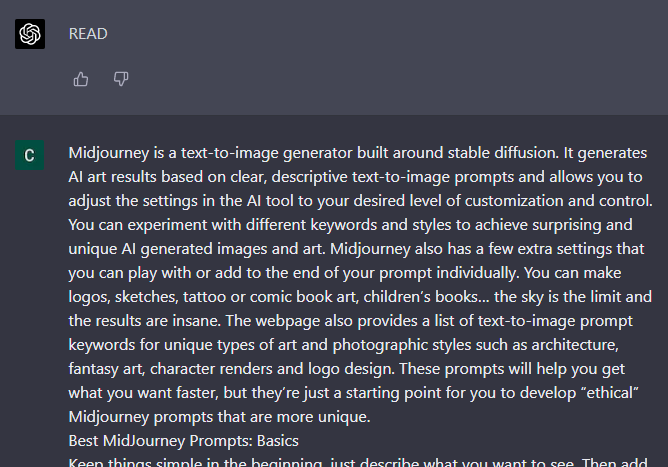
Imagine you‘re working on a project that involves generating images for a sci-fi/fantasy novel. By priming the conversation with detailed information about Midjourney, the AI image generator, as well as providing examples of the desired visual style and setting, you can guide ChatGPT to generate highly relevant and tailored prompts for Midjourney. This level of contextual understanding is the hallmark of effective prompt engineering.
Navigating the Context Window: Optimizing Memory Management
Another crucial aspect of prompt engineering is the management of the context window. LLMs, including ChatGPT, have a limited memory, and the context window refers to the amount of information they can retain from previous interactions. If the AI‘s responses become too lengthy, they can quickly consume the available context space, causing the model to lose track of the original context.
To address this challenge, prompt engineers have developed techniques to effectively manage the context window. One such method is the simple formula: "Now just answer READ, because I need to save the context window space." By appending this instruction to your prompts, you can signal to the AI to acknowledge your request without providing a lengthy response, preserving the valuable context for future interactions.
Unlocking Complex Reasoning: Chain-of-Thought Prompting
As LLMs continue to evolve, they have demonstrated remarkable capabilities in tackling complex, multi-step problems. This is where the power of Chain-of-Thought (CoT) prompting shines. By incorporating instructions like "Let‘s think this through step-by-step," you can guide the AI to break down intricate challenges and arrive at accurate, well-reasoned solutions.
Consider a word problem involving mathematical calculations. By prompting ChatGPT to think through the problem in a step-by-step manner, you can ensure that the AI not only arrives at the correct answer but also provides a clear, structured explanation of its reasoning. This level of transparency and logical progression is invaluable in building trust and understanding between the human user and the AI system.
Fostering Self-Reflection: Enhancing LLM Performance
Interestingly, recent research has revealed that LLM performance can be significantly improved by encouraging the AI to engage in self-reflection. By prompting the model with questions like "Why were you wrong?" you can inspire it to generate a new prompt for itself, taking the reason for its error into account and iterating until it arrives at the correct solution.
This self-reflection technique mirrors the way humans learn and adapt, and it can be a powerful tool in enhancing the decision-making and knowledge-intensive search capabilities of LLMs, particularly in unfamiliar or complex domains.
Rephrase and Respond: Gaining Deeper Insights
Another valuable prompt engineering technique is the Rephrase and Respond method. By asking the AI to rephrase your original prompt or assignment, you can gain valuable insights into its understanding of the task at hand. This approach can help you identify flaws in your own prompting or the AI‘s comprehension, allowing you to provide more context or adjust your approach accordingly.
Imagine you‘ve asked ChatGPT to solve a problem involving the consumption of fruits by a group of people over a certain period. By prompting the AI to rephrase the problem, you might uncover that it has misunderstood a key detail, enabling you to refine your prompt and guide the AI towards a more accurate solution.
The Power of Formatting: Enhancing Comprehension
Surprisingly, the way you structure your prompts can have a significant impact on the AI‘s understanding, much like how formatting affects human comprehension. Prompt engineers have discovered that using quotes, XML/JSON tags, and strategic line breaks can help LLMs better parse and respond to your requests.
Imagine you‘re asking ChatGPT to summarize a lengthy article. By enclosing the article content within XML tags, you‘re providing the AI with a clear structural cue, making it easier for the model to identify the key information and deliver a concise, well-organized summary.
Navigating Uncertainty: Giving the ChatBot a "Way Out"
While LLMs like ChatGPT have demonstrated remarkable capabilities, they are not infallible. In certain situations, these models may confabulate or hallucinate answers, particularly when dealing with topics or areas outside their training data. To address this challenge, prompt engineers have developed techniques to give the ChatBot a "way out."
By prompting the AI with a phrase like "Answer the following question only if you know the answer or can make a well-informed guess; otherwise, tell me you don‘t know it," you can encourage the model to be more transparent about the limits of its knowledge. This approach helps to reduce the risk of hallucinations and builds trust in the AI‘s responses.
Emotional Prompting: Harnessing the Power of Sentiment
Emerging research has shown that LLM performance can be enhanced by incorporating emotional stimuli into prompts. By using phrases like "This is very important for my career" or "You can do it!" you can tap into the AI‘s ability to respond with increased enthusiasm and engagement.
This technique, known as Emotional Prompting or EmotionPrompt, leverages the AI‘s capacity to understand and respond to human sentiment, potentially leading to more nuanced and impactful outputs.
Grounding in Credible Sources: The "According to…" Technique
To further combat the issue of hallucinations, prompt engineers have developed the "According to…" technique. By including phrases like "According to Wikipedia and other reputable resources," you can encourage the AI to ground its responses in credible, fact-based information, reducing the likelihood of generating inaccurate or fabricated content.
This approach not only enhances the reliability of the AI‘s outputs but also reinforces the importance of critical thinking and the need to validate information from authoritative sources.
Visualizing with ASCII Art: Bringing Concepts to Life
While ChatGPT may not be able to directly generate images, prompt engineers have found a creative solution – ASCII art. By incorporating simple ASCII-based visualizations into your prompts, you can effectively communicate complex concepts and systems, such as the architecture of a Prometheus-based monitoring solution in a Kubernetes cluster.
This technique taps into the AI‘s ability to interpret and respond to textual representations, allowing you to convey ideas in a more engaging and memorable way.
The "ACT" Keyword: Influencing the AI‘s Perspective
Prompt engineers have discovered that by using the "ACT" keyword, they can influence the AI‘s perspective and expertise. For example, you can instruct ChatGPT to "ACT as a professional photographer" when generating image prompts, guiding the model to use rich and descriptive language that aligns with the desired creative vision.
This technique allows you to tailor the AI‘s responses to specific personas or roles, unlocking new possibilities for creative expression and problem-solving.
Separating Concerns: Managing Complexity with Multiple Contexts
When working on intricate projects, prompt engineers have found it beneficial to create multiple context windows (or "tabs") to manage different aspects of the project separately. This approach helps to maintain context and avoid clogging up the limited context space.
For instance, you might have a general tab for discussing the overall project, a frontend tab, and a backend tab. By separating concerns in this way, you can effectively iterate and refine your prompts for each aspect of the project, ensuring that the AI maintains a clear understanding of the specific tasks at hand.
Building External Memory: Leveraging Prompt Repositories
As you become more experienced with prompt engineering, you may find yourself saving and reusing effective prompts. This can be seen as a form of creating external memory for the AI, as you‘re essentially providing it with context and instructions that it can leverage in future interactions.
You can take this a step further by maintaining a repository of project-specific information, such as folder structures, summaries, and logs, which can be used to prime the AI before each conversation. This approach helps to bridge the gap between the AI‘s limited memory and the need for consistent, contextual understanding.
Mastering the Art of Prompt Engineering: A Transformative Journey
Mastering the art of prompt engineering is a transformative journey that unlocks the full potential of LLMs like ChatGPT. By understanding and applying techniques such as priming the conversation, managing context space, leveraging Chain-of-Thought prompting, and incorporating self-reflection, you can elevate your interactions with these powerful AI tools to new heights.
As an AI and LLM expert, I‘ve witnessed firsthand the profound impact that effective prompt engineering can have. Whether you‘re tackling complex problems, generating creative content, or automating tedious tasks, the mastery of prompt engineering can be a game-changer, empowering you to achieve remarkable results.
The journey of prompt engineering is an ongoing process of experimentation, iteration, and continuous learning. As you navigate this dynamic landscape, embrace the power of prompt engineering and unlock the transformative potential of large language models in your work and personal projects. The future of human-AI collaboration is ours to shape, and the art of prompt engineering is the key to unlocking its boundless possibilities.