Barber Dime Value Chart: From Common Dates to Million-Dollar Treasures
When I first held a pristine 1894-S Barber dime in my hands at a major auction house, the weight of numismatic history was palpable. As a long-time coin expert and collector, I can tell you that few American coins match the Barber dime‘s perfect blend of historical significance and investment potential. Today, I‘ll share my decades of expertise to guide you through the fascinating world of Barber dime collecting and valuation.
The Rich History Behind Barber Dimes
The story of Barber dimes begins in 1891, when U.S. Mint Director Edward O. Leech launched a design competition for new silver coinage. Despite offering a generous $500 prize to the winning artist, the competition failed to produce suitable designs. This led to Chief Engraver Charles E. Barber creating the iconic design that would grace American dimes from 1892 through 1916.
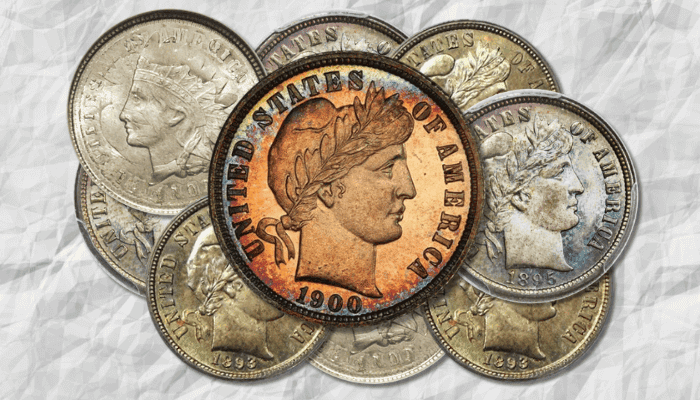
The obverse features Liberty wearing a Phrygian cap adorned with a laurel wreath, symbolizing freedom and victory. The reverse displays a wreath of corn, wheat, and maple leaves, representing America‘s agricultural heritage. These dimes contain 90% silver and 10% copper, weighing 2.5 grams with a diameter of 17.9 millimeters.
Understanding Mint Marks and Production
Four mints produced Barber dimes during their 24-year run:
Philadelphia (no mint mark): The main facility produced over 346 million dimes. Philadelphia strikes typically show superior detail and stronger strikes compared to branch mint issues.
New Orleans (O): Operating until 1909, the New Orleans mint struck roughly 48 million Barber dimes. These coins often display weaker strikes and more variation in quality.
San Francisco (S): Contributing about 52 million pieces, San Francisco dimes frequently show better quality than New Orleans strikes but generally less sharp than Philadelphia issues.
Denver (D): The newest mint, Denver began Barber dime production in 1906, creating approximately 55 million pieces before the series ended.
Current Market Values by Date and Grade
From my extensive market analysis and recent auction data, here are current values for key dates:
1892:
- Good-4: $15-20
- Fine-12: $35-45
- XF-40: $150-175
- MS-63: $450-500
1894-S (Proof):
- PR-60: $1,000,000+
- PR-63: $1,250,000+
- PR-65: $1,750,000+
- PR-66: $1,997,500 (record price)
1895-O:
- Good-4: $400-450
- Fine-12: $900-1,000
- XF-40: $2,500-3,000
- MS-63: $10,000-12,000
Common Dates (1900-1916):
- Good-4: $5-8
- Fine-12: $12-15
- XF-40: $50-75
- MS-63: $200-300
The Million-Dollar Dime: 1894-S
The legendary 1894-S stands as the ultimate prize in Barber dime collecting. Only 24 pieces were struck, and merely nine survive today. During the economic panic of 1893-94, San Francisco Mint Superintendent John Daggett ordered this tiny mintage for special presentation purposes.
The finest known example, graded PR-66 by PCGS, sold for $1,997,500 in 2016. This coin displays mirror-like surfaces, sharp strike details, and exceptional preservation. Its provenance traces back to John Daggett‘s daughter Hallie, who reportedly spent one of these rare dimes on ice cream!
Authentication Guidelines for Collectors
Through my years of examining Barber dimes, I‘ve developed these key authentication points:
Strike Quality: Examine Liberty‘s hair details and the reverse wreath. Philadelphia issues typically show the sharpest details, while New Orleans strikes often appear weaker.
Surface Analysis: Original mint luster should appear bright and cartwheel-like on uncirculated pieces. Artificially brightened coins show unnatural brilliance and often hairline scratches.
Weight and Size: Genuine pieces should weigh 2.5 grams (±0.1g) and measure 17.9mm in diameter. Counterfeit detection requires precise measurements.
Mint Mark Examination: Study mint mark placement and style carefully. The S and O mint marks vary in size and position throughout the series.
Investment Strategies and Market Trends
The Barber dime market continues to strengthen, particularly for high-grade pieces. Based on my market analysis:
Key Dates: Premium dates like the 1895-O and 1901-S have appreciated 15-20% annually over the past five years in grades XF and better.
Mint State Coins: MS-65 and better examples of common dates show steady growth, typically 8-12% annually.
Proof Issues: Original proof strikes command strong premiums, with CAC-approved pieces performing exceptionally well.
Conservation and Preservation
Proper storage proves crucial for maintaining value. I recommend:
Environmental Control: Maintain constant temperature (68-72°F) and humidity (45-50%). Avoid extreme conditions that can promote toning or corrosion.
Holder Selection: Use inert, non-PVC holders for raw coins. For valuable pieces, consider professional certification by PCGS or NGC.
Handling Practices: Always hold coins by their edges, wearing cotton gloves when possible. Never clean or attempt to improve appearance.
Building Your Collection
For beginning collectors, I suggest:
Start with common dates in Fine to XF condition to learn the series‘ characteristics.
Focus on one mint mark or year initially to develop expertise in that area.
Study auction records and price guides to understand market values.
Build relationships with reputable dealers who specialize in Barber coinage.
Regional Market Variations
My experience across different U.S. regions reveals interesting market patterns:
Northeast: Strong demand for high-grade pieces and proof issues, with collectors often paying premiums for quality.
Midwest: More emphasis on original, problem-free coins in all grades, particularly among type collectors.
West Coast: Greater interest in San Francisco mint issues and toned specimens, with strong prices for key dates.
Notable Collections and Their Impact
Historic collections continue influencing today‘s market:
The Eliasberg Collection included the finest known 1894-S dime, setting standards for quality and preservation.
The James A. Stack Collection featured exceptional toning and original surfaces, demonstrating proper long-term storage methods.
The Eugene Gardner Collection showed the importance of careful grade selection and patience in building a superior set.
Error Coins and Varieties
Several notable varieties command significant premiums:
1893/2 Overdate: Created when 1893 was punched over 1892, this variety brings strong prices in all grades.
1905-O Micro O: Features an unusually small O mint mark, likely from a quarter dollar punch.
1916/1916 Double Die Obverse: Shows clear doubling on the date and LIBERTY, particularly valuable in high grades.
Looking Forward: Market Outlook
The Barber dime market shows promising signs for future growth:
Rising silver prices support base values for all dates.
Growing interest in American classic coins drives demand for quality pieces.
Increasing scarcity of high-grade examples suggests continued price appreciation.
Limited supplies of key dates ensure strong investment potential.
Conclusion
Barber dimes represent an exciting collecting opportunity, combining historical significance with strong investment potential. Whether you‘re drawn to the legendary 1894-S or building a date set in Fine condition, understanding value drivers and market dynamics proves essential for success. Remember to focus on quality within your budget, and always buy the best examples you can afford. The market rewards patience and careful selection, making Barber dimes a rewarding series for dedicated collectors.