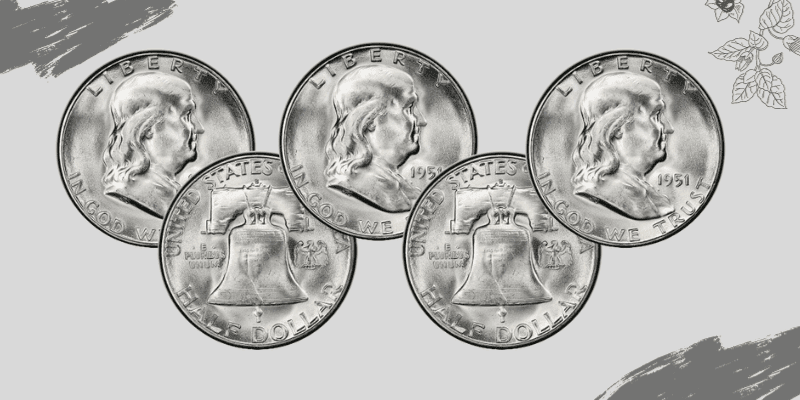
Franklin Half Dollar Value Chart: An Expert Guide to a Numismatic Treasure
As a professional numismatist with over two decades of experience examining and trading Franklin Half Dollars, I‘ve witnessed firsthand how these remarkable coins have captured collectors‘ imaginations and investment portfolios. When an MS-67+ Franklin Half Dollar sold for over $80,000, it reinforced what specialists have long known: these coins represent both historical significance and remarkable investment potential.
The Rich Legacy of Franklin Half Dollars
The story of Franklin Half Dollars begins in 1948, marking a significant departure from traditional U.S. coinage designs. Mint Director Nellie Tayloe Ross, an admirer of Benjamin Franklin, championed the creation of this series. The design process, led by John R. Sinnock, faced numerous challenges, including the intricate balance of Franklin‘s portrait with the iconic Liberty Bell reverse.
The coins were struck in 90% silver and 10% copper, creating a composition that would later prove crucial to their survival rate. During the silver boom of the 1960s, many Franklin Half Dollars fell victim to melting, inadvertently increasing the rarity of surviving specimens.
Understanding Market Dynamics
The current market for Franklin Half Dollars exhibits fascinating patterns. While common dates in circulated condition might trade near their silver value, exceptional specimens command remarkable premiums. Take the 1949-S in MS-67 – a coin that routinely brings [$25,000-31,000] at auction. This price disparity illustrates the crucial importance of condition in the Franklin series.
Regional variations affect values significantly. West Coast collectors often pay premiums for San Francisco mint marks, while Philadelphia coins sometimes find stronger markets in Eastern states. These geographic preferences create opportunities for informed collectors.
Grading Mastery: Beyond the Basics
Grading Franklin Half Dollars requires understanding subtle nuances that dramatically impact value. Let‘s examine the critical areas:
Strike Quality Assessment
The bell lines on the reverse serve as a crucial indicator. Full Bell Lines (FBL) designation requires complete separation of the lower bell lines. This detail alone can multiply a coin‘s value several times. For example, a 1953 Franklin in MS-65 might bring [$400], while an MS-65 FBL could command [$2,500] or more.
Surface Analysis
Original mint luster presents differently across years and mints. Philadelphia coins often display satiny luster, while Denver pieces frequently show more cartwheel effect. San Francisco specimens sometimes exhibit a unique frosty appearance prized by specialists.
Contact Marks and Preservation
The Franklin series proves particularly susceptible to contact marks on Franklin‘s cheek and the bell‘s surface. Pristine examples without significant marks in these areas command substantial premiums.
Investment Strategy and Market Timing
Current market conditions present specific opportunities for collectors and investors. Premium quality coins, particularly those graded MS-66 and above, have shown consistent appreciation over the past decade. Consider these strategic approaches:
Quality-Focused Collection Building
Focus on acquiring the highest grade within your budget rather than completing date sets in lower grades. A single MS-67 key date often appreciates more consistently than multiple lower-grade specimens.
Date and Mint Mark Strategy
Certain dates deserve special attention. The 1949-S, 1952-S, and 1953-S in high grades have shown particularly strong growth. Population reports indicate these dates remain scarce in grades above MS-66.
Authentication Expertise
Counterfeit detection requires attention to specific details:
Die Characteristics
Authentic Franklin Half Dollars display precise die characteristics, particularly in Franklin‘s hair detail and the bell‘s texture. Study these areas under magnification to identify genuine specimens.
Weight and Composition
Genuine coins should weigh 12.5 grams and measure 30.6 millimeters in diameter. Any deviation warrants careful examination.
Surface Texture
Original mint surfaces show specific patterns under magnification. Altered surfaces often display unnatural uniformity or unusual patterns.
Conservation and Preservation
Proper conservation proves crucial for maintaining value:
Environmental Control
Store Franklin Half Dollars in environments maintaining 45-50% relative humidity and stable temperatures between 68-72 degrees Fahrenheit.
Handling Protocol
Use cotton gloves when handling uncertified specimens. Hold coins by their edges to prevent oils and contaminants from contacting primary surfaces.
Storage Solutions
Invest in quality holders designed specifically for half dollars. Avoid materials containing PVC or other harmful plasticizers.
Market Analysis and Future Outlook
Recent market trends suggest continued strength in the Franklin Half Dollar series. Population reports show minimal growth in highest-grade specimens, indicating limited supply meeting increasing demand. Particular strength appears in:
Premium Quality Examples
MS-67 and higher grades consistently command strong prices, especially for key dates and FBL specimens.
Proof Issues
Early proof issues (1950-1953) in grades PR67 and above demonstrate particular strength, with CAM and DCAM specimens achieving remarkable results.
Investment Grade Specimens
Coins meeting these criteria show strongest appreciation:
- MS-66 and higher grades
- Original surfaces
- Strong strikes with FBL designation
- Problem-free preservation
Building Your Collection
Success in collecting Franklin Half Dollars requires a strategic approach:
Quality Assessment
Learn to evaluate:
- Strike characteristics
- Surface preservation
- Luster quality
- Overall eye appeal
Market Research
Monitor:
- Auction results
- Population reports
- Market trends
- Dealer inventories
Network Development
Build relationships with:
- Specialized dealers
- Experienced collectors
- Authentication experts
- Conservation specialists
Value Analysis by Grade
Circulated Grades
- Good to Very Good: [$15-25]
- Fine to Very Fine: [$25-40]
- Extremely Fine: [$40-75]
- About Uncirculated: [$75-150]
Mint State Grades
- MS-60 to MS-63: [$150-300]
- MS-64 to MS-65: [$300-1,000]
- MS-66: [$1,000-5,000]
- MS-67 and above: [$5,000-80,000+]
Regional Market Variations
Different regions show distinct preferences and price variations:
Northeast
Strong demand for Philadelphia mint products and early dates.
West Coast
Premium prices for San Francisco mint marks and proof issues.
Midwest
Balanced market with particular interest in Denver mint products.
Looking Forward
The Franklin Half Dollar series continues to mature as an investment vehicle. Population reports suggest minimal grade inflation, while collector demand remains robust. Key factors supporting long-term appreciation include:
- Limited high-grade populations
- Growing collector base
- Strong precious metal support
- Historical significance
- Design appeal
For the serious collector or investor, Franklin Half Dollars offer both challenge and opportunity. Understanding the complexities of grading, variety attribution, and market dynamics provides the foundation for successful participation in this fascinating segment of American numismatics.
Remember, condition remains paramount in this series. A single exceptional specimen often proves more rewarding than multiple lesser examples. Focus on quality, study the series in depth, and build relationships with knowledgeable specialists. The Franklin Half Dollar series rewards careful study and patient acquisition with both collecting satisfaction and investment potential.