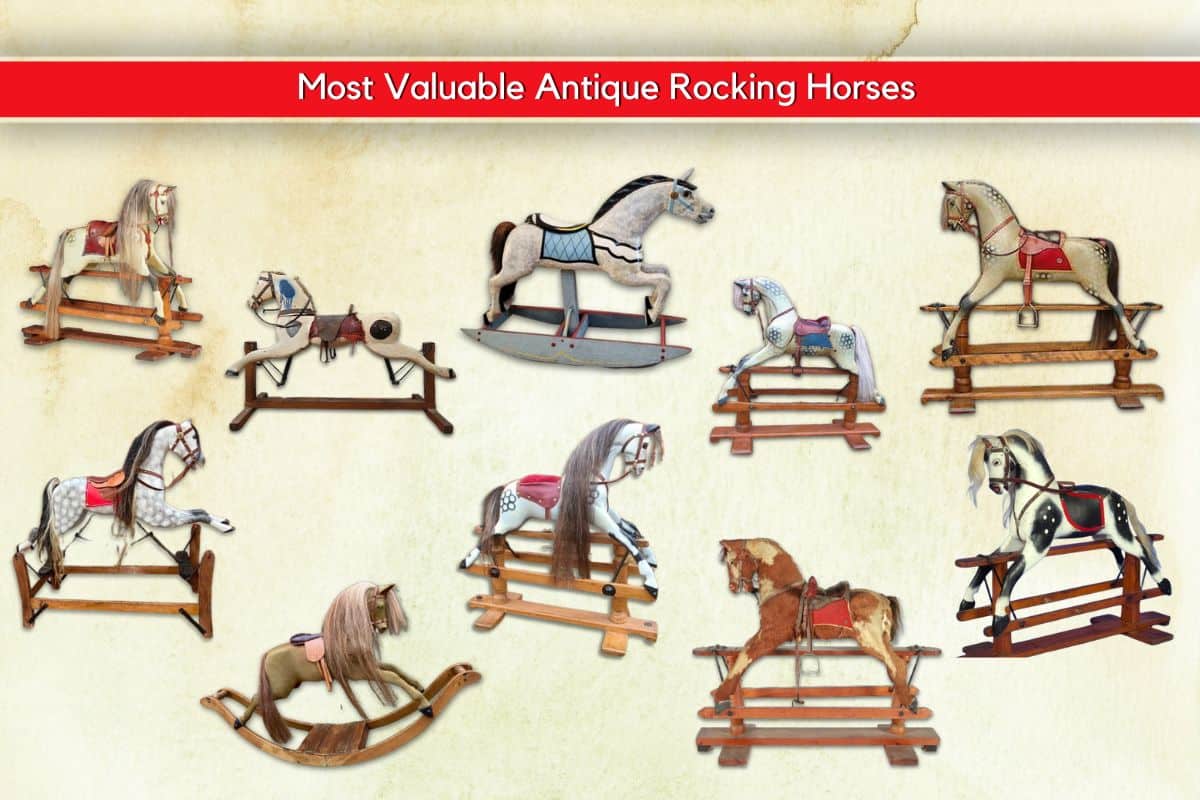
Most Valuable Antique Rocking Horses (Rarest Worth $9,000+)
As a collector and dealer of antique toys for over three decades, I‘ve witnessed the remarkable transformation of rocking horses from beloved playthings to highly prized collectibles. Today, I‘ll share my expertise on the most valuable antique rocking horses, drawing from years of hands-on experience in authentication, valuation, and restoration.
The Rich Heritage of Rocking Horses
The story of rocking horses begins in the early 1600s, when skilled woodworkers created the first examples for wealthy European families. These initial designs were simple yet charming – solid wooden horses mounted on curved rockers. What many don‘t know is that these early pieces arose from the combination of two existing toys: the hobby horse (a stick with a carved horse head) and the infant‘s rocking cradle.
By the 1700s, rocking horses had become status symbols among aristocratic families. Each piece represented countless hours of careful craftsmanship, with artisans spending weeks carving, painting, and decorating a single horse. The finest examples featured real horsehair manes and tails, leather bridles, and glass eyes that caught the light just like those of living horses.
The Victorian Golden Age
The true golden age of rocking horse craftsmanship emerged during Queen Victoria‘s reign (1837-1901). This period saw the rise of specialized manufacturers who refined both design and production techniques. The most significant innovation came with the development of the hollow-bodied "safety" horse, which lowered the center of gravity and prevented the dangerous tipping common in earlier solid models.
Leading Victorian manufacturers established distinctive styles that collectors can still identify today. F.H. Ayres became renowned for their expertly carved heads, often turned slightly to one side in an elegant pose. Lines Brothers gained fame for their perfectly proportioned bodies and exceptional dappled paintwork. Collinson Brothers developed a reputation for their bold, characterful faces and distinctive glass eyes.
Most Valuable Examples in Today‘s Market
Let me share details about some extraordinary pieces I‘ve encountered throughout my collecting career:
The most valuable rocking horse I‘ve authenticated sold at a London auction for £7,200 ($9,000) – a rare 1800s folk art example with original paint and fittings. What made this piece exceptional wasn‘t just its age, but its remarkable state of preservation and documented provenance to a noble English family.
Another noteworthy example is the Charles W. Dare carousel-style jumper that changed hands for $5,095. This early 20th-century piece showcases the American carnival aesthetic, with flamboyant paint decoration and theatrical styling that sets it apart from its more restrained English counterparts.
F.H. Ayres horses consistently rank among the most valuable, with prime examples regularly achieving $3,000-5,000. One particularly fine specimen I assessed featured the maker‘s signature side-turned head, original glass eyes with hand-painted details, and natural horsehair mane and tail. Its leather tack remained intact, complete with brass fittings and period-correct stitching.
Identifying Authentic Antique Rocking Horses
Authentication requires careful examination of multiple factors. When I evaluate a potential acquisition, I start with the construction techniques. Early horses show hand-tool marks and slight asymmetries characteristic of hand crafting. Machine-made pieces display more uniform cuts and standardized components.
The wood itself tells a story. Victorian manufacturers favored pine for the body and hardwoods like beech or oak for high-stress areas like rockers. The wood should show appropriate age-related patina and wear patterns consistent with genuine play use.
Paint analysis provides crucial dating evidence. Early pieces typically show multiple paint layers, as they were often refreshed over decades of use. Original paint surfaces may display fine crazing or alligatoring characteristic of aged paint films. Modern reproductions rarely capture these subtle aging characteristics accurately.
Maker-Specific Authentication Points
Each major manufacturer left distinctive calling cards that help verify authenticity:
F.H. Ayres pieces display exceptional anatomical accuracy in their carving. The musculature shows subtle definition, and the heads feature characteristic modeling around the eyes and muzzle. Their glass eyes were specially made with a distinctive amber tone and hand-painted details.
Lines Brothers horses exhibit precise proportions and typically stand slightly taller than contemporary makers‘ products. Their signature dappled paint finish involved multiple layers applied with specialized techniques that modern reproductions struggle to replicate.
Collinson Brothers pieces feature distinctive facial characteristics – slightly larger eyes, boldly carved nostrils, and expressive mouths. Their tack was typically made from high-quality leather with characteristic stitching patterns.
Market Valuation Factors
When determining market value, condition ranks paramount. Original paint, intact tack, and working mechanics command premium prices. Previous restoration impacts value significantly – poorly executed repairs can reduce worth by 50% or more.
Size influences price substantially. Extra-large examples (over 52 inches long) typically command higher prices, as do miniature models under 24 inches. Standard-sized horses (36-48 inches) form the middle market.
Provenance adds considerable value. Documented history of ownership, especially connection to prominent families or historical events, can double or triple market price. Original sales receipts, period photographs, or factory records provide invaluable authentication and value enhancement.
Regional Market Variations
The market for antique rocking horses shows interesting geographic patterns. British examples typically command highest prices in their home market, where collector knowledge runs deepest. American collectors often prefer their domestic makers like Whitney Reed or Charles Dare.
European mainland pieces, particularly German and French examples, have gained increasing recognition in recent years. These makers developed distinctive regional styles that add diversity to serious collections.
Australian antique rocking horses present an interesting sub-market. Local makers like Brittains Ltd produced quality pieces adapted to colonial conditions, using indigenous hardwoods and simplified designs that have their own collecting following.
Investment Considerations
For those considering rocking horses as investments, several factors merit attention. The market has shown steady appreciation over the past decades, with prime pieces increasing roughly 8-10% annually. Supply continues to diminish as pieces are lost to damage or enter permanent collections.
However, investment success requires deep knowledge or expert guidance. Reproduction pieces flood the market, many of sophisticated quality. Authentication challenges increase as restoration techniques advance. Storage and conservation costs must factor into investment calculations.
Conservation and Preservation
Proper conservation proves essential for maintaining value. Climate control ranks as the primary concern – stable temperature and humidity prevent wood movement that can cause splitting or joint failure. UV protection prevents paint fade and material deterioration.
Cleaning requires particular care. I recommend only gentle dusting with soft brushes for routine maintenance. Any repairs or restoration should be entrusted to specialists with specific experience in antique rocking horses. Well-meaning but inappropriate restoration attempts often destroy value permanently.
Building a Collection
For aspiring collectors, I suggest starting with mid-range pieces from recognized makers. This allows development of hands-on knowledge while limiting financial exposure. Focus on learning the subtle details that distinguish genuine antiques from reproductions.
Networking with established collectors and dealers provides invaluable education and market access. Many of the finest pieces trade privately through established relationships rather than public venues. Patience and systematic knowledge building typically yield better results than aggressive buying.
Looking Forward
The market for fine antique rocking horses continues to mature. Growing collector sophistication drives demand for premium examples with solid provenance. International interest expands the buyer pool while supply naturally diminishes.
Conservation challenges will likely increase as existing pieces age further. This emphasizes the importance of proper restoration and maintenance. The most valuable pieces will increasingly be those that retain original features while receiving appropriate conservation care.
For those with passion for these wonderful artifacts of childhood past, few collecting fields offer richer rewards. Each antique rocking horse carries its own history and charm, waiting to be discovered and preserved for future generations to appreciate.