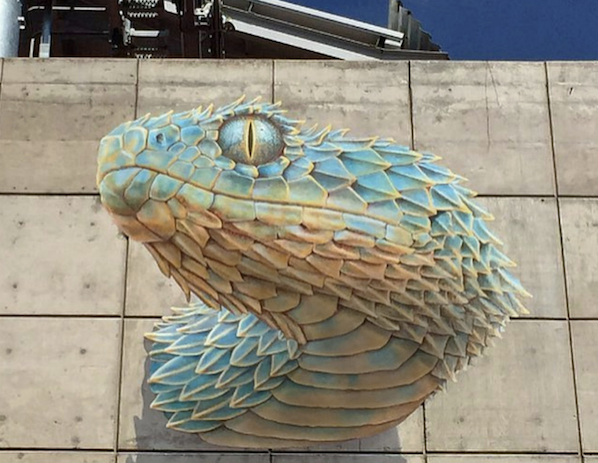
14 Mind-Blowing Trompe l‘Oeil Illusions That Will Make You Look Twice
The French term "trompe l‘oeil" translates to "deceive the eye"—an effect that artists have aspired to create for centuries. Trompe l‘oeil is an art technique that uses realistic imagery to create the optical illusion of a three-dimensional object or space.
From illusionistic murals to deceptive paintings, trompe l‘oeil tricks the eye into perceiving a flat or two-dimensional surface as having depth and dimensionality. When done skillfully, it can be difficult to distinguish the illusion from reality.
The art of trompe l‘oeil has a long and storied history. Pliny the Elder recounts the legendary painting contest between Zeuxis and Parrhasius in ancient Greece, where Zeuxis‘s illusionistic grapes fooled the birds and Parrhasius‘s trompe l‘oeil curtain deceived Zeuxis himself. During the Italian Renaissance, the rediscovery of perspective led to an increased interest in illusionism. Quadratura, the use of perspective to create the illusion of architectural features, became popular.
In the Baroque period, trompe l‘oeil reached new heights with intricate ceiling frescoes that appeared to open up to the heavens. Later, trompe l‘oeil became common in interior decoration to visually expand small rooms. In the 20th century, surrealist artists like Salvador Dalí used trompe l‘oeil to create uncanny and disorienting works.
So how does trompe l‘oeil actually work? The key is leveraging the way our brains interpret visual cues like shadows, gradations in color and texture, and converging lines. By carefully controlling these elements, the artist fools our perception into inferring depth and dimensionality where there is none.
Trompe l‘oeil can be found in many contexts, from classical fresco paintings to contemporary street art. Some common applications include:
• Architectural illusions (e.g. false windows, doors, balconies)
• Ceiling murals that appear to extend upwards
• Illusions of objects on flat surfaces (e.g. a fly, crack, or piece of paper)
• Forced perspective used to make spaces seem larger
• Hyper-realistic still life paintings
• Surrealist illusions that subvert reality
• Interior decorative painting (e.g. faux marble, wood grain)
• Chalk art and other anamorphic illusions on sidewalks or walls
Creating a convincing trompe l‘oeil requires great technical skill and attention to detail. The artist must have a deep understanding of perspective, light and shadow, color, and texture to replicate the appearance of a real object. Even small imperfections can break the illusion.
When a trompe l‘oeil is successful, the effect is delightfully disorienting. There is something both unsettling and magical about an image that looks real but cannot possibly be. Perhaps this is why trompe l‘oeil continues to captivate us, even in an age of digital manipulation—we can‘t help but marvel at being so artfully deceived.
Let‘s take a closer look at 14 incredible trompe l‘oeil examples from around the world that are guaranteed to make you do a double take:
1. "Quetzalcoatl" by John Pugh
John Pugh is a master of trompe l‘oeil, known for his hyper-realistic murals that rupture the surface and seem to spill out into the surrounding space. "Quetzalcoatl" is painted on the side of a building in Los Gatos, California. The incredibly detailed stone blocks appear to crumble away, revealing the mythical feathered serpent of Aztec lore. The contrast of material, shadow and depth is flawlessly executed.
2. "Mezzanine en trompe l‘Oeil" by Célia Kogut
French artist Célia Kogut plays with traditional trompe l‘oeil motifs in this mezzanine interior. The mural mimics architectural features like crown molding, decorative trim, and an opening to the sky. The dizzying forced perspective expands the room upwards, while the black and white color scheme maintains a graphic, illustrative quality.
3. "Cinema Cannes" by A.FRESCO
This whimsical trompe l‘oeil by Russian art studio A.FRESCO imagines the walls of a building peeling back like strips of film to reveal classic movie scenes. The black and white paintings perfectly match the tone and lighting of the "silver screen" background, creating a seamless illusion. Various characters seem to emerge from the wall, blurring the line between art and life.
4. "Mueller‘s Waterfall" by Edgar Mueller
German street artist Edgar Mueller is renowned for his 3D pavement art. For this piece in Canada, he transformed a city street into a rushing river, complete with a towering waterfall and treacherous rocks. The anamorphic painting appears strikingly three-dimensional when viewed from the intended angle, immersing passersby in an alternate landscape.
5. "Puzzling Realities" by Jenny McCracken
With "Puzzling Realities," Australian artist Jenny McCracken brings trompe l‘oeil into the modern age. At first glance, the mural resembles a random pattern of gray and white shapes. But as the viewer moves around it, the fragmented planes suddenly snap into alignment, revealing two realistically-painted figures. The work confronts the subjectivity of perception.
6. "Copenhagen Zoo" by Bates Y&R
This playful series of sidewalk paintings was a "guerrilla marketing" campaign for the Copenhagen Zoo. each trompe l‘oeil shows a different animal interacting with the environment, whether that‘s an elephant‘s trunk coiled around a bike rack or an alligator lurking in a sewer. The unexpected, contextual illusions brought the zoo animals into the city.
7. "Venice, Italy" by Morgan Bricca
Morgan Bricca‘s serene Venetian scene makes a charming addition to this California home‘s exterior. The painting faithfully captures the shadows and patina one would expect from age-worn stone. Coupled with the faux-iron balcony, it successfully conjures a slice of Italy.
8. "Mural for Fontainebleau Hotel" by Richard Haas
Richard Haas is a leader in contemporary architectural trompe l‘oeil. His massive mural for the Fontainebleau Hotel plays on the building‘s existing features—extending arches, columns, and windows into an impossible neoclassical façade. Haas‘s work actually melds multiple illusions, with certain elements appearing three-dimensional and others creating the impression of an alternate structure entirely.
9. "Flatiron Building, Toronto" by Derek Besant
For this public art installation, Derek Besant covered the Flatiron Building in Toronto with a 50-foot black and white photograph printed on mesh. The image shows an interior view of the historic building‘s original light well. Wrapped around the exterior walls, this trompe l‘oeil X-ray seems to expose the building‘s hidden skeleton.
10. "Le Radeau de Lampéduse" by Pierre Delavie
Using a collage-like technique, Pierre Delavie creates startlingly realistic illusions of destruction and decay on urban buildings. "Le Radeau de Lampéduse" imagines a Parisian apartment building partially destroyed to reveal an interior scene—specifically, Théodore Géricault‘s famous painting The Raft of the Medusa. The work is a commentary on the European migrant crisis, "sinking" the ideals of French society.
11. "Trompe l‘Oeil books" by Paul Czainski
Paul Czainski‘s still life paintings elevate everyday objects to uncanny hyperrealism. In this piece, dog-eared paperbacks and wrinkled slips of paper cast soft shadows against a marbled surface. Czainski‘s obsessive attention to detail rewards the careful viewer, who discovers new textures and surprises the longer they look.
12. "Derelict building" by Nina Camplin
At first glance, this might seem like an actual building—a shabby shack with cracked stucco and a boarded up window. But Nina Camplin‘s mural is entirely illusionistic, transforming an unremarkable wall into a three-dimensional ruin. The weathered, lichen-speckled surfaces are utterly convincing.
13. "Capri" by Rainer Maria Latzke
Rainer Maria Latzke takes trompe l‘oeil to a grand scale with his immersive interiors. "Capri" covers an entire room, surrounding the viewer with sunny, lushly-painted vistas. Stone arches open onto the sea, framing colorful vignettes of boats, bougainvillea, and the rocky coastline. The dreamy scene feels like stepping into a fantasy of the Italian island.
14. "Oh crumbs!" by Julian Beever
Julian Beever is a master of anamorphic chalk art. "Oh crumbs!" depicts a pair of construction workers who appear to have broken through the asphalt, leaving a gaping hole in their wake. Viewed from the correct angle, the illusion is unsettlingly realistic, with rubble, tools and the men‘s bodies emerging from the three-dimensional pit.
As these examples show, trompe l‘oeil is an endlessly inventive art form. From massive murals to subtle still lifes, artists continue to find new ways to dupe the eye and delight the viewer. With skill and imagination, flat surfaces spring to life, revealing hidden worlds just beyond the borders of the real.
So the next time you encounter a suspicious painting, don‘t just take it at face value—look closer and let yourself be amazed. Trompe l‘oeil reminds us of the magic that‘s possible when we allow ourselves to be deceived. These tricks of the eye are really a gateway to rediscovering our sense of wonder.
Whether it‘s on the streets, the walls of a building, or hanging in a gallery, trompe l‘oeil has the power to stop us in our tracks and challenge our assumptions about the world. It invites us to question what we see and embrace the impossible made visible. In a time when so much is artificial or virtual, the analog illusions of trompe l‘oeil feel more vital than ever.
So seek out trompe l‘oeil art wherever you can find it. Train your eye to spot the tells and marvels at the ingenuity on display. Linger in that liminal space where reality and illusion blur together. And most of all, never stop being delighted by the the artist‘s cunning ability to pull the wool over your eyes. Because in the end, trompe l‘oeil is a celebration of the pleasures of seeing and believing.