How to Create a Winning Social Media Framework: Insights from 3000+ Consumers
Social media has become an indispensable tool for brands looking to connect with customers and drive business growth. Consider these eye-opening statistics:
- 4.6 billion people worldwide use social media in 2022, a figure projected to grow to 6.8 billion by 2024 (Statista)
- The average user spends 2 hours and 27 minutes per day on social platforms (Backlinko)
- 54% of browsers use social media when researching products and services (GlobalWebIndex)
- 51% of brands are planning on increasing social media marketing budgets in 2022 (HubSpot)
Clearly, social media is a massive opportunity for brands. But it‘s also an increasingly complex and competitive space. To help companies navigate this challenging landscape, HubSpot partnered with the University of Virginia to study how consumers want to engage with brands on social media.
The result is a robust social media engagement framework based on data from over 3,000 consumers, enriched with insights from HubSpot‘s own social media benchmarks. In this post, we‘ll walk through the key components of the framework and share tips for putting it into practice based on real-world examples.
Deconstructing the Social Media Framework
At its core, a social media framework is a playbook for how brands should approach social media to maximize impact and efficiency. Our research identified four critical pillars of an effective framework:
- Channel strategy
- Content strategy
- Engagement strategy
- Measurement strategy
Let‘s explore each of these pillars in more depth.
Channel Strategy: Be Where Your Audience Is
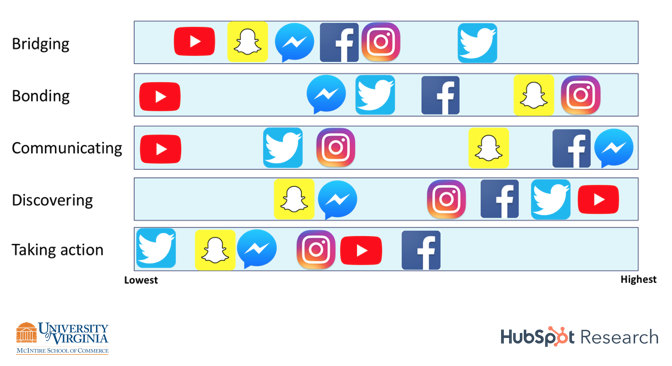
Not all social channels are created equal, and brands need to be strategic about where they invest time and resources. Our survey found that consumers use different social platforms for distinct reasons:
| Platform | Primary Motivation |
|---|---|
| Communicate with friends/family | |
| Express identity | |
| Build professional network | |
| Follow news and trends |
Source: HubSpot/UVA Consumer Survey
The takeaway? Don‘t take a scattershot approach to social media. Instead, focus on the channels that best align with your target audience and business goals. For example, a B2B brand might prioritize LinkedIn for thought leadership, while a D2C fashion brand might focus on Instagram for product discovery.
Once you‘ve identified priority channels, set clear objectives and KPIs for each one. Use historical benchmarks to inform your goal-setting. For example, HubSpot‘s own data shows the median monthly Instagram follower growth rate is 0.85% for brands with 10K-100K followers.
Content Strategy: Give the People What They Want
Posting on social media is easy. Posting content that resonates with your audience is harder. That‘s where a data-driven content strategy comes in.
Our research found that people prefer different types of content across social platforms:
| Platform | Top Content Types |
|---|---|
| 1. Videos 2. News articles 3. Photos | |
| 1. Photos 2. Short-form videos 3. Stories | |
| 1. News articles 2. Professional content 3. Trending topics | |
| 1. News 2. Opinions/takeaways 3. Trending topics |
Source: HubSpot/UVA Consumer Survey
To maximize engagement, tailor your content mix for each channel based on these preferences. Don‘t just broadcast the same posts everywhere.
It‘s also important to strike the right balance of content types. At HubSpot, we find the following ratios work well:
- 40% entertaining
- 40% educating
- 20% promoting
Of course, the optimal mix will vary based on your brand and goals. The key is to map out a content calendar that delivers value to your audience while supporting your objectives.
Don‘t feel like you need to create everything from scratch. Curating content from trusted third-party sources can enhance your credibility and reduce content production workload. For example, HubSpot uses Lists by HubSpot to curate relevant articles and quotes to complement our original content.
Engagement Strategy: Foster Meaningful Connections
Social media is first and foremost about building relationships. To form genuine connections with followers, brands need an engagement strategy that combines reactive, proactive, and influencer tactics.
On the reactive side, set clear guidelines for monitoring, moderating, and responding to audience interactions. Make sure you have dedicated resources to handle inquiries in a timely manner—53% of consumers expect brands to respond to social media comments within an hour (Sprout Social). At HubSpot, we use our Service Hub to manage and track all social interactions.
Proactively, use social listening tools to find relevant conversations to join. For example, if you‘re a fitness brand, you might monitor hashtags like #WorkoutWednesday to share tips and engage with people looking for motivation.
Collaborating with relevant influencers allows you to tap into new audiences and build credibility through trusted voices. The key is finding influencers who authentically align with your brand values. At HubSpot, we partner with marketing experts through our Speaker Program to co-create valuable educational content.
Don‘t overlook the power of employee and customer advocacy. Encourage your team to share brand content and engage with followers. Regularly repost user-generated content to foster community and show appreciation. At HubSpot, employee re-shares drive 8x more impressions on average compared to shares from our brand handle.
Measurement Strategy: Prove and Improve Performance
What gets measured gets managed. To prove the value of social media and continuously optimize performance, brands need to define the right success metrics and consistently report on progress.
Common social media goals and KPIs include:
- Brand awareness: Reach, impressions, follower growth, share of voice
- Engagement: Likes, shares, comments, saves, brand mentions
- Traffic: Link clicks, click-through rate, bounce rate
- Conversions: Sign-ups, downloads, purchases, revenue
At HubSpot, we track all of these metrics using native platform analytics, Google Analytics, and customized dashboards. The key is tying social media KPIs directly to overarching business objectives to demonstrate impact.
Of course, data isn‘t just for reporting—it should inform ongoing optimization. Use A/B testing to evaluate different content types, formats, CTAs, and targeting. Analyze top-performing posts to identify themes and formats to double down on.
We‘re constantly running experiments to improve our social media approach at HubSpot. For example, we recently tested removing links from some of our LinkedIn posts to see if it would boost reach—and it led to a 2.5x increase in average impressions.
Eyes on the Horizon: Preparing for the Future of Social Media
Social media is constantly evolving, and what works today might not work tomorrow. To future-proof your social strategy, stay on top of emerging trends and technologies such as:
- Short-form vertical video (a la TikTok)
- Social audio (like Clubhouse or Twitter Spaces)
- VR/AR integrations (such as Snap‘s Lenses)
- Social commerce
- AI-powered chatbots and content creation tools
For example, as short-form video has exploded in popularity, HubSpot has adapted by launching our own TikTok channel and increasing our investment in Instagram Reels.
The key is having a flexible framework that allows you to experiment with new tactics and platforms while staying true to your overarching strategy. At HubSpot, we dedicate 20% of our content calendar to piloting new formats and channels.
Putting the Framework into Action: Success Stories
Theory is great, but how does this framework look in practice? Let‘s examine a few brands that exemplify a strategic approach to social media.
Wendy‘s: Mastering Real-Time Engagement on Twitter
Wendy‘s has become the gold standard for real-time brand engagement on Twitter. The fast food chain is known for its witty, irreverent voice and willingness to roast competitors and engage with customers.
For example, when a Twitter user recently asked what Wendy‘s employees do during their downtime, the brand quipped back "Honestly? Stare at the clock and dream up ways to roast people on Twitter." The tweet racked up over 75K likes.
By consistently showcasing its distinctive brand personality, creating highly shareable content, and quickly responding to timely moments, Wendy‘s has built a massive following of over 3.9 million on Twitter. More importantly, Wendy‘s credits its social media presence for driving tangible results like a 15% boost in profit margins.
Peloton: Building Community Through UGC
Peloton, the connected fitness company, has grown a cult-like following thanks in large part to its social media strategy. At the heart of that strategy is celebrating its community.
Peloton regularly features user-generated content from customers sharing their fitness journeys across its social channels. This not only provides social proof, but makes customers feel appreciated and motivates them to keep engaging with the brand.
By rallying around the shared identity of being a "Peloton person," the company has organically built a powerful community of advocates—the official Peloton member page on Facebook has over 400,000 highly active users. This community has been integral to the brand‘s success, driving over a million bike sales in 2021 alone.
Drift: Generating Demand Through Education on LinkedIn
Drift, the conversational marketing platform, uses LinkedIn strategically to engage with potential buyers and establish thought leadership. But rather than bombarding followers with product pitches, they focus on providing value.
The brand regularly shares educational content like blog posts, videos, and webinars on topics relevant to its target audience of B2B marketers and salespeople. Drift also actively participates in discussions in LinkedIn Groups to build credibility.
By consistently delivering useful information and advice, Drift has positioned itself as a trusted resource and partner rather than just another vendor. This approach has helped the company generate 80% of its pipeline directly attributable to content marketing.
These examples illustrate the power of a cohesive social media framework rooted in deep audience understanding, authentic brand storytelling, and continuous performance optimization. While the specific tactics may vary, the core principles remain the same.
Go Forth and Conquer Social Media
Building an effective social media presence is not a one-and-done endeavor—it requires ongoing effort, experimentation, and analysis. But brands that invest in developing and executing a strategic framework stand to reap major rewards in terms of awareness, engagement, and ultimately, revenue.
As you craft your own social media framework, keep these key takeaways in mind:
- Focus on the platforms that best align with your audience and objectives
- Deliver value through a balanced mix of entertaining, educational, and promotional content
- Engage proactively and authentically with your community
- Measure what matters and continuously optimize based on data
- Stay nimble and adapt to emerging trends while staying true to your brand
Most importantly, never lose sight of the "social" in social media. At the end of the day, these platforms are about forging human connections. The brands that win hearts, minds, and wallets on social media are those that stay relentlessly focused on understanding, delighting, and empowering their customers.
Ready to uplevel your social media game? Start putting these principles into practice—your customers (and your bottom line) will thank you. And if you‘re looking for a partner to help you along the way, HubSpot‘s tools and expertise are here to help. The future of social media is bright for those willing to put in the work.