A Technical Odyssey: Navigating the Landscapes of Data Science, Machine Learning, and Deep Learning
The Awakening of Intelligent Systems
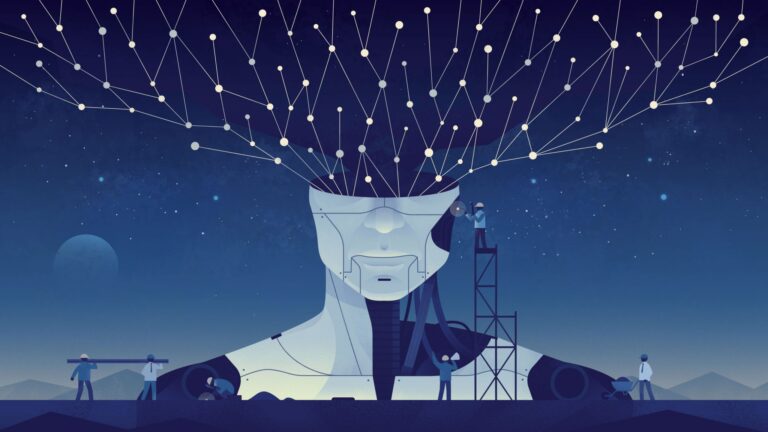
Imagine standing at the crossroads of human creativity and computational power. This is where data science, machine learning, and deep learning converge – a realm where algorithms breathe life into raw information, transforming abstract patterns into intelligent insights.
My journey through the world of artificial intelligence began not with grand visions of technological revolution, but with a simple fascination: How do machines learn? How can lines of code mimic the intricate neural pathways of human cognition?
The Genesis of Intelligent Computation
The story of machine learning is fundamentally a narrative of human curiosity. In the mid-20th century, pioneers like Alan Turing and John McCarthy dared to ask radical questions about machine intelligence. Their theoretical groundwork laid the foundation for what would become a technological metamorphosis.
Early computational models were rigid, rule-based systems that struggled with complexity. Imagine teaching a computer to recognize a cat – not by providing explicit instructions about whiskers, fur, and ears, but by allowing it to discover these characteristics autonomously. This was the revolutionary promise of machine learning.
Decoding the Architectural Foundations
Data Science: The Alchemical Art of Insight Extraction
Data science represents more than mathematical manipulation; it‘s a sophisticated art of transforming raw information into meaningful narratives. Modern data scientists are part mathematician, part storyteller, wielding statistical techniques to uncover hidden insights within massive datasets.
Consider how financial institutions predict market trends or how healthcare systems forecast disease progression. These aren‘t mere calculations but complex interpretations of interconnected variables, revealing patterns invisible to human perception.
Machine Learning: The Learning Mechanism
Machine learning transcends traditional programming paradigms. Instead of writing explicit instructions, we create adaptive algorithms capable of improving through experience. This fundamental shift represents a profound reimagining of computational intelligence.
Supervised learning models learn from labeled datasets, creating predictive frameworks across domains. Imagine training an algorithm to distinguish between malignant and benign medical images – not through rigid rules, but by exposing it to thousands of annotated examples, allowing it to develop nuanced recognition capabilities.
Unsupervised learning takes this concept further, discovering intrinsic structures within unlabeled data. Clustering algorithms can identify consumer segments, detect anomalies in network security, or reveal complex social network dynamics without predefined categories.
The Neural Network Revolution
Deep learning represents the pinnacle of machine learning sophistication. Inspired by biological neural networks, these computational models create intricate, multi-layered representations of data.
Convolutional Neural Networks (CNNs) have revolutionized computer vision, enabling machines to interpret visual information with remarkable precision. From autonomous vehicle navigation to medical image analysis, these networks decode complex spatial relationships with unprecedented accuracy.
Recurrent Neural Networks (RNNs) excel in processing sequential data, making breakthrough contributions in natural language processing. They can understand context, predict text sequences, and even generate human-like prose.
Transformer Models: A Paradigm Shift
The introduction of transformer architectures marked a watershed moment in artificial intelligence. Models like BERT and GPT have demonstrated extraordinary language understanding capabilities, bridging communication gaps between human linguistic complexity and machine interpretation.
These models don‘t merely process words; they comprehend context, nuance, and semantic relationships, approaching a level of linguistic intelligence that was previously inconceivable.
Ethical Frontiers and Societal Implications
As artificial intelligence becomes increasingly sophisticated, ethical considerations become paramount. We‘re not just developing technological systems; we‘re creating computational entities with profound societal implications.
Bias mitigation, transparency, and responsible AI development are no longer academic discussions but critical imperatives. Each algorithm carries inherent ethical responsibilities, requiring continuous scrutiny and refinement.
The Human-AI Collaboration
The future of artificial intelligence isn‘t about machine replacement but collaborative intelligence. We‘re moving towards symbiotic systems where human creativity and machine processing power complement each other, solving complex challenges across multiple domains.
Emerging Technological Horizons
Generative AI represents the next frontier of computational creativity. Models capable of generating realistic images, composing music, and writing coherent text challenge our understanding of creativity and machine intelligence.
Edge computing and distributed AI architectures promise to democratize intelligent systems, bringing sophisticated computational capabilities to diverse global contexts.
Looking Forward: The Continuous Evolution
Machine learning and artificial intelligence are not static technologies but dynamic, evolving ecosystems. Each breakthrough opens new philosophical and technological questions, pushing the boundaries of what we consider possible.
As an AI researcher, I‘m continuously humbled by the complexity of intelligence – both artificial and biological. Our journey is not about creating perfect machines but about understanding the intricate mechanisms of learning, adaptation, and discovery.
A Personal Reflection
My fascination with artificial intelligence stems from its fundamental promise: to augment human potential, to solve complex challenges, and to expand the horizons of our collective understanding.
We stand at an extraordinary moment in technological history – where lines of code can dream, learn, and reimagine the world around us.
Conclusion: The Unfolding Narrative
Data science, machine learning, and deep learning are more than technological domains. They represent a profound exploration of intelligence itself – a continuous dialogue between human creativity and computational possibility.
As we venture further into this exciting landscape, one thing becomes clear: our journey of discovery has only just begun.