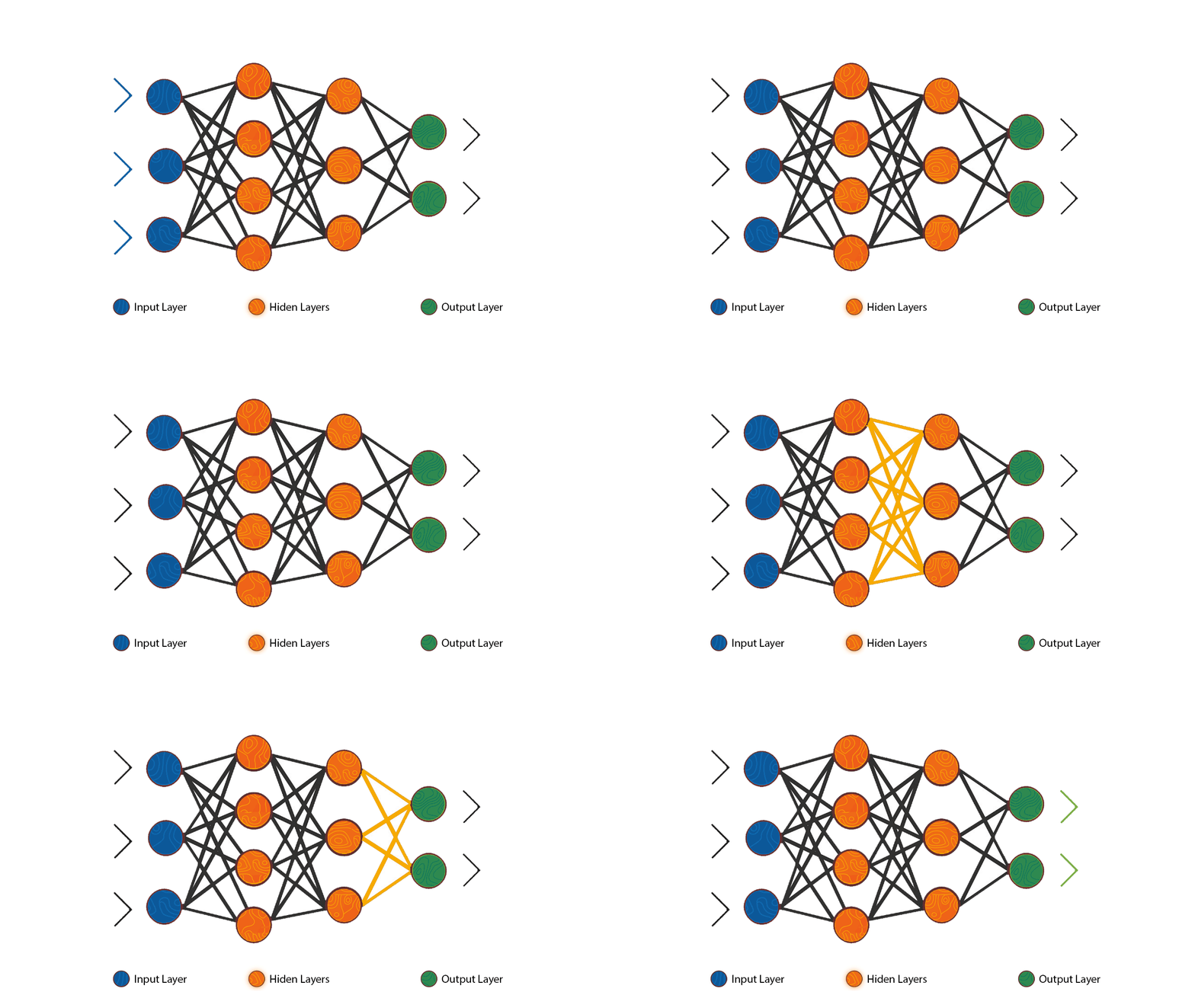
Decoding the Perceptron: A Profound Journey into Binary Classification
The Genesis of Intelligent Learning
Imagine stepping into a world where machines begin to mimic human thought processes. This is precisely where the Perceptron emerges – not just an algorithm, but a revolutionary concept that transformed how we understand computational learning.
A Glimpse into Machine Intelligence
In the late 1950s, when computers were massive rooms filled with vacuum tubes and punch cards, Frank Rosenblatt conceived something extraordinary. The Perceptron wasn‘t merely a mathematical model; it was a glimpse into a future where machines could learn, adapt, and make decisions.
The Mathematical Symphony of Learning
Consider the Perceptron as a delicate dance of numbers, where each step represents a decision, each movement a learning opportunity. The fundamental equation [z = w_1x_1 + w_2x_2 + … + w_nx_n + b] isn‘t just a formula – it‘s a language of intelligence.
Weights: The Cognitive Connectors
In this mathematical landscape, weights [w_i] are more than numerical values. They represent connection strengths, similar to synaptic connections in biological neural networks. Each weight captures the importance of a specific feature, determining its influence on the final decision.
Computational Learning: Beyond Simple Calculations
The Perceptron isn‘t about complex calculations; it‘s about understanding patterns. Imagine teaching a child to distinguish between apples and oranges. Similarly, the Perceptron learns by adjusting its internal representations based on observed data.
The Learning Mechanism Unveiled
When the Perceptron makes a prediction, it doesn‘t just output a result. It compares its prediction with the actual outcome, creating a learning opportunity. The weight update rule [w_i(t+1) = w_i(t) + \alpha(y – \hat{y})x_i] becomes a mechanism of continuous improvement.
Geometric Landscapes of Decision Making
Picture a two-dimensional space where data points are scattered. The Perceptron draws a linear boundary, separating these points into distinct categories. This isn‘t just a mathematical operation; it‘s a visualization of decision-making processes.
The Elegance of Linear Separation
Linear separability represents a fundamental concept. Not all problems can be solved with a single straight line. This limitation becomes a profound lesson in understanding computational complexity and the nuanced nature of learning algorithms.
Practical Implementation: Breathing Life into Mathematics
class IntelligentClassifier:
    def __init__(self, learning_rate=0.01):
        self.cognitive_weights = None
        self.neural_bias = None
        self.learning_momentum = learning_rate

    def train_intelligence(self, feature_space, classification_labels):
        # Intricate training process simulating cognitive learning
        pass

    def make_prediction(self, new_experience):
        # Decision-making mechanism
        pass
Historical Context: More Than an Algorithm
Rosenblatt‘s Perceptron wasn‘t just a technical achievement. It represented a philosophical breakthrough – the idea that machines could learn from experience, adapt, and improve their understanding.
Computational Learning Theory Perspectives
The Perceptron challenged existing paradigms. It suggested that learning isn‘t about pre-programmed rules but about adaptive mechanisms that evolve with experience.
Modern Interpretations and Limitations
While groundbreaking, the Perceptron has limitations. It struggles with complex, non-linear problems. Modern neural networks have transcended these constraints, building upon the foundational principles established by Rosenblatt.
The Evolutionary Path of Machine Learning
Each limitation became a stepping stone. The challenges faced by the Perceptron inspired more sophisticated architectures like multi-layer neural networks and support vector machines.
Psychological Parallels in Machine Learning
Interestingly, the Perceptron‘s learning mechanism mirrors human cognitive processes. Just as humans learn from mistakes, adjust perspectives, and refine understanding, the Perceptron continuously updates its internal representations.
Cognitive Flexibility: A Shared Trait
The ability to learn, adapt, and improve isn‘t exclusive to biological systems. The Perceptron demonstrated that computational models could exhibit similar adaptive capabilities.
Computational Complexity: A Deeper Dive
Beyond its basic formulation, the Perceptron represents a profound exploration of learning algorithms‘ computational complexity. Each weight adjustment, each decision boundary represents a computational journey.
Mathematical Rigor Meets Intuitive Understanding
The beauty of the Perceptron lies in its ability to transform abstract mathematical concepts into tangible learning mechanisms.
Conclusion: A Timeless Computational Concept
The Perceptron isn‘t just a historical footnote in machine learning. It‘s a testament to human creativity, a bridge between mathematical abstraction and intelligent behavior.
As you reflect on this journey through computational learning, remember that every complex system begins with a simple idea – a single neuron, a basic algorithm, a spark of imagination.
The Perceptron teaches us that intelligence isn‘t about complexity, but about the elegant ability to learn, adapt, and understand.