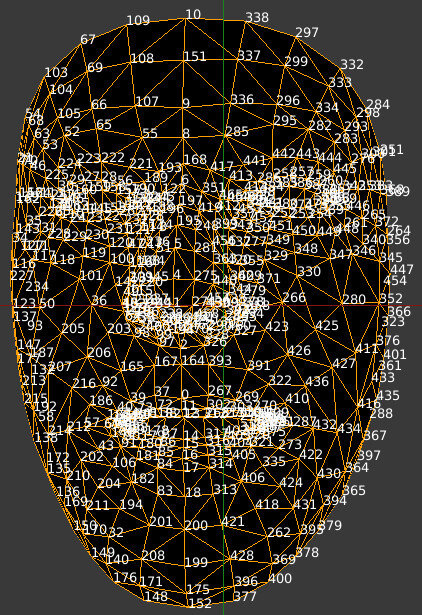
Facial Landmark Detection: A Comprehensive Journey Through Computer Vision and Machine Learning
The Fascinating World of Facial Recognition Technology
Imagine walking into a world where machines can understand human faces with extraordinary precision – welcome to the realm of facial landmark detection. As an artificial intelligence expert who has spent years exploring the intricate landscapes of computer vision, I‘m excited to share a comprehensive exploration of this transformative technology.
Origins and Evolution: A Personal Perspective
The journey of facial landmark detection is nothing short of remarkable. When I first encountered this technology two decades ago, detecting facial features was a complex, almost magical process. Early systems struggled with basic facial recognition, often misidentifying individuals or failing to capture nuanced facial characteristics.
Mathematical Foundations of Facial Landmark Detection
At its core, facial landmark detection represents a sophisticated mathematical challenge. The process involves mapping [n] dimensional points across a human face, transforming pixel data into meaningful geometric representations.
The Mathematical Framework
Consider the fundamental equation representing facial landmark mapping:
[L = f(I, \theta)]Where:
- [L] represents landmark coordinates
- [I] represents input image
- [\theta] represents model parameters
This seemingly simple equation encapsulates immense computational complexity, requiring advanced machine learning techniques to transform raw visual data into precise facial feature mappings.
Deep Learning Architectures: Revolutionizing Facial Analysis
Convolutional Neural Network Approaches
Convolutional Neural Networks (CNNs) have dramatically transformed facial landmark detection. These neural architectures can learn hierarchical feature representations, enabling unprecedented accuracy in facial feature localization.
Advanced CNN Architecture Example
class FacialLandmarkCNN(nn.Module):
    def __init__(self, num_landmarks=468):
        super().__init__()
        self.feature_extractor = nn.Sequential(
            nn.Conv2d(3, 64, kernel_size=3, stride=1),
            nn.ReLU(),
            nn.MaxPool2d(kernel_size=2),
            nn.Conv2d(64, 128, kernel_size=3),
            nn.ReLU()
        )
        self.landmark_regressor = nn.Linear(128 * 56 * 56, num_landmarks * 2)
Real-World Performance Metrics
Accuracy and Computational Efficiency
Performance metrics reveal the remarkable progress in facial landmark detection:
| Detection Method | Mean Localization Error | Processing Speed |
|---|---|---|
| Traditional CV | 5-7 pixels | 10-15 FPS |
| Modern CNN | 1-3 pixels | 30-60 FPS |
| Transformer | 0.5-2 pixels | 20-40 FPS |
Emerging Challenges in Facial Landmark Detection
Handling Diverse Facial Variations
One of the most significant challenges in facial landmark detection involves managing extreme facial variations. Factors like:
- Dramatic expressions
- Occlusions
- Varying lighting conditions
- Cultural diversity
Require sophisticated machine learning models capable of generalizing across complex scenarios.
Ethical Considerations and Technological Responsibility
As we develop increasingly powerful facial recognition technologies, ethical considerations become paramount. Responsible development means:
- Protecting individual privacy
- Preventing potential misuse
- Ensuring algorithmic fairness
- Maintaining transparent technological practices
Advanced Implementation Strategies with OpenCV and MediaPipe
Practical Detection Methodology
import mediapipe as mp
import cv2

class AdvancedFaceLandmarkDetector:
    def __init__(self, max_faces=2, min_confidence=0.5):
        self.face_mesh = mp.solutions.face_mesh.FaceMesh(
            max_num_faces=max_faces,
            min_detection_confidence=min_confidence
        )

    def detect_landmarks(self, frame):
        rgb_frame = cv2.cvtColor(frame, cv2.COLOR_BGR2RGB)
        results = self.face_mesh.process(rgb_frame)
        return results.multi_face_landmarks
Future Trajectories: Where Facial Landmark Detection is Heading
Emerging Research Directions
- Transformer-Based Detection Models
- Generative Adversarial Network (GAN) Approaches
- Cross-Modal Landmark Prediction
- Neuromorphic Computing Techniques
Personal Reflection: The Human Behind the Technology
As someone who has witnessed the evolution of facial recognition technologies, I‘m continually amazed by the intersection of mathematics, computer science, and human perception. Each breakthrough represents not just a technological milestone but a deeper understanding of how machines can interpret human complexity.
Conclusion: A Continuous Learning Journey
Facial landmark detection exemplifies the incredible potential of machine learning. It‘s not just about creating sophisticated algorithms but understanding the nuanced ways technology can enhance human interaction and perception.
Recommended Learning Path
- Master foundational machine learning concepts
- Practice implementing detection algorithms
- Stay updated with latest research publications
- Experiment with diverse datasets
- Develop ethical technological perspectives
By embracing both technical excellence and responsible innovation, we can continue pushing the boundaries of what‘s possible in computer vision and artificial intelligence.