FlashText: Revolutionizing Text Processing in the Machine Learning Landscape
The Origin Story: When Text Processing Became a Bottleneck
Imagine spending days processing massive text datasets, watching your computational resources crawl at a snail‘s pace. As a machine learning practitioner, I‘ve experienced this frustration firsthand. Traditional text processing methods often felt like using a horse-drawn carriage in an era of high-speed trains.
The world of Natural Language Processing (NLP) demands speed, precision, and efficiency. Enter FlashText—a game-changing library that transformed how we approach keyword searching and replacement.
The Technical Genesis of FlashText
FlashText wasn‘t born from a theoretical whiteboard session but from practical challenges faced by developers wrestling with large-scale text processing. Its creator recognized a fundamental problem: existing text manipulation techniques were woefully inadequate for modern computational demands.
Understanding the Performance Challenge
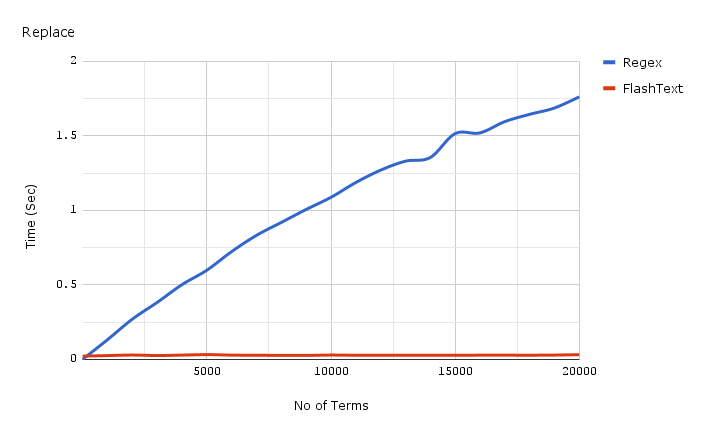
Regular expressions, while powerful, become exponentially slower as keyword complexity increases. Imagine searching through millions of documents—each regex search becomes a computational nightmare. FlashText emerged as an elegant solution, leveraging advanced data structures to solve this intricate problem.
Diving Deep: The Algorithmic Mechanics of FlashText
Trie Data Structure: The Architectural Marvel
At the core of FlashText lies the Trie data structure—a tree-like organization that revolutionizes keyword matching. Unlike traditional linear search methods, Tries enable character-level traversal with remarkable efficiency.
Consider a Trie representing keywords like "machine", "learning", and "intelligence":
Root
├── m
│   └── a
│       └── c
│           └── h
│               └── i
│                   └── n
│                       └── e
├── l
│   └── e
│       └── a
│           └── r
│               └── n
│                   └── i
│                       └── n
│                           └── g
└── i
    └── n
        └── t
            └── e
                └── l
                    └── l
                        └── i
                            └── g
                                └── e
                                    └── n
                                        └── c
                                            └── e
This structure enables [O(k)] time complexity, where k represents the keyword length—a significant improvement over traditional search algorithms.
Single-Pass Replacement: A Computational Symphony
FlashText‘s single-pass replacement mechanism is akin to a precision orchestra, where each keyword is processed simultaneously without redundant iterations. This approach minimizes computational overhead and maximizes efficiency.
Performance Metrics: Beyond Traditional Benchmarks
Comparative Analysis with Regular Expressions
While regular expressions remain versatile, FlashText demonstrates superior performance in specific scenarios:
-
Keyword Volume Processing
- Under 500 keywords: Marginal regex advantage
- Over 500 keywords: FlashText dominates performance metrics
-
Replacement Speed
- Consistent performance across varying keyword volumes
- Linear time complexity
- Minimal memory consumption
Practical Implementation: Real-World Scenarios
NLP Preprocessing Transformations
Imagine normalizing text data across multiple domains—medical records, financial documents, or social media streams. FlashText provides a robust solution for standardizing terminology, anonymizing sensitive information, and preparing datasets for machine learning models.
Code Example: Advanced Text Normalization
from flashtext import KeywordProcessor

def normalize_medical_terminology(text):
    processor = KeywordProcessor(case_sensitive=False)

    # Medical terminology mapping
    processor.add_keywords({
        ‘myocardial infarction‘: ‘heart attack‘,
        ‘cerebrovascular accident‘: ‘stroke‘,
        ‘neoplasm‘: ‘tumor‘
    })

    return processor.replace_keywords(text)

# Sample medical text transformation
medical_text = "Patient diagnosed with myocardial infarction"
normalized_text = normalize_medical_terminology(medical_text)
Machine Learning Integration Potential
FlashText isn‘t merely a text processing library—it‘s a potential catalyst for advanced machine learning workflows. By providing efficient keyword manipulation, it enables:
- Enhanced feature engineering
- Rapid text preprocessing
- Scalable data cleaning pipelines
- Improved model training efficiency
Psychological Impact on Developer Productivity
Beyond technical metrics, FlashText represents a psychological breakthrough. It transforms tedious text processing from a days-long ordeal into a matter of minutes, reigniting developers‘ passion for solving complex computational challenges.
Future Horizons: Evolution of Text Processing
As machine learning continues advancing, libraries like FlashText will play increasingly critical roles. The future promises more sophisticated, context-aware text manipulation techniques that seamlessly integrate computational linguistics with artificial intelligence.
Potential Research Directions
- Context-aware keyword replacement
- Multilingual text processing
- Dynamic Trie structure optimization
- Machine learning-driven text normalization
Conclusion: Embracing Computational Efficiency
FlashText is more than a library—it‘s a testament to human ingenuity in solving complex computational challenges. By reimagining text processing through intelligent algorithmic design, we unlock new possibilities in natural language understanding.
For machine learning practitioners, data scientists, and developers, FlashText represents not just a tool, but a philosophy of computational efficiency.
Remember, in the world of text processing, speed isn‘t just a feature—it‘s a fundamental requirement.