Gaussian Mixture Models: A Machine Learning Expert‘s Deep Dive into Probabilistic Clustering
My Journey into the World of Probabilistic Clustering
When I first encountered Gaussian Mixture Models (GMMs), it felt like discovering a hidden treasure map in the vast landscape of machine learning. As an AI researcher who has spent years navigating complex data landscapes, GMMs represented more than just another clustering algorithm – they were a profound mathematical framework that could decode intricate data patterns.
The Mathematical Poetry of Probabilistic Clustering
Imagine data as a complex symphony, where each point carries multiple harmonies instead of a single, rigid note. This is precisely what Gaussian Mixture Models accomplish. Unlike traditional clustering techniques that force data into predefined, rigid clusters, GMMs allow for a more nuanced, probabilistic interpretation.
The Fundamental Essence of Gaussian Mixture Models
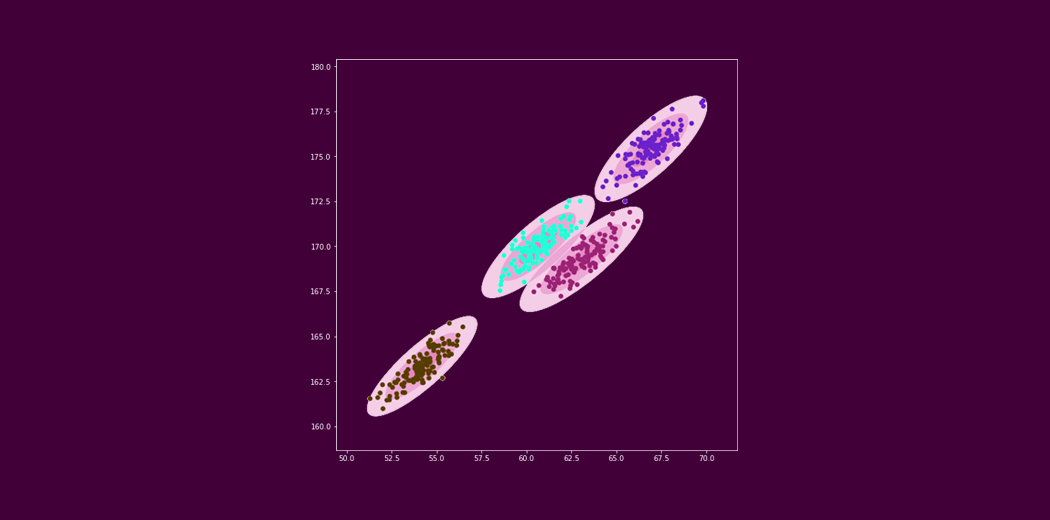
At its core, a Gaussian Mixture Model is a probabilistic model that assumes data points are generated from a mixture of several Gaussian distributions. Think of it like understanding a complex social network where individuals don‘t belong exclusively to one group but have varying degrees of association with multiple communities.
Mathematical Foundations: Beyond Simple Clustering
The mathematical representation of GMMs is elegant in its complexity. Let‘s break down the probability density function that powers this remarkable technique:
[f(x|\mu,\Sigma) = \sum_{k=1}^{K} \pi_k \cdot \frac{1}{(2\pi)^{d/2}|\Sigma_k|^{1/2}} \exp\left(-\frac{1}{2}(x-\mu_k)^T\Sigma_k^{-1}(x-\mu_k)\right)]Where:
- [K]: Number of Gaussian components
- [\pi_k]: Mixture weights
- [\mu_k]: Mean vector for each component
- [\Sigma_k]: Covariance matrix
- [d]: Data dimensionality
A Real-World Perspective
Consider a scenario in customer behavior analysis. Traditional clustering might categorize customers into rigid segments. GMMs, however, recognize that a customer can simultaneously exhibit characteristics of multiple segments – perhaps 60% aligned with a "budget-conscious" group and 40% with a "luxury-seeking" segment.
The Expectation-Maximization (EM) Algorithm: A Computational Symphony
The EM algorithm is the magical conductor that orchestrates the parameter estimation in GMMs. It‘s an iterative process that elegantly navigates the complex parameter space:
- Expectation Step: Estimate hidden variable probabilities
- Maximization Step: Update model parameters to maximize likelihood
Computational Intuition
Imagine you‘re solving a complex puzzle where the pieces constantly shift. The EM algorithm is like a patient puzzle solver, gradually refining its understanding with each iteration, ultimately revealing the most probable configuration.
Practical Implementation in Python
Here‘s a comprehensive implementation that captures the essence of GMMs:
import numpy as np
import matplotlib.pyplot as plt
from sklearn.mixture import GaussianMixture
from sklearn.preprocessing import StandardScaler

class GMMExpert:
    def __init__(self, n_components=3):
        self.n_components = n_components
        self.gmm = GaussianMixture(
            n_components=n_components,
            random_state=42
        )

    def fit_and_predict(self, X):
        # Standardize data for optimal performance
        scaler = StandardScaler()
        X_scaled = scaler.fit_transform(X)

        # Fit GMM and predict cluster probabilities
        self.gmm.fit(X_scaled)
        return self.gmm.predict_proba(X_scaled)

# Example usage with synthetic data
X = np.random.randn(1000, 2)
gmm_expert = GMMExpert()
cluster_probabilities = gmm_expert.fit_and_predict(X)
Advanced Techniques and Emerging Research
As machine learning continues evolving, GMMs are finding innovative applications:
- Anomaly Detection: Identifying rare events in complex systems
- Generative Models: Creating synthetic data with realistic distributions
- Bioinformatics: Understanding genetic variation patterns
Performance Considerations and Computational Insights
GMMs offer remarkable flexibility but come with computational trade-offs. The algorithmic complexity grows quadratically with data dimensionality, making them less suitable for extremely high-dimensional datasets.
Future Horizons: Where GMMs Are Heading
The future of Gaussian Mixture Models lies in hybrid approaches. Researchers are exploring combinations with deep learning techniques, creating more adaptive and context-aware clustering mechanisms.
Concluding Reflections
Gaussian Mixture Models represent more than a mathematical technique – they‘re a philosophical approach to understanding data‘s inherent complexity. They remind us that reality is rarely binary, and true insight comes from embracing probabilistic thinking.
As machine learning continues pushing boundaries, GMMs stand as a testament to the power of probabilistic reasoning, bridging mathematical elegance with practical problem-solving.
About the Expert
With years of experience navigating complex data landscapes, I‘ve witnessed the transformative power of techniques like Gaussian Mixture Models. They‘re not just algorithms – they‘re windows into understanding the nuanced patterns that shape our world.