Mask R-CNN: Revolutionizing Car Damage Detection Through Advanced Computer Vision
The Journey of Seeing Beyond Pixels
Imagine standing beside a damaged vehicle, your trained eye scanning every contour, every minute scratch. Now, picture an artificial intelligence system doing precisely that—with superhuman precision and consistency. This is the promise of Mask R-CNN in automotive damage assessment.
A Personal Perspective on Machine Vision
As an artificial intelligence researcher who has spent years exploring the intricate landscapes of computer vision, I‘ve witnessed remarkable transformations. The evolution from rudimentary object detection to pixel-perfect segmentation represents more than technological progress—it‘s a fundamental reimagining of how machines perceive and interpret visual information.
The Technical Symphony of Mask R-CNN
Mask R-CNN isn‘t just another algorithm; it‘s a sophisticated neural architecture that bridges multiple complex computational techniques. At its core, this technology performs a delicate dance between region proposal networks and fully convolutional networks, creating a harmonious system capable of understanding visual nuances.
Architectural Elegance
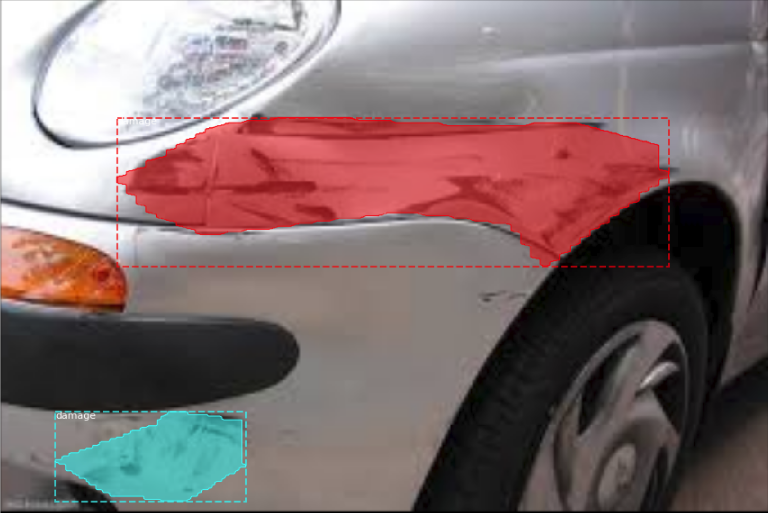
The magic begins with region proposal networks that intelligently scan images, identifying potential areas of interest. These regions then pass through a series of convolutional layers, each extracting increasingly abstract features. Unlike traditional object detection methods that merely draw rectangular boxes, Mask R-CNN generates pixel-precise segmentation masks.
[Mask{Segmentation} = FCN(RPN(Input{Image}))]This mathematical representation encapsulates the complex transformation from raw image data to precise damage localization.
Real-World Challenges in Automotive Damage Assessment
Detecting vehicle damage isn‘t simply about identifying scratches or dents. It‘s about understanding context, interpreting subtle variations, and providing actionable insights. Traditional computer vision approaches often struggled with:
-
Varied Lighting Conditions
Sunlight, shadows, and reflective surfaces can dramatically alter image perception. Mask R-CNN‘s advanced architecture incorporates sophisticated normalization techniques that mitigate these challenges. -
Complex Surface Textures
Modern vehicles feature intricate paint finishes and complex geometric designs. Distinguishing between intentional design elements and actual damage requires nuanced understanding. -
Computational Efficiency
Processing high-resolution images in real-time demands significant computational resources. Mask R-CNN‘s optimized architecture allows for rapid, accurate assessments.
Training: The Heart of Intelligent Perception
Building an effective Mask R-CNN model for car damage detection requires more than sophisticated algorithms—it demands meticulously curated training data and intelligent learning strategies.
Data Collection Strategies
Successful model development hinges on diverse, representative datasets. We‘re not just collecting images; we‘re capturing the entire spectrum of potential damage scenarios. This means gathering images from:
- Different vehicle types
- Varied environmental conditions
- Multiple damage severities
- Diverse lighting scenarios
Transfer Learning: Accelerating Intelligence
Instead of training models from scratch, we leverage pre-trained weights from extensive datasets like COCO (Common Objects in Context). This approach allows our model to inherit foundational visual understanding, dramatically reducing training time and improving initial performance.
Performance Metrics: Beyond Simple Accuracy
Evaluating an instance segmentation model requires sophisticated metrics that capture nuanced performance characteristics:
[mAP = \frac{1}{N} \sum_{class} AP(class)]Mean Average Precision (mAP) provides a comprehensive view of model performance across different damage classes, ensuring robust, reliable assessments.
Practical Implementation Considerations
Developing a production-ready Mask R-CNN model for automotive damage detection involves navigating complex technical and practical challenges:
Hardware Requirements
- High-performance GPUs
- Significant RAM allocation
- Efficient storage solutions
Software Ecosystem
- TensorFlow or PyTorch frameworks
- Specialized computer vision libraries
- Robust data preprocessing pipelines
Economic and Industrial Implications
The potential impact extends far beyond technological curiosity. Insurance companies could save millions by automating damage assessment. Used car markets could provide more transparent, objective evaluations. Repair shops could streamline damage documentation processes.
Ethical Considerations and Future Outlook
As we push technological boundaries, we must remain cognizant of ethical implications. AI-driven damage assessment must prioritize:
- Data privacy
- Algorithmic transparency
- Fair, unbiased assessments
Emerging Research Frontiers
The next decade will likely see:
- Integration with augmented reality
- Real-time mobile damage assessment
- Predictive maintenance technologies
Conclusion: A New Vision of Automotive Intelligence
Mask R-CNN represents more than an algorithmic breakthrough—it‘s a glimpse into a future where machines comprehend visual information with unprecedented sophistication. We‘re not just detecting damage; we‘re teaching systems to see and understand.
The journey of computer vision continues, with each breakthrough bringing us closer to machines that perceive the world with remarkable clarity and depth.