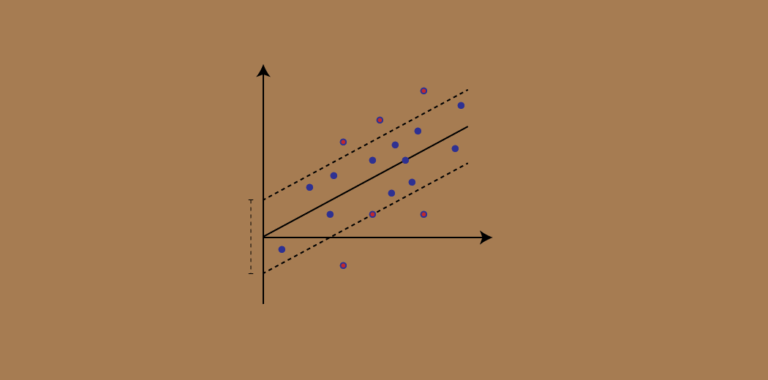
Mastering Automated Multi-Class Text Classification: A Journey Through Machine Learning Landscapes
The Unexpected Path to Intelligent Text Understanding
When I first encountered text classification as a young machine learning researcher, I never imagined how profoundly this technology would transform our interaction with digital information. My journey began with a seemingly simple challenge: teaching machines to understand human language beyond binary yes-or-no decisions.
The Evolution of Machine Comprehension
Text classification wasn‘t always the sophisticated discipline we know today. In the early days, researchers struggled with rudimentary approaches that treated text as mere collections of characters. Imagine trying to understand Shakespeare by counting word frequencies – it‘s like attempting to capture a symphony by counting musical notes.
Mathematical Foundations of Intelligent Classification
Modern multi-class text classification represents a beautiful intersection of mathematics, linguistics, and computational intelligence. At its core, we‘re solving a complex mapping problem: transforming unstructured textual data into meaningful categorical representations.
The Probabilistic Symphony
Consider the mathematical elegance of classification algorithms. Each text document becomes a high-dimensional vector space where probability distributions dance across multiple potential categories. The goal isn‘t just categorization but understanding the nuanced probabilities underlying each classification.
[P(Category_i | Document) = \frac{P(Document | Category_i) \times P(Category_i)}{P(Document)}]This Bayesian formula encapsulates the magic of multi-class text classification – probabilistically determining the most likely category for a given document.
Technological Metamorphosis: From Rule-Based to Intelligent Systems
The Machine Learning Revolution
Traditional rule-based systems were like rigid bureaucrats, following strict predefined guidelines. Modern machine learning models are more like adaptable translators, learning contextual nuances and evolving their understanding dynamically.
Feature Extraction: Transforming Text into Numerical Landscapes
Text preprocessing involves sophisticated transformations. Consider word embeddings like Word2Vec or GloVe, which map linguistic representations into dense vector spaces. These techniques capture semantic relationships, allowing machines to understand contextual meanings.
Example transformation:
def semantic_vector_mapping(text_corpus):
    # Advanced embedding transformation
    word_vectors = advanced_embedding_model.transform(text_corpus)
    return semantic_representation
Practical Challenges in Real-World Deployment
The Complexity of Contextual Understanding
Imagine classifying customer support tickets across multiple domains. A technical complaint about a smartphone might sound dramatically different from a billing inquiry, yet both require precise categorization.
Handling Linguistic Diversity
Natural language presents intricate challenges:
- Sarcasm detection
- Cultural context variations
- Domain-specific terminologies
- Contextual ambiguities
Performance Optimization Strategies
Successful multi-class text classification demands more than algorithmic brilliance. It requires:
- Intelligent feature selection
- Robust preprocessing pipelines
- Continuous model refinement
- Computational efficiency
Advanced Algorithmic Approaches
Ensemble Learning: Collective Intelligence
Ensemble methods represent a profound approach to classification. By combining multiple models, we create a collective intelligence that transcends individual algorithmic limitations.
[Ensemble{Prediction} = \sum{i=1}^{n} (Weight_i \times Model_i(Input))]This mathematical representation shows how different models contribute to a unified prediction, mimicking collaborative human decision-making.
Emerging Technological Frontiers
Transfer Learning and Pre-trained Models
Recent advancements in transformer architectures like BERT and GPT have revolutionized text understanding. These models learn contextual representations across massive text corpora, enabling unprecedented classification accuracy.
Code Illustration of Transfer Learning
from transformers import AutoModelForSequenceClassification

class AdvancedTextClassifier:
    def __init__(self, pre_trained_model):
        self.model = AutoModelForSequenceClassification.from_pretrained(pre_trained_model)

    def classify_text(self, text_input):
        # Intelligent classification logic
        return predicted_categories
Ethical Considerations and Responsible AI
As we develop increasingly sophisticated classification systems, ethical considerations become paramount. We must ensure:
- Fairness in model predictions
- Transparency in decision-making processes
- Mitigation of potential biases
- Respect for individual privacy
Future Technological Horizons
The future of multi-class text classification lies in:
- Contextual understanding
- Cross-lingual models
- Reduced training data requirements
- Interpretable AI systems
Predictive Insights
Imagine classification models that don‘t just categorize but provide nuanced explanations, bridging the gap between machine prediction and human comprehension.
Conclusion: A Continuous Learning Journey
Multi-class text classification represents more than a technological achievement – it‘s a testament to human creativity in teaching machines to understand our complex linguistic landscapes.
As an AI researcher, I‘m continuously humbled by the intricate dance between human language and computational intelligence. Each classification represents a small victory in our ongoing quest to build more intelligent, empathetic technological systems.
Your journey in understanding multi-class text classification has just begun. Embrace curiosity, experiment fearlessly, and remember: behind every algorithm lies a story waiting to be understood.