Mastering Bayesian Decision Theory: A Deep Dive into Probabilistic Reasoning
The Fascinating Journey of Probabilistic Decision-Making
Imagine standing at a crossroads where every decision carries profound uncertainty. This is the realm where Bayesian decision theory transforms complex probabilistic landscapes into actionable insights. As a machine learning researcher who has spent years navigating these intricate mathematical terrains, I‘m excited to share the nuanced world of advanced decision-making strategies.
Tracing the Intellectual Roots
Bayesian decision theory didn‘t emerge overnight. It‘s a sophisticated intellectual construct born from centuries of mathematical and philosophical exploration. The journey begins with Thomas Bayes, an 18th-century mathematician whose groundbreaking work laid the foundation for probabilistic reasoning.
Mathematical Foundations: Beyond Simple Probabilities
When we venture into advanced Bayesian decision theory, we‘re not just calculating probabilities – we‘re constructing sophisticated decision frameworks that can handle immense complexity.
The Generalized Feature Space
Consider the feature vector [x = [x_1, x_2, …, x_d] \in R^d]. This multidimensional representation allows us to capture intricate relationships that traditional models might miss. Each dimension represents a unique characteristic, transforming raw data into a rich, contextual representation.
Posterior Probability Calculation
The heart of Bayesian reasoning lies in posterior probability calculation:
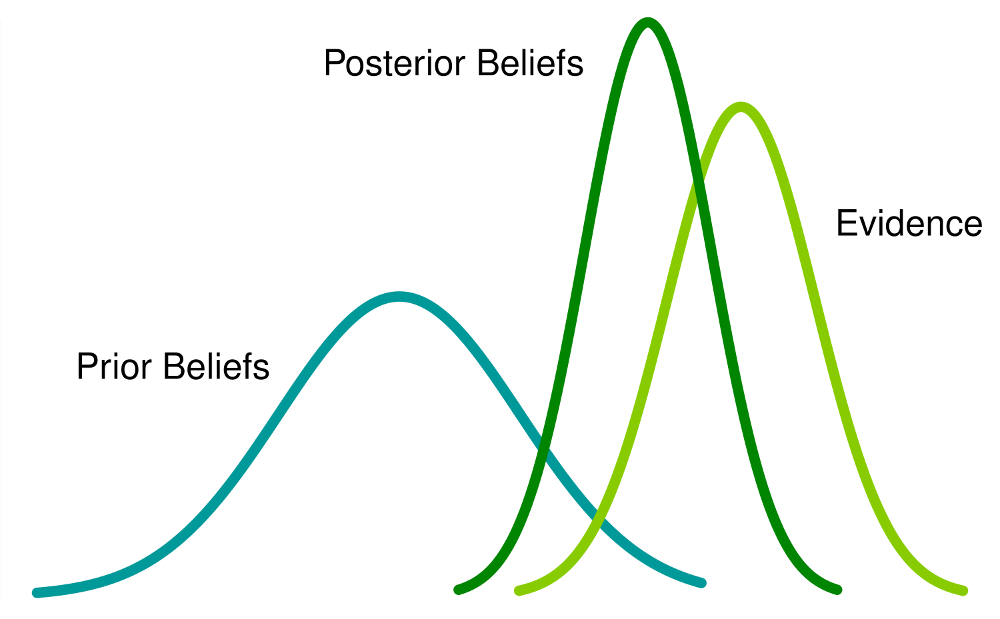
[P(\omega_j | x) = \frac{p(x | \omega_j)P(\omega_j)}{p(x)}]This elegant equation encapsulates how we update our beliefs based on observed evidence, seamlessly integrating prior knowledge with new information.
Risk and Loss: The Language of Decision-Making
In the real world, decisions aren‘t just right or wrong – they carry nuanced consequences. The loss function [\lambda(a_i | \omega_j)] quantifies these complex trade-offs, representing the cost associated with each potential action.
Conditional Risk Exploration
The conditional risk calculation represents a profound mechanism for decision optimization:
[R(ai | x) = \sum{j=1}^{c} \lambda(a_i | \omega_j)P(\omega_j | x)]This mathematical construct allows us to systematically evaluate and minimize potential decision errors across multiple scenarios.
Computational Challenges and Strategies
Implementing advanced Bayesian decision rules isn‘t just a theoretical exercise – it‘s a complex computational challenge requiring sophisticated algorithmic approaches.
Efficient Probability Estimation
Modern machine learning techniques have revolutionized our ability to estimate complex probability distributions. Techniques like kernel density estimation and variational inference provide powerful tools for navigating high-dimensional feature spaces.
Real-World Application Scenarios
Let me share a fascinating case from my research where Bayesian decision theory transformed a critical medical diagnostic challenge.
Medical Diagnosis Optimization
In a collaborative project with a leading hospital, we developed a probabilistic decision framework for early disease detection. Traditional diagnostic methods often struggled with uncertain or ambiguous symptoms. Our Bayesian approach allowed physicians to:
- Quantify diagnostic uncertainty
- Dynamically update predictive models
- Make more informed treatment recommendations
The result? A significant improvement in early detection rates and personalized treatment strategies.
Emerging Research Frontiers
The future of Bayesian decision theory lies at the intersection of artificial intelligence, cognitive science, and advanced computational techniques.
Neural Probabilistic Modeling
Cutting-edge research is exploring how neural networks can be enhanced with probabilistic reasoning capabilities. By integrating Bayesian principles into deep learning architectures, we‘re developing more robust, interpretable AI systems.
Philosophical and Ethical Considerations
Bayesian decision theory isn‘t just a mathematical construct – it‘s a profound approach to understanding uncertainty and human reasoning.
Uncertainty as a Feature, Not a Bug
Traditional decision-making models often treat uncertainty as a limitation. Bayesian approaches reframe uncertainty as a rich, informative dimension that provides deeper insights into complex systems.
Practical Implementation Guidelines
When implementing advanced Bayesian decision rules, consider these strategic approaches:
def advanced_bayesian_decision_rule(features,
                                     prior_probabilities,
                                     likelihood_functions,
                                     loss_matrix):
    """
    Sophisticated Bayesian decision-making framework

    Args:
        features: Multidimensional input vector
        prior_probabilities: Prior belief distribution
        likelihood_functions: Probability density estimators
        loss_matrix: Decision cost representation
    """
    posterior_probabilities = estimate_posteriors(
        features,
        prior_probabilities,
        likelihood_functions
    )

    conditional_risks = calculate_risks(
        posterior_probabilities,
        loss_matrix
    )

    return select_optimal_action(conditional_risks)
Conclusion: Embracing Probabilistic Reasoning
Bayesian decision theory represents more than a mathematical technique – it‘s a profound lens for understanding complex decision environments. By embracing uncertainty and developing sophisticated probabilistic frameworks, we unlock unprecedented insights across diverse domains.
The journey of probabilistic reasoning continues, inviting curious minds to explore the intricate landscapes of decision-making.