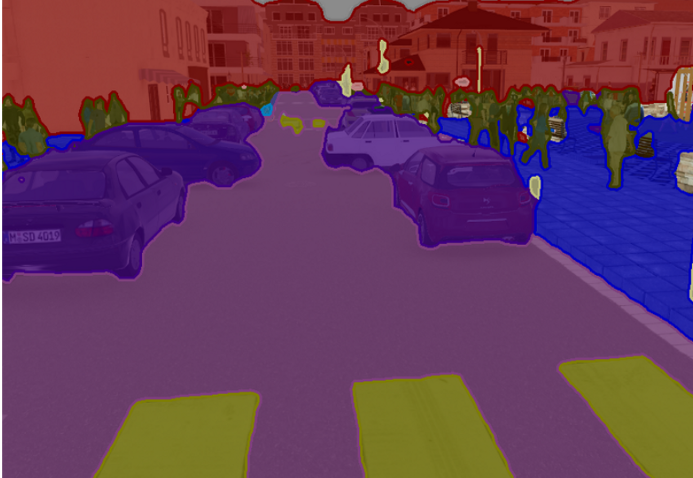
Mastering Object Detection: A Deep Dive into TensorFlow 1.0 and 2.0 Architectures
The Journey of Computer Vision: From Pixels to Intelligence
Imagine standing at the intersection of mathematics, computer science, and visual perception. This is where object detection lives – a fascinating realm where machines learn to see and understand the world much like humans do. As an AI researcher who has spent years exploring the intricate landscapes of machine learning, I‘m excited to share insights into the transformative world of object detection using TensorFlow.
The Mathematical Foundations of Seeing
Object detection isn‘t just about recognizing objects; it‘s about understanding spatial relationships, contextual information, and deriving meaningful insights from visual data. At its core, object detection involves complex mathematical transformations that convert raw pixel information into structured, interpretable representations.
Computational Representation of Visual Information
When we talk about object detection, we‘re essentially discussing how neural networks translate two-dimensional pixel arrays into meaningful semantic understanding. This process involves sophisticated mathematical operations:
[f(x) = \sigma(Wx + b)]Where:
- [f(x)] represents the neural network‘s transformation function
- [\sigma] is the activation function
- [W] represents weight matrices
- [b] represents bias terms
TensorFlow‘s Evolution: A Paradigm Shift in Deep Learning
TensorFlow 1.0 and 2.0 represent more than just version upgrades – they symbolize a fundamental philosophical shift in how we approach machine learning infrastructure.
TensorFlow 1.0: The Static Graph Era
In TensorFlow 1.0, computational graphs were static and predefined. Developers had to construct entire computational graphs before execution, which provided excellent performance but reduced flexibility. This approach required explicit session management and more verbose code structures.
def tensorflow_1_object_detection(input_tensor):
    """
    Object detection implementation in TensorFlow 1.0
    Demonstrates static graph computation
    """
    with tf.Session() as sess:
        # Complex graph definition
        detection_graph = construct_detection_graph()
        sess.run(detection_graph)
    return detection_results
TensorFlow 2.0: Dynamic and Intuitive
TensorFlow 2.0 introduced eager execution, making neural network development more pythonic and intuitive. The framework now seamlessly integrates with Keras, providing a more user-friendly approach to building complex neural architectures.
@tf.function
def tensorflow_2_object_detection(input_tensor):
    """
    Object detection implementation in TensorFlow 2.0
    Demonstrates dynamic graph computation
    """
    detection_results = model(input_tensor)
    return detection_results
Neural Network Architectures: Beyond Simple Recognition
Object detection isn‘t a monolithic concept but a complex ecosystem of architectural designs. Each architecture represents a unique approach to solving visual understanding challenges.
Convolutional Neural Network Designs
Convolutional Neural Networks (CNNs) form the backbone of modern object detection systems. These networks leverage hierarchical feature extraction, progressively learning more abstract representations from raw pixel data.
The typical CNN architecture involves:
- Convolutional layers for feature extraction
- Pooling layers for spatial dimensionality reduction
- Fully connected layers for final classification
Performance Optimization Strategies
Developing high-performance object detection models requires understanding computational trade-offs. Modern approaches focus on:
- Model compression techniques
- Efficient feature representation
- Reduced computational complexity
Transfer Learning: Knowledge Distillation
Transfer learning allows models to leverage pre-trained weights, significantly reducing training time and improving generalization. By transferring knowledge from large, comprehensive datasets, we can create specialized object detection models with minimal computational overhead.
Real-World Implementation Challenges
While theoretical frameworks provide robust foundations, practical implementation reveals nuanced challenges. Factors like:
- Varying lighting conditions
- Occlusions
- Complex backgrounds
- Diverse object scales
Demand sophisticated preprocessing and augmentation strategies.
Advanced Data Augmentation Techniques
def advanced_data_augmentation(image):
    """
    Sophisticated image augmentation for robust object detection
    """
    augmented_image = (
        image
        .random_flip_left_right()
        .random_brightness()
        .random_contrast()
        .random_saturation()
    )
    return augmented_image
The Future of Object Detection
As machine learning continues evolving, we‘re witnessing fascinating developments:
- Self-supervised learning paradigms
- Enhanced generative models
- More efficient neural architectures
Practical Recommendations
- Start with pre-trained models
- Understand your specific use case
- Experiment with different architectures
- Focus on data quality over quantity
- Continuously benchmark and iterate
Conclusion: A Continuous Learning Journey
Object detection represents more than a technological capability – it‘s a testament to human ingenuity in teaching machines to perceive and understand visual information.
By embracing both TensorFlow 1.0 and 2.0 architectures, we‘re not just writing code; we‘re crafting intelligent systems that can interpret the world around us.
Remember, every line of code is a step towards machines that can truly see.
Recommended Further Reading
- TensorFlow Official Documentation
- Computer Vision Research Papers
- Advanced Deep Learning Textbooks