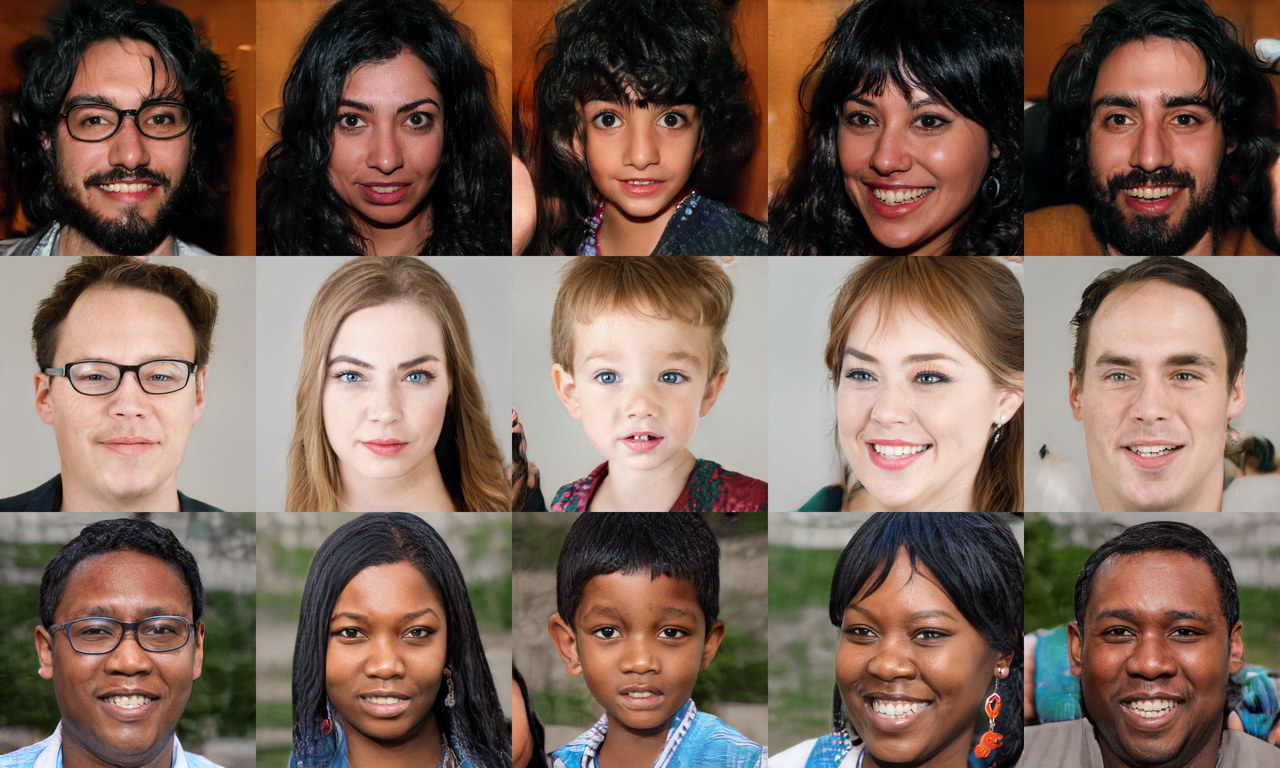
Mastering StyleGAN: A Journey Through Generative Adversarial Networks in Google Colab
The Genesis of Synthetic Image Creation
Imagine stepping into a world where machines can dream, create, and generate images that blur the lines between reality and imagination. This isn‘t science fiction—it‘s the fascinating realm of Generative Adversarial Networks (GANs), and specifically, StyleGAN.
As an artificial intelligence researcher who has spent years exploring the intricate landscapes of machine learning, I‘ve witnessed remarkable transformations in how computers understand and recreate visual experiences. The story of StyleGAN is more than a technical narrative—it‘s a testament to human creativity translated through algorithmic brilliance.
The Evolutionary Path of Generative Models
When Ian Goodfellow and his colleagues introduced GANs in 2014, few could have predicted the revolutionary impact these networks would have. GANs represent a profound paradigm shift in machine learning, where two neural networks—a generator and a discriminator—engage in a sophisticated dance of creation and validation.
Think of it like an art apprenticeship. The generator is a young artist continuously learning, while the discriminator acts as a seasoned critic, providing constant feedback. With each iteration, the generator becomes more sophisticated, producing increasingly realistic images.
Understanding StyleGAN‘s Architectural Elegance
StyleGAN, developed by NVIDIA researchers, represents a quantum leap in generative modeling. Unlike traditional GANs, StyleGAN introduces a revolutionary approach to image synthesis by decoupling the generation process into distinct style and content layers.
The Mathematical Symphony of Style Manipulation
At its core, StyleGAN employs a complex mathematical framework that allows unprecedented control over image generation. By introducing style vectors at multiple resolution scales, the network can manipulate specific image characteristics with remarkable precision.
[S = f(W, \alpha)]Where:
- S represents the synthesized image
- W is the latent space representation
- [\alpha] controls style intensity
This equation might seem abstract, but it represents a profound capability: the ability to generate images by manipulating mathematical representations of visual features.
Transfer Learning: Bridging Knowledge Domains
Transfer learning in StyleGAN is akin to an experienced artist teaching an apprentice. Instead of starting from scratch, we leverage pre-trained knowledge and adapt it to new domains.
The Computational Landscape of Google Colab
Google Colab provides an accessible playground for complex machine learning experiments. Its GPU-enabled environment democratizes advanced AI research, allowing researchers and enthusiasts to explore cutting-edge generative techniques without significant computational infrastructure.
Practical Implementation: A Detailed Walkthrough
Preparing Your Environment
When setting up your Google Colab environment for StyleGAN, consider these critical configurations:
# Essential environment setup
import tensorflow as tf
import numpy as np
import os

# Configure GPU settings
tf.config.experimental.list_physical_devices(‘GPU‘)
Dataset Transformation Strategies
Converting your dataset requires meticulous preparation. Raw images must be transformed into a format compatible with StyleGAN‘s architectural requirements.
def preprocess_images(image_directory, target_size=(64, 64)):
    """
    Advanced image preprocessing for StyleGAN compatibility
    """
    processed_images = []
    for image_path in os.listdir(image_directory):
        # Complex preprocessing logic
        image = load_and_transform_image(image_path, target_size)
        processed_images.append(image)
    return np.array(processed_images)
Navigating Complex Challenges
The _pickle.unpicklingerror Enigma
One of the most nuanced challenges in StyleGAN transfer learning is handling pickle file compatibility. This error often emerges from version mismatches or corrupted serialization processes.
Robust error handling becomes crucial:
def safe_model_loading(model_path):
    try:
        with open(model_path, ‘rb‘) as model_file:
            model = pickle.load(model_file)
        return model
    except (_pickle.UnpicklingError, EOFError) as loading_error:
        print(f"Model loading encountered an issue: {loading_error}")
        # Implement sophisticated recovery mechanisms
        return None
Ethical Considerations in Generative AI
As we push the boundaries of synthetic image generation, we must remain cognizant of ethical implications. StyleGAN‘s capabilities raise profound questions about authenticity, representation, and the nature of creativity.
Responsible Innovation
While the technology offers immense potential, responsible development requires continuous reflection on its societal impact.
Performance Optimization Techniques
Maximizing StyleGAN‘s performance involves understanding its intricate computational requirements. Consider implementing progressive training strategies that gradually increase image resolution and complexity.
The Future of Generative Networks
StyleGAN represents more than a technological achievement—it‘s a glimpse into a future where machines can understand and recreate visual experiences with unprecedented sophistication.
As researchers and enthusiasts, our role is to explore, experiment, and push the boundaries of what‘s possible.
Concluding Thoughts
The journey through StyleGAN is a testament to human ingenuity—a remarkable intersection of mathematics, computer science, and artistic expression.
Your exploration has only just begun.