Pretrained Word Embeddings: Decoding the Language of Machines
Prologue: A Linguistic Revolution
Imagine standing at the intersection of human communication and computational intelligence. Here, in this fascinating domain, word embeddings emerge as the Rosetta Stone of machine learning—translating the nuanced, complex language of humans into a mathematical dialect that computers can comprehend and manipulate.
As an artificial intelligence researcher who has spent years exploring the intricate landscapes of natural language processing, I‘ve witnessed the remarkable transformation of how machines understand text. Word embeddings represent more than a technical innovation; they‘re a profound bridge between human expression and computational reasoning.
The Semantic Archaeology of Language Representation
When we communicate, our words carry layers of meaning beyond their literal definitions. A single word can convey emotion, context, cultural nuance—a complexity that traditional computational approaches struggled to capture. Word embeddings revolutionized this challenge by creating dense, meaningful vector representations that encode semantic relationships.
Mathematical Foundations: Mapping Linguistic Landscapes
At its core, word embedding is a mathematical art of transforming linguistic symbols into geometric spaces. Consider the mathematical mapping [f: W \rightarrow \mathbb{R}^d], where:
- [W] represents our entire vocabulary
- [d] defines the embedding‘s dimensional complexity
- Each word becomes a vector capturing its semantic essence
This transformation allows extraordinary capabilities: semantic relationships can be explored through vector arithmetic. The famous example [king – man + woman \approx queen] illustrates how embeddings capture intricate linguistic patterns.
The Computational Alchemy of Semantic Spaces
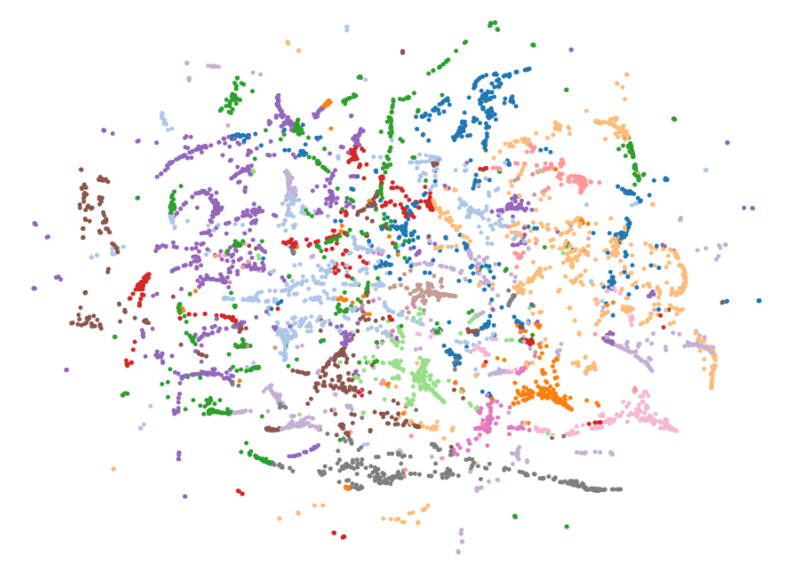
Imagine each word as a point in a multi-dimensional universe, where proximity represents semantic similarity. Words describing related concepts cluster together, while semantically distant concepts drift apart. This geometric representation enables machines to "understand" linguistic relationships with remarkable precision.
Historical Evolution: From Sparse to Dense Representations
The Limitations of Traditional Approaches
Before word embeddings, computational linguistics relied on sparse, inefficient representations like one-hot encoding. These techniques treated each word as an independent, unrelated entity—a computational approach as limited as trying to describe a painting using only black and white pixels.
Word2Vec: A Paradigm-Shifting Technique
Developed by Google researchers, Word2Vec introduced two revolutionary architectures that transformed our understanding of language representation:
Continuous Bag of Words (CBOW)
CBOW predicts a target word by analyzing its surrounding context. This approach mirrors how humans often understand words through their contextual usage. By training neural networks to predict words based on their neighborhood, researchers created embeddings that capture contextual nuances.
Skip-gram Model
In contrast, the Skip-gram model predicts context words from a given target word. This technique proved particularly powerful for capturing rare word representations and understanding complex linguistic relationships.
Advanced Embedding Techniques: Beyond Initial Approaches
GloVe: Global Semantic Mapping
Stanford‘s GloVe approach introduced a fascinating technique of utilizing global corpus statistics. By analyzing word co-occurrence matrices, GloVe created embeddings that captured broader semantic patterns across entire text collections.
FastText: Subword-Level Linguistic Insights
Facebook‘s FastText revolutionized embedding generation by decomposing words into character n-grams. This approach dramatically improved representation for morphologically complex languages, handling out-of-vocabulary words with unprecedented sophistication.
Contextual Embeddings: The Next Frontier
Modern techniques like BERT, ELMo, and GPT embeddings represent a quantum leap in language representation. These contextual embeddings adapt dynamically, generating representations that change based on surrounding text—mimicking the human ability to interpret words differently depending on context.
The Computational Complexity of Context
Contextual embeddings introduce extraordinary computational challenges. Unlike static embeddings, these representations must:
- Dynamically generate vector representations
- Capture multi-layered semantic nuances
- Maintain computational efficiency
Practical Implementation: Bridging Theory and Application
When implementing word embeddings, consider these critical factors:
- Domain-specific relevance
- Computational resource constraints
- Task-specific requirements
- Embedding dimensionality trade-offs
Performance Optimization Strategies
Effective embedding utilization requires sophisticated optimization techniques:
- Implement intelligent dimensionality reduction
- Develop efficient caching mechanisms
- Leverage transfer learning approaches
Ethical Considerations: The Philosophical Dimension
Word embeddings aren‘t merely technical constructs—they‘re mirrors reflecting societal linguistic patterns. Researchers must critically examine potential biases embedded within these representations.
Emerging research focuses on:
- Developing more inclusive embedding techniques
- Mitigating inherent representational biases
- Creating fair, balanced language models
Future Horizons: Emerging Research Frontiers
The future of word embeddings promises extraordinary possibilities:
- Quantum-inspired embedding techniques
- Neuromorphic computing approaches
- Self-supervised generation methodologies
- Cross-linguistic semantic mapping
Conclusion: A Transformative Journey
Word embeddings represent more than a computational technique—they‘re a profound translation mechanism between human complexity and machine precision. By transforming abstract linguistic constructs into mathematically tractable representations, we‘re fundamentally reimagining human-machine communication.
Invitation to Exploration
As technology evolves, word embeddings will continue pushing the boundaries of computational linguistics. The journey of understanding language through mathematical representations is just beginning.
Stay curious. Stay learning.