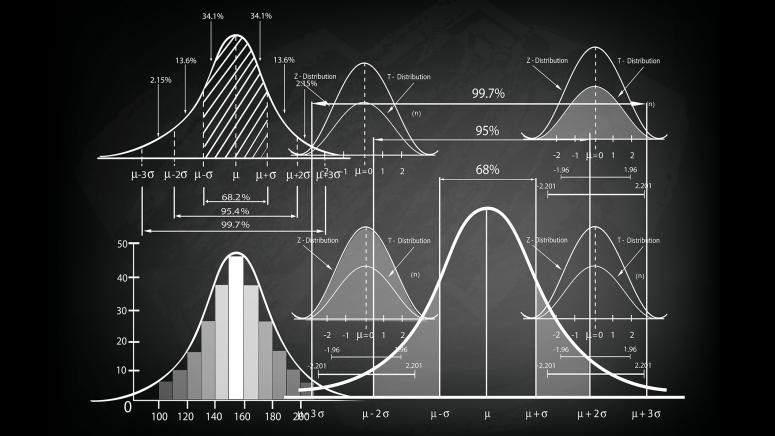
Q-Q Plots: Mastering Distribution Analysis for Intelligent Machine Learning Models
The Hidden Language of Data Distributions
Imagine standing before a vast landscape of numerical data, where every point tells a story, and every pattern holds a secret. As a machine learning expert, I‘ve spent years deciphering these complex narratives, and today, I‘ll share a powerful technique that transforms how we understand and leverage data: the Quantile-Quantile (Q-Q) plot.
Unraveling the Mathematical Tapestry
Probability distributions are more than mathematical abstractions—they‘re the fundamental language through which data communicates its underlying structure. When we talk about Q-Q plots, we‘re essentially creating a translation mechanism that allows us to understand how our data speaks.
The mathematical essence of Q-Q plots lies in comparing theoretical and empirical quantiles. Quantiles represent specific points in a dataset that divide the distribution into equal segments. By plotting these quantiles against each other, we create a visual map that reveals intricate distribution characteristics.
The Quantum Leap in Distribution Analysis
Mathematically, we can represent this comparison through the following framework:
[Q_T(p) = F_T^{-1}(p)] [Q_S(p) = F_S^{-1}(p)]Where:
- [Q_T(p)] represents theoretical distribution quantiles
- [Q_S(p)] represents sample distribution quantiles
- [F_T^{-1}] signifies the inverse cumulative distribution function
- [p] denotes probability levels between 0 and 1
A Journey Through Distribution Landscapes
Consider your data as a complex terrain. Traditional analysis methods provide a bird‘s-eye view, but Q-Q plots offer a ground-level exploration. They reveal nuanced topographical features that might escape conventional statistical techniques.
Real-World Distribution Challenges
In my years of machine learning consulting, I‘ve encountered numerous scenarios where distribution understanding became pivotal:
-
Financial Risk Modeling
Predicting market behaviors requires understanding how returns deviate from expected distributions. Q-Q plots help identify whether historical data follows expected probabilistic patterns. -
Healthcare Predictive Analytics
When developing predictive models for patient outcomes, understanding the distribution of medical parameters becomes crucial. Q-Q plots help validate whether our assumptions align with actual data characteristics. -
Autonomous Systems
For self-driving car algorithms, understanding sensor data distributions ensures robust decision-making under varied environmental conditions.
Advanced Implementation Strategies
import numpy as np
import scipy.stats as stats
import matplotlib.pyplot as plt

def comprehensive_distribution_analysis(data, theoretical_distribution=stats.norm):
    """
    Perform multi-dimensional distribution exploration
    """
    fig, axes = plt.subplots(2, 2, figsize=(15, 12))

    # Q-Q Plot
    stats.probplot(data, dist=theoretical_distribution, plot=axes[0, 0])
    axes[0, 0].set_title(‘Quantile-Quantile Comparison‘)

    # Histogram
    axes[0, 1].hist(data, bins=‘auto‘, density=True)
    axes[0, 1].set_title(‘Data Distribution‘)

    # Kernel Density Estimation
    data_kde = stats.gaussian_kde(data)
    x_range = np.linspace(data.min(), data.max(), 100)
    axes[1, 0].plot(x_range, data_kde(x_range))
    axes[1, 0].set_title(‘Kernel Density Estimation‘)

    # Cumulative Distribution
    axes[1, 1].plot(x_range, theoretical_distribution.cdf(x_range))
    axes[1, 1].set_title(‘Cumulative Distribution Function‘)

    plt.tight_layout()
    return fig

# Example usage
experimental_data = np.random.normal(0, 1, 5000)
comprehensive_distribution_analysis(experimental_data)
Computational Insights and Performance Considerations
Q-Q plot generation involves sophisticated computational techniques. The algorithmic complexity typically follows O(n log n), making it computationally efficient for moderate to large datasets.
Key performance metrics include:
- Computational Complexity: Logarithmic scaling
- Memory Requirements: Linear with dataset size
- Recommended Minimum Sample Size: Approximately 500 data points
Emerging Research Frontiers
The future of distribution analysis lies at the intersection of machine learning, quantum computing, and probabilistic modeling. Researchers are exploring:
- Quantum Probabilistic Frameworks
- Non-Parametric Distribution Mapping
- Adaptive Learning Algorithms
- Probabilistic Neural Network Architectures
Practical Wisdom: Beyond Mathematical Abstraction
Q-Q plots aren‘t just statistical tools—they‘re storytelling mechanisms. They help us understand how our data behaves, revealing hidden patterns and potential modeling challenges.
When you encounter a Q-Q plot, look beyond the lines and curves. Each point represents a moment of data revelation, a glimpse into the complex probabilistic world underlying your machine learning models.
Navigating Limitations with Expertise
While powerful, Q-Q plots aren‘t infallible. They assume:
- Independent and identically distributed data
- Sufficient sample sizes
- Meaningful theoretical distribution comparisons
Understanding these limitations transforms statistical analysis from a mechanical process to an intelligent, nuanced exploration.
Conclusion: Your Data, Your Story
Q-Q plots represent more than a visualization technique—they‘re a gateway to understanding the intricate language of data distributions. By mastering their interpretation, you transform raw numbers into meaningful insights.
As you continue your machine learning journey, remember: every dataset has a story. Q-Q plots help you become its most insightful narrator.
Your Next Steps
- Implement Q-Q plot analysis in current projects
- Experiment with different theoretical distributions
- Develop custom visualization frameworks
- Continuously challenge your modeling assumptions
The world of data distribution analysis awaits your exploration.