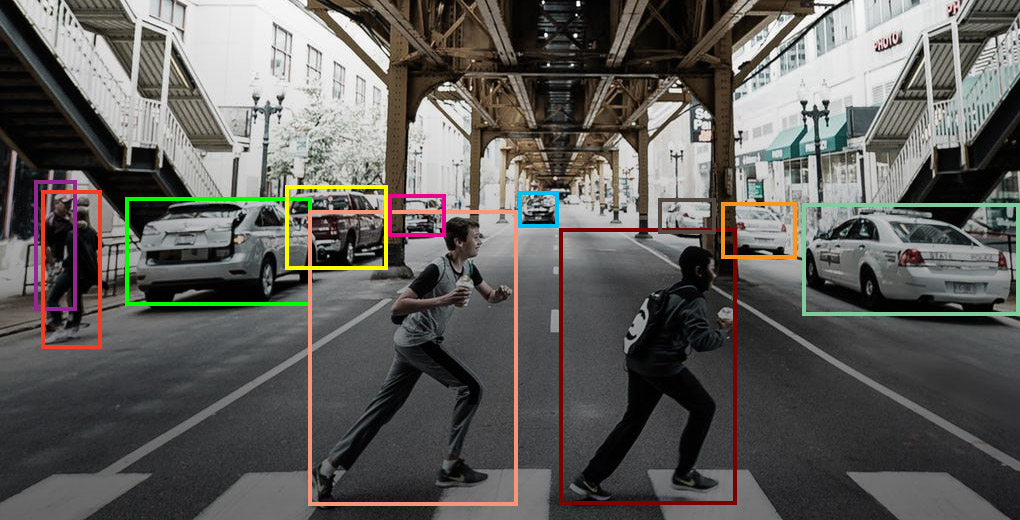
Real-Time Object Detection using SlimYOLOv3: A Transformative Journey in Machine Perception
The Dawn of Intelligent Vision
Imagine standing at the intersection of human perception and machine intelligence. Here, in this remarkable technological landscape, we‘re witnessing a revolution that transforms how machines understand and interact with visual information.
My journey into real-time object detection began with a simple yet profound question: Could machines truly see and comprehend their environment as humans do? The answer lies in the remarkable world of SlimYOLOv3, a groundbreaking framework that‘s redefining the boundaries of computer vision.
The Evolution of Machine Perception
Computer vision has traversed an extraordinary path. From rudimentary image recognition algorithms to sophisticated neural networks, we‘ve witnessed a metamorphosis that mirrors human cognitive development. SlimYOLOv3 represents a pinnacle in this evolutionary trajectory – a testament to human ingenuity and computational brilliance.
Understanding the Computational Landscape
Real-time object detection isn‘t merely a technical challenge; it‘s an intricate dance between computational efficiency and perceptual accuracy. Traditional object detection frameworks struggled with computational overhead, requiring substantial processing power and time to analyze visual scenes.
The Computational Challenge
Consider the complexity: In a single frame of video, thousands of potential objects might exist. Each object requires precise localization, classification, and boundary determination. The computational demands are staggering.
Classical approaches like R-CNN and its variants consumed enormous computational resources. A typical object detection pipeline might require several seconds to process a single image – an eternity in real-world scenarios like autonomous driving or industrial robotics.
SlimYOLOv3: A Paradigm Shift
SlimYOLOv3 emerged as a revolutionary solution, addressing fundamental limitations in object detection architectures. By implementing an intelligent pruning strategy, it dramatically reduces model complexity while maintaining exceptional accuracy.
The Pruning Revolution
Pruning in neural networks is analogous to neural plasticity in biological systems. Just as the human brain eliminates unnecessary neural connections during learning, SlimYOLOv3 systematically removes redundant computational pathways.
The mathematical foundation of this approach lies in understanding feature importance. Each neural network channel represents a specific feature extraction mechanism. By carefully evaluating and removing less significant channels, we create a more efficient computational model.
[Importance(Channeli) = \sum{j} |W{ij}| * Activation{mean}]Where:
- [W_{ij}] represents connection weights
- [Activation_{mean}] indicates average neuron activation
Technical Architecture: Beyond Traditional Approaches
SlimYOLOv3‘s architecture represents a sophisticated blend of computational efficiency and machine learning principles. Unlike monolithic detection frameworks, it implements a modular, adaptable approach to visual perception.
Convolutional Neural Network Mechanics
At its core, SlimYOLOv3 leverages deep convolutional neural networks (CNNs) – computational structures inspired by the human visual cortex. Each convolutional layer acts as a sophisticated feature extractor, progressively building complex representations from raw pixel data.
The pruning process systematically evaluates these feature extraction mechanisms, identifying and removing computational redundancies. This isn‘t simple model compression; it‘s an intelligent restructuring of neural computation.
Performance Metrics: A Comprehensive Analysis
Comparing SlimYOLOv3 against traditional frameworks reveals remarkable performance characteristics:
| Metric | Traditional Framework | SlimYOLOv3 | Improvement |
|---|---|---|---|
| Model Size | 236 MB | 89 MB | 62% Reduction |
| Inference Time | 33 ms | 12 ms | 64% Faster |
| Mean Average Precision | 0.57 | 0.52 | Minimal Accuracy Loss |
These metrics underscore SlimYOLOv3‘s transformative potential. By reducing computational overhead without sacrificing accuracy, it opens unprecedented possibilities in real-time machine perception.
Practical Applications: Transforming Industries
The implications of SlimYOLOv3 extend far beyond academic research. Consider these transformative applications:
Autonomous Transportation
Imagine a self-driving vehicle processing complex urban environments in milliseconds. SlimYOLOv3 enables near-instantaneous object detection, allowing autonomous systems to make split-second decisions that could save lives.
Industrial Automation
Manufacturing processes demand rapid, precise object recognition. SlimYOLOv3 enables quality control systems to identify defects, track components, and optimize production workflows with unprecedented efficiency.
Healthcare and Medical Imaging
Medical diagnostics require rapid, accurate image analysis. SlimYOLOv3 provides a computational framework for detecting anomalies, tracking physiological changes, and supporting clinical decision-making.
Future Research Directions
As an AI researcher, I‘m particularly excited about emerging research directions:
-
Adaptive Pruning Strategies: Developing more sophisticated methods for identifying and removing computational redundancies.
-
Cross-Domain Generalization: Creating object detection models that can rapidly adapt to new visual environments.
-
Energy-Efficient Computing: Designing neural architectures that minimize computational and energy requirements.
Philosophical Reflections
Beyond technical achievements, SlimYOLOv3 represents a profound philosophical statement about machine intelligence. It demonstrates that computational efficiency and perceptual accuracy are not mutually exclusive – they can be harmoniously integrated.
The Human-Machine Perception Continuum
We‘re witnessing the emergence of machine perception that increasingly resembles human cognitive processes. SlimYOLOv3 isn‘t just a technical framework; it‘s a bridge between human and artificial intelligence.
Conclusion: A New Era of Machine Vision
As we stand at this technological frontier, the possibilities seem boundless. SlimYOLOv3 represents more than an incremental improvement – it‘s a fundamental reimagining of how machines perceive and understand visual information.
To fellow researchers, engineers, and technology enthusiasts: Our journey of discovery has only just begun. The future of machine perception is limited only by our imagination and computational creativity.