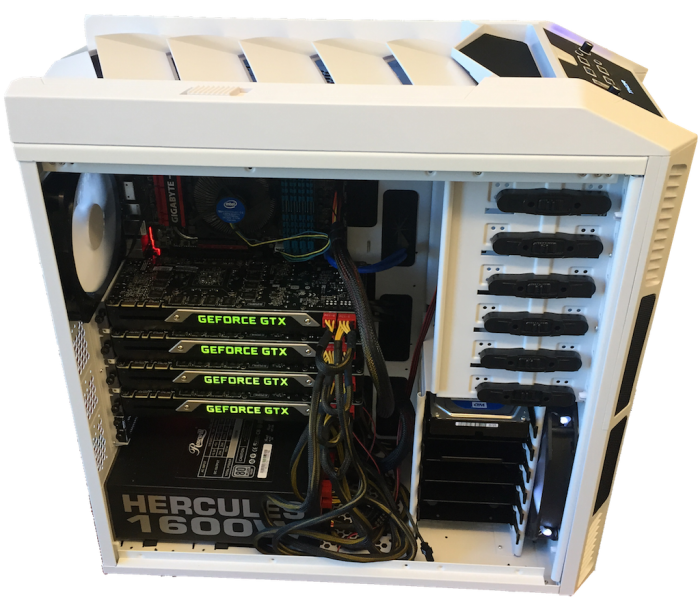
The GPU Revolution: Unveiling the Computational Heart of Deep Learning
A Journey Through Computational Transformation
Imagine standing at the crossroads of technological innovation, where every computational breakthrough reshapes our understanding of artificial intelligence. This is the story of Graphics Processing Units (GPUs) – the unsung heroes that transformed deep learning from an academic curiosity into a world-changing technology.
The Computational Landscape Before GPUs
In the early days of computing, researchers faced an insurmountable challenge. Complex mathematical models required extraordinary computational power, and traditional Central Processing Units (CPUs) struggled under the weight of increasingly sophisticated neural network architectures.
Picture a researcher in the early 2000s, watching a single neural network training process crawl across their screen, taking days or even weeks to complete. Each matrix multiplication felt like moving mountains, with computational limitations acting as an impenetrable barrier to scientific progress.
Understanding Computational Complexity
Deep learning models are mathematical marvels that require unprecedented computational capabilities. When you train a neural network, you‘re essentially performing millions of simultaneous mathematical operations. [O(n^3)] computational complexity isn‘t just a number – it‘s a real-world constraint that can transform promising research into an endless waiting game.
The Mathematical Symphony of Neural Networks
Consider a typical convolutional neural network processing image recognition tasks. Each layer represents a complex transformation:
- Input layer: Raw data representation
- Hidden layers: Feature extraction
- Computational graph: Intricate mathematical relationships
- Backpropagation: Gradient descent optimization
These processes demand parallel processing capabilities that traditional CPUs simply cannot provide.
GPU Architecture: A Computational Revolution
NVIDIA‘s breakthrough came not just from creating faster hardware, but by fundamentally reimagining computational architecture. Their CUDA platform transformed GPUs from graphics rendering tools into powerful scientific computing engines.
Parallel Processing: The Core Innovation
Traditional CPUs operate like skilled individual workers, handling tasks sequentially. GPUs, in contrast, function like a massive team working simultaneously. A modern NVIDIA A100 GPU contains 6,912 CUDA cores – essentially 6,912 mini-processors working in perfect synchronization.
Performance Metrics That Changed Everything
Let‘s explore the transformative performance metrics:
-
Computational Speed
Traditional CPU: 100-500 GFLOPS
Modern GPU: 19.5 TFLOPS -
Memory Bandwidth
CPU: 50-100 GB/s
GPU: Approaching 2,000 GB/s
These aren‘t just numbers – they represent a fundamental shift in computational capabilities.
Real-World Implications
Consider machine learning models like GPT-3, which require training on massive datasets. Without GPU acceleration, such models would be practically impossible to develop. A task that might take months on a CPU can be completed in days or even hours using specialized GPU infrastructure.
The Energy Efficiency Perspective
Contrary to popular belief, GPUs aren‘t just faster – they‘re often more energy-efficient. By optimizing computational density and parallel processing, modern GPUs deliver significantly more computational output per watt of energy consumed.
Emerging Technological Frontiers
The GPU revolution continues to evolve. Emerging technologies like tensor cores, specialized AI chips, and quantum computing integrations promise even more dramatic computational breakthroughs.
Practical Guidance for Researchers and Practitioners
When selecting GPU infrastructure, consider:
- Specific computational requirements
- Budget constraints
- Long-term scalability
- Energy consumption profiles
- Compatibility with existing research infrastructure
The Human Element in Technological Progress
Behind every GPU is a story of human ingenuity. Engineers and researchers who dared to reimagine computational possibilities have created technologies that solve previously unsolvable problems.
Looking Toward the Horizon
As artificial intelligence continues to expand, GPUs will remain critical. They represent more than hardware – they‘re the computational canvas upon which we‘ll paint future technological masterpieces.
Conclusion: A Computational Renaissance
The GPU story isn‘t just about faster computers. It‘s about human potential, scientific curiosity, and our collective ability to push technological boundaries.
We stand at the beginning of a computational renaissance, where every breakthrough brings us closer to understanding the intricate dance between mathematics, technology, and human creativity.
The journey continues, and the most exciting chapters are yet to be written.