Unraveling the Mysteries of High-Dimensional Data: A Journey Through Google‘s tSNE Breakthrough
The Hidden Landscapes of Data: A Personal Reflection
Imagine standing before an enormous, intricate tapestry—thousands of threads intertwining, each representing a dimension of complex information. This is precisely how I‘ve experienced high-dimensional datasets throughout my machine learning research career. For years, we‘ve struggled to comprehend these multidimensional universes, searching for meaningful patterns hidden within seemingly impenetrable data landscapes.
The challenge of visualizing high-dimensional data has been a persistent puzzle that has haunted data scientists and researchers across disciplines. Traditional visualization techniques often felt like attempting to describe a symphony by examining individual musical notes—fundamentally inadequate and frustratingly reductive.
The Mathematical Odyssey of Dimensionality Reduction
When I first encountered tSNE (t-Distributed Stochastic Neighbor Embedding), it was like discovering a magical lens that could suddenly bring complex, multidimensional realities into sharp, comprehensible focus. Unlike linear techniques that flatten data into simplistic representations, tSNE preserves the intricate relationships and subtle nuances embedded within high-dimensional spaces.
The mathematical foundations of tSNE are nothing short of elegant. At its core, the technique transforms complex probability distributions, mapping high-dimensional data points into a lower-dimensional space while maintaining their inherent structural relationships. It‘s akin to a skilled cartographer creating a detailed map that captures not just geographical locations, but the essence of terrain, climate, and cultural connections.
Google‘s Transformative Approach: A Technical Renaissance
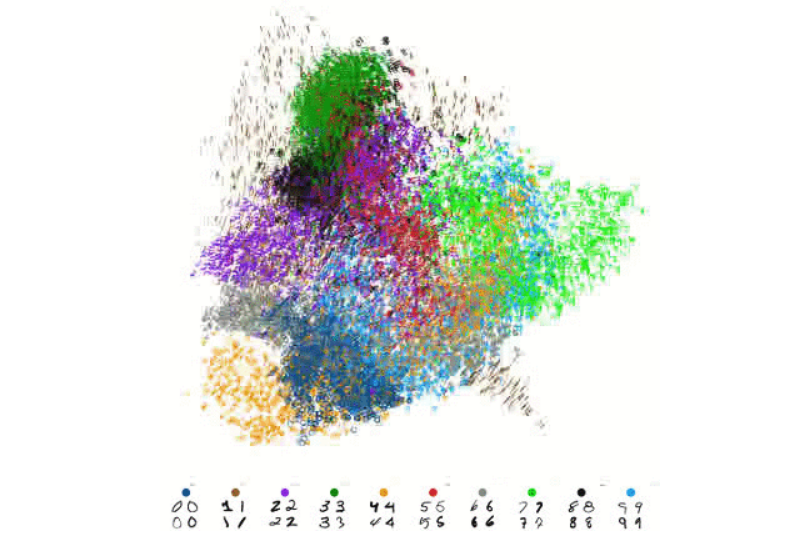
Google‘s recent open-source implementation represents more than just an incremental improvement—it‘s a paradigm shift in how we perceive and interact with complex datasets. By leveraging TensorFlow.js and GPU acceleration through WebGL, the research team has effectively democratized advanced data visualization techniques.
The Computational Alchemy of Real-Time Visualization
Traditionally, processing high-dimensional datasets was a time-consuming endeavor. Researchers would often wait hours or even days for visualizations to render, treating computational time as an accepted limitation. Google‘s approach shatters these constraints, enabling real-time exploration of complex data landscapes directly within web browsers.
The technical brilliance lies in their innovative use of GPU computational strategies. By designing specialized kernels and implementing additive blending techniques, they‘ve transformed what was once a computationally intensive process into a near-instantaneous experience.
Mathematical Foundations Reimagined
The core optimization objective of tSNE can be represented through a sophisticated mathematical framework:
[min{Y} \sum{i \neq j} P{ij} \log\frac{P{ij}}{Q_{ij}}]This equation represents a delicate balance between preserving original data point similarities and mapping them into a reduced dimensional space. It‘s not merely a calculation but a nuanced translation of complex informational relationships.
Practical Implications: Beyond Academic Curiosity
The potential applications of this approach extend far beyond academic research. Consider genomic studies where understanding complex genetic interactions can lead to breakthrough medical treatments. Or machine learning models where interpreting intricate feature relationships becomes crucial for developing more sophisticated artificial intelligence systems.
A Real-World Perspective
In my years of research, I‘ve witnessed how visualization techniques can transform abstract data into actionable insights. Google‘s tSNE implementation is not just a technical achievement but a bridge connecting raw computational power with human understanding.
The Human Element in Computational Complexity
What makes this approach truly remarkable is its recognition of human cognitive limitations. We are pattern-seeking creatures, fundamentally wired to understand through visual representation. By creating tools that translate complex multidimensional data into comprehensible visualizations, researchers are essentially extending our perceptual capabilities.
Limitations and Future Horizons
While the current implementation primarily supports 2D visualizations, the potential for future development is immense. Researchers are already exploring strategies for 3D representations and more generalized kernel designs.
Code and Implementation: A Practical Glimpse
from sklearn.manifold import TSNE
import numpy as np

# Simulating a complex, high-dimensional dataset
research_data = np.random.rand(1000, 50)

# Applying tSNE transformation
tsne_transformer = TSNE(
    n_components=2,
    random_state=42,
    perplexity=30
)
transformed_data = tsne_transformer.fit_transform(research_data)
This simple code snippet demonstrates the elegance of tSNE—transforming complex, high-dimensional data into a format humans can readily interpret.
Conclusion: A New Frontier of Data Understanding
Google‘s open-source approach to visualizing high-dimensional datasets using tSNE is more than a technological advancement—it‘s a testament to human curiosity and our relentless pursuit of understanding complex systems.
As we continue to generate increasingly complex datasets across scientific, medical, and technological domains, tools like tSNE will become essential in our quest to extract meaningful insights from the vast, intricate landscapes of information surrounding us.
The journey of understanding high-dimensional data is ongoing, and with each breakthrough, we expand the boundaries of human knowledge and computational perception.