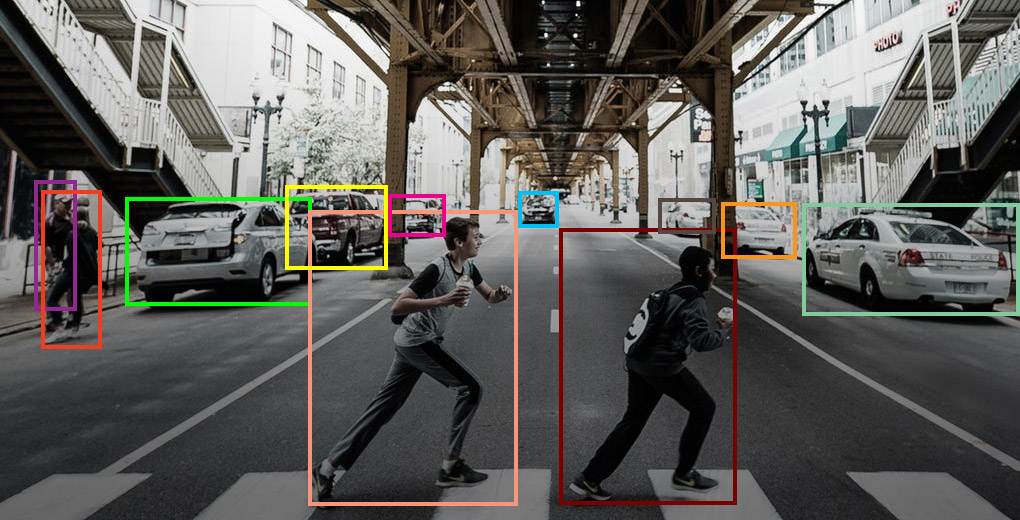
Unveiling the Haar Cascade Algorithm: A Journey Through Object Detection‘s Pioneering Landscape
The Genesis of Machine Perception
Imagine standing at the intersection of mathematics, computer science, and human perception. This is where the Haar Cascade algorithm emerges – not just as a technical solution, but as a profound exploration of how machines can begin to "see" and understand visual information.
In the early days of computer vision, researchers faced an extraordinary challenge: how could we teach machines to recognize objects the way human eyes effortlessly do? The answer would come from an elegant mathematical approach that would reshape our understanding of computational perception.
A Mathematical Symphony of Perception
The Haar Cascade algorithm represents more than just a technical method – it‘s a mathematical symphony that translates complex visual information into computable features. Developed by Paul Viola and Michael Jones in 2001, this approach revolutionized object detection by introducing a remarkably efficient computational technique.
Mathematical Foundations: Beyond Simple Calculations
At its core, the Haar Cascade algorithm leverages a profound mathematical concept: the ability to extract meaningful features from images through intelligent windowing and feature comparison. Unlike traditional image processing techniques, Haar-like features operate by calculating intensity differences across rectangular regions.
The Elegance of Feature Extraction
Consider how our human eyes perceive edges, transitions, and contrasts. The Haar Cascade mimics this process through sophisticated mathematical transformations. By sliding a window across an image and computing intensity differences, the algorithm can identify distinctive patterns that represent objects.
[F(x,y) = \sum_{i=1}^{n} w_i \cdot (R_i^{white} – R_i^{black})]This seemingly simple equation encapsulates a complex process of feature detection. Each term represents a calculated difference between white and black rectangular regions, weighted to emphasize specific visual characteristics.
Computational Architecture: A Multilayered Approach
The true brilliance of the Haar Cascade lies in its cascading classifier structure. Imagine a vigilant security system that quickly dismisses irrelevant information while progressively examining promising regions. This is exactly how the algorithm operates.
The Cascading Classifier: An Intelligent Filtering Mechanism
Each stage in the cascade acts as a sophisticated filter:
- Initial stages rapidly eliminate non-object regions
- Subsequent stages apply increasingly complex classifiers
- Only regions passing multiple stages are considered potential objects
This approach dramatically reduces computational complexity, allowing real-time object detection on modest hardware.
Training the Algorithm: From Raw Data to Intelligent Detection
Training a Haar Cascade is akin to teaching a child to recognize objects – it requires patience, diverse examples, and intelligent learning strategies. The process involves collecting extensive image datasets, generating Haar-like features, and using AdaBoost for intelligent feature selection.
The Learning Journey
Imagine collecting thousands of images – some containing the object of interest, others deliberately diverse and unrelated. The algorithm learns by:
- Generating multiple Haar-like features
- Evaluating each feature‘s discriminative power
- Selecting the most informative features
- Creating a cascading classifier that can generalize across variations
Real-World Performance: Beyond Academic Theory
In practical implementations, Haar Cascade demonstrates remarkable capabilities:
- Detection speeds of 15-30 milliseconds per frame
- Memory footprint of 50-100 KB
- Processing capability of 30-60 frames per second
These performance characteristics made the algorithm revolutionary, especially in resource-constrained environments.
Comparative Landscape: Where Haar Cascade Stands Today
While deep learning techniques have emerged, Haar Cascade remains relevant in specific domains:
- Embedded systems with limited computational resources
- Industrial vision applications
- Educational and research contexts
- Scenarios requiring lightweight, fast detection
Practical Implementation: A Technical Deep Dive
def detect_objects_intelligently(image, cascade_classifier):
    """
    Advanced object detection with intelligent multi-scale approach
    """
    detected_objects = cascade_classifier.detectMultiScale(
        image,
        scaleFactor=1.1,      # Adaptive scaling
        minNeighbors=3,       # Noise reduction
        minSize=(30, 30),     # Minimum object threshold
        maxSize=(300, 300)    # Maximum detection range
    )
    return detected_objects
Future Horizons: Beyond Current Limitations
The Haar Cascade algorithm represents more than a technical solution – it‘s a testament to human ingenuity in teaching machines to perceive. As computational capabilities evolve, this approach continues to inspire researchers exploring the boundaries of machine perception.
Emerging Research Directions
Researchers are exploring hybrid methodologies that combine Haar Cascade‘s computational efficiency with modern machine learning techniques. These approaches promise more robust, adaptable object detection systems.
Conclusion: A Continuous Journey of Discovery
The Haar Cascade algorithm reminds us that technological innovation often emerges from elegant, simple approaches. It transformed our understanding of how machines can interpret visual information, paving the way for today‘s advanced computer vision systems.
As we continue pushing the boundaries of artificial perception, algorithms like Haar Cascade will remain foundational – not just as technical solutions, but as profound explorations of computational creativity.