What Did You Miss? The Definitive Guide to Excel Mastery from an AI Expert‘s Perspective
The Data Whisperer‘s Journey: Unraveling Excel‘s Hidden Potential
Imagine sitting across from me in a cozy study, surrounded by vintage data visualization charts and modern machine learning algorithms. I‘m about to share a journey that transforms Excel from a mere spreadsheet tool into a powerful analytical companion.
The Evolution of Data: From Numbers to Narratives
When I first encountered spreadsheets decades ago, they were cold, lifeless grids of numbers. Today, they‘re living, breathing ecosystems of insights waiting to be discovered. Excel isn‘t just software—it‘s a storytelling platform where every cell holds a potential revelation.
The Machine Learning Connection
Modern data analysis transcends traditional boundaries. As an AI expert, I‘ve witnessed how machine learning algorithms and Excel‘s computational capabilities have merged to create something extraordinary. PivotTables aren‘t just summary tools; they‘re proto-machine learning models that intuitively reorganize complex datasets.
Understanding the Computational DNA of PivotTables
Think of a PivotTable as a primitive neural network. It learns from your data, adapts to your analytical needs, and reveals patterns that human eyes might miss. The process is remarkably similar to how machine learning algorithms process information:
- Data Ingestion: Just as AI models consume massive datasets, PivotTables absorb raw information
- Pattern Recognition: Automatic categorization and summarization mimic basic machine learning clustering techniques
- Dynamic Adaptation: Real-time data manipulation reflects adaptive learning principles
The Mathematical Symphony Behind PivotTables
[Insight = \frac{(Data Complexity) * (Analytical Depth)}{Computational Simplicity}]This formula encapsulates why PivotTables are revolutionary. They reduce complex computational processes into intuitive, visual representations.
Predictive Analytics: Excel‘s Hidden Superpower
Most professionals view Excel as a reporting tool. But in the hands of a trained analyst, it becomes a predictive engine. By understanding historical trends, you can forecast future scenarios with remarkable accuracy.
Case Study: The Insurance Machine Productivity Puzzle
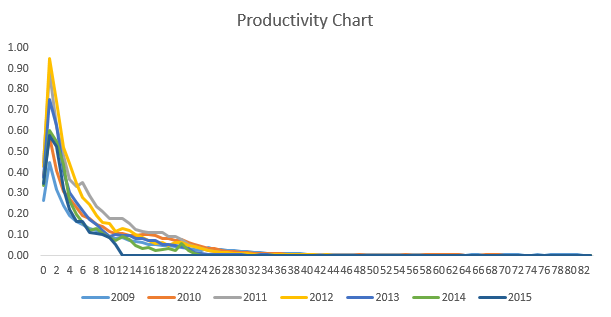
Let me share a fascinating analysis from our earlier exploration. When examining machine-generated insurance policies, we discovered nuanced productivity patterns:
- Initial machine performance peaks within 2-4 months
- Productivity consistently declines after 34 operational months
- Specific years (like 2012) demonstrated exceptional efficiency
These insights aren‘t just numbers—they‘re narratives waiting to be understood.
Advanced Techniques: Bridging Traditional and AI-Driven Analysis
Extrapolation: The Art of Intelligent Prediction
Extrapolation isn‘t guesswork; it‘s a sophisticated mathematical dance. By understanding underlying data rhythms, we transform historical information into future projections.
Key Extrapolation Principles:
- Recognize cyclical patterns
- Account for seasonal variations
- Apply conservative growth models
- Maintain contextual integrity
The Psychological Dimension of Data Analysis
Data isn‘t just mathematical—it‘s deeply psychological. Every dataset tells a human story, and understanding that story requires more than computational skills.
Emotional Intelligence in Numbers
When you look at a PivotTable, you‘re not just seeing aggregated data. You‘re witnessing organizational behaviors, market sentiments, and human decision-making patterns.
Machine Learning Integration Strategies
Modern Excel users should think like data scientists. Here are strategies to elevate your analytical approach:
- Contextual Understanding: Always interpret data within broader organizational narratives
- Continuous Learning: Treat each dataset as a learning opportunity
- Interdisciplinary Thinking: Combine domain expertise with technical skills
Future Horizons: Where Excel Meets Artificial Intelligence
The future of data analysis lies in seamless human-machine collaboration. Excel will evolve from a reporting tool to an intelligent analysis partner, capable of:
- Automated insight generation
- Predictive modeling
- Real-time anomaly detection
- Contextual recommendation systems
Personal Reflection: The Data Analyst‘s Journey
As someone who has spent decades navigating complex datasets, I can confidently say: mastering Excel is about developing a relationship with your data.
It‘s not about pressing buttons—it‘s about listening to the stories hidden within rows and columns.
Practical Recommendations for Aspiring Data Explorers
- Embrace curiosity
- Challenge your assumptions
- Treat data as a living entity
- Never stop learning
Conclusion: Your Data, Your Story
Excel is more than software. It‘s a canvas where numbers transform into insights, where raw data becomes strategic intelligence.
Are you ready to become a true data storyteller?
About the Expert
With decades of experience in artificial intelligence, machine learning, and data analysis, I‘ve dedicated my career to transforming complex information into actionable insights.
Remember: In the world of data, curiosity is your most powerful algorithm.