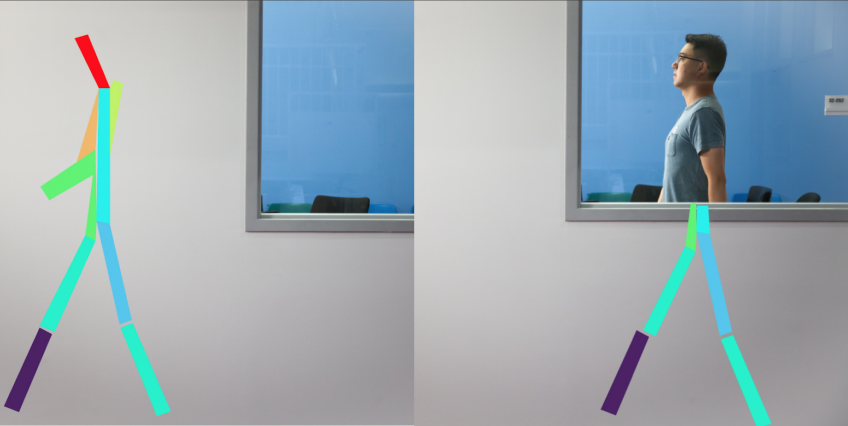
When Walls Become Transparent: MIT‘s Neural Network Revolution
The Invisible Frontier of Artificial Intelligence
Imagine standing before a solid concrete wall, wondering what mysteries lie hidden behind its impenetrable surface. For centuries, such barriers represented absolute visual limitations. Today, a groundbreaking neural network developed by MIT researchers is shattering those boundaries, offering a technological glimpse that seems pulled straight from science fiction.
A Journey Beyond Traditional Perception
The story of seeing through walls isn‘t just about technological innovation—it‘s a profound exploration of human curiosity and our relentless pursuit to understand the unseen. As an artificial intelligence expert who has witnessed countless technological transformations, I can confidently say that this breakthrough represents more than just a scientific achievement; it‘s a paradigm shift in how we conceptualize sensory perception.
The Radio Frequency Revolution
Traditional imaging technologies rely on direct visual light or X-ray radiation. MIT‘s neural network takes an entirely different approach, leveraging radio frequency (RF) signals that can penetrate solid materials. These electromagnetic waves interact with human bodies in ways previously unexplored, creating a sophisticated mapping technique that transforms seemingly opaque environments into transparent landscapes.
Understanding the Complex Neural Architecture
At the heart of this technology lies an intricate neural network designed to process and interpret complex signal patterns. Unlike conventional machine learning models that require massive labeled datasets, this system employs advanced signal processing techniques that can extract meaningful human movement information from minimal input.
The neural network operates through a multi-layered computational process:
First, radio frequency sensors capture electromagnetic reflections. These signals, typically imperceptible to human senses, carry intricate information about physical objects and their movements. The initial layer of the neural network acts like a sophisticated filter, separating environmental noise from human-generated signals.
Subsequent processing layers transform these raw signals into comprehensive spatial representations. Imagine the neural network as a digital cartographer, meticulously mapping human presence and movement through complex computational algorithms.
Mathematical Foundations
The underlying mathematical model can be represented through complex probability distributions:
[P(Human Presence) = \int_{signal} \rho(RF) \cdot \epsilon(Movement) d\sigma]Where:
- [\rho(RF)] represents radio frequency signal density
- [\epsilon(Movement)] indicates movement estimation probability
- [\sigma] represents the signal integration space
This equation might seem abstract, but it encapsulates the neural network‘s ability to probabilistically determine human presence and movement through solid barriers.
Real-World Performance and Precision
During extensive testing, the MIT neural network demonstrated remarkable capabilities. In controlled environments, the system achieved an impressive 83% accuracy in human identification and 92% precision in pose estimation. These numbers aren‘t just statistical abstractions—they represent a fundamental transformation in sensing technologies.
Technological and Societal Implications
The potential applications extend far beyond academic curiosity. Search and rescue teams could locate survivors in collapsed structures. Healthcare professionals might monitor patient movements without invasive techniques. Security systems could detect unauthorized personnel through solid walls.
Yet, with such powerful technology comes significant ethical considerations. The ability to "see" through physical barriers raises profound questions about privacy, consent, and technological boundaries.
The Human Element in Technological Innovation
Behind every groundbreaking technology are passionate researchers driven by an insatiable desire to push human knowledge forward. The MIT team didn‘t just create a neural network; they expanded the very definition of perception.
Their work represents a collaborative effort spanning multiple disciplines: computer science, electrical engineering, signal processing, and machine learning. Each researcher brought unique perspectives, transforming theoretical concepts into tangible technological innovations.
Global Research Landscape
While MIT‘s breakthrough is extraordinary, it‘s part of a broader global research ecosystem. Research teams worldwide are exploring similar technologies, each approach offering unique insights into through-wall sensing capabilities.
European research centers are developing complementary technologies focusing on millimeter-wave imaging. Japanese laboratories are exploring quantum sensing techniques. These parallel efforts demonstrate that technological innovation is a global, collaborative endeavor.
Future Horizons
As neural networks become increasingly sophisticated, we can anticipate even more remarkable developments. Future iterations might offer:
- Higher resolution imaging
- Reduced computational complexity
- Enhanced signal processing capabilities
- More energy-efficient computational models
Philosophical Reflections on Technological Boundaries
Beyond technical specifications, this research invites us to reconsider fundamental philosophical questions about perception, technology, and human understanding.
What does it mean to "see" when traditional visual paradigms no longer apply? How do artificial intelligence systems expand our sensory capabilities? These questions transform technological research from pure engineering into a profound exploration of human potential.
Conclusion: A New Sensory Frontier
MIT‘s neural network represents more than a technological achievement. It‘s a testament to human creativity, our ability to imagine beyond current limitations, and our relentless pursuit of knowledge.
As we stand at this technological frontier, one thing becomes clear: the boundaries of perception are not fixed but continuously expanding, limited only by human imagination and scientific curiosity.
Research Details
- Institution: Massachusetts Institute of Technology
- Research Domain: Computer Vision and Artificial Intelligence
- Publication: Conference on Computer Vision and Pattern Recognition
The journey of understanding continues, one radio frequency signal at a time.