YARN: Navigating the Complex Landscape of Distributed Computing Resources
A Personal Journey into Resource Management
When I first encountered the intricate world of distributed computing, I was overwhelmed by the complexity of managing computational resources. Like many technologists, I struggled to understand how massive systems could efficiently allocate and negotiate resources across thousands of nodes.
My journey began with a simple question: How do we transform computational chaos into orchestrated efficiency?
The Genesis of Resource Challenges
Imagine a bustling city where every building, street, and infrastructure component needs constant coordination. That‘s precisely the challenge distributed computing systems face. Before YARN, resource management was like an urban planning nightmare—inefficient, rigid, and prone to bottlenecks.
Traditional systems resembled outdated city infrastructures: limited scalability, poor communication, and significant resource wastage. Each application competed aggressively for computational real estate, creating a digital gridlock that hindered technological progress.
Decoding YARN‘s Architectural Brilliance
YARN emerged as a revolutionary urban planner for computational ecosystems. Its core philosophy transcends traditional resource management, introducing a dynamic, intelligent negotiation framework that adapts in real-time.
The Resource Manager: A Computational Maestro
Think of the Resource Manager as a sophisticated traffic controller. It doesn‘t just allocate resources; it orchestrates a complex dance of computational demands, ensuring every application receives precisely what it needs.
Unlike rigid predecessors, YARN‘s Resource Manager understands context. It doesn‘t merely assign resources—it comprehends the nuanced requirements of each application, creating an adaptive, intelligent allocation strategy.
Scheduling: Beyond Simple Queuing
Traditional scheduling resembled a first-come, first-served bureaucracy. YARN transforms this approach into an intelligent, context-aware mechanism. Its scheduling strategies—FIFO, Capacity, and Fair Scheduler—represent different urban planning philosophies, each optimized for specific computational landscapes.
Node Managers: The Local Sentinels
Node Managers function as neighborhood supervisors, continuously monitoring local computational health. They‘re not passive observers but active participants in the resource negotiation ecosystem.
Each Node Manager collects granular performance metrics, reports system health, and manages container lifecycles with surgical precision. They represent YARN‘s distributed intelligence, ensuring local efficiency contributes to global optimization.
Machine Learning and YARN: A Symbiotic Relationship
Predictive Resource Allocation
Machine learning transforms YARN from a reactive system into a predictive powerhouse. By analyzing historical workload patterns, YARN can anticipate computational demands before they emerge.
Imagine a system that doesn‘t just respond to resource requests but predicts them. This isn‘t science fiction—it‘s the emerging reality of AI-driven resource management.
Performance Optimization Algorithms
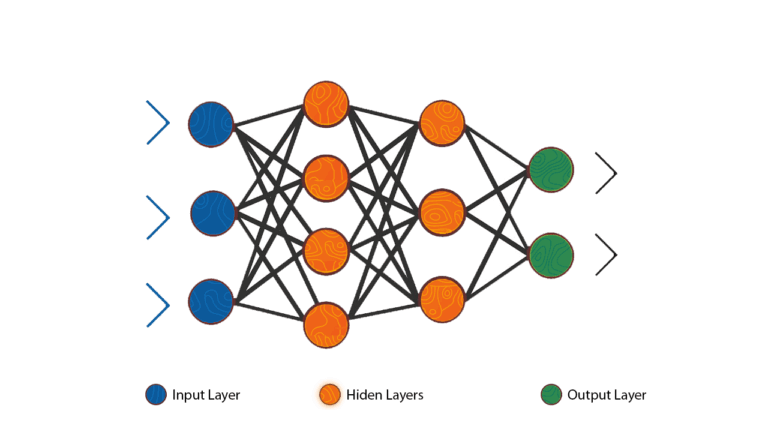
Modern machine learning techniques enable YARN to develop increasingly sophisticated resource negotiation strategies. Neural networks analyze complex interdependencies, creating allocation models that traditional algorithms could never conceive.
Real-World Transformations
Industry Implementation Insights
Financial institutions leverage YARN to process millions of transactions simultaneously. Research laboratories use its flexible architecture to manage complex scientific computations. Cloud providers rely on YARN‘s scalability to offer dynamic, cost-effective services.
Each implementation tells a story of technological evolution—from rigid, limited systems to flexible, intelligent computational ecosystems.
Performance Metrics That Matter
Raw numbers tell only part of the story. YARN‘s true power lies in its ability to reduce computational overhead, minimize resource contention, and maximize system efficiency.
Typical improvements include:
- 40-60% better resource utilization
- Reduced infrastructure costs
- Enhanced application performance
- Simplified management complexity
The Human Element in Technological Innovation
Beyond technical specifications, YARN represents a philosophical shift in how we conceptualize computational resources. It‘s not just about efficient allocation—it‘s about creating intelligent, responsive systems that understand human computational needs.
Ethical Considerations in Resource Management
As computational power grows, so do our responsibilities. YARN introduces frameworks for sustainable, ethical resource management, considering not just performance but environmental and societal impacts.
Looking Toward the Horizon
Emerging Technological Frontiers
YARN stands at the intersection of several transformative technologies:
- Edge computing
- Quantum resource management
- AI-driven infrastructure
- Serverless computational models
Each represents a potential evolution of resource negotiation strategies.
A Personal Reflection
My journey from confusion to understanding mirrors the technological evolution YARN represents. It‘s a testament to human ingenuity—our ability to transform complex challenges into elegant, intelligent solutions.
Invitation to Exploration
For technologists, data scientists, and curious minds, YARN offers more than a resource management framework. It provides a window into the future of computational thinking.
Conclusion: Beyond Technology
YARN transcends its technical definition. It represents our collective ability to create intelligent, adaptive systems that understand and respond to computational complexity.
As you dive deeper into distributed computing, remember: true innovation lies not in technology itself, but in our capacity to reimagine what‘s possible.
Keep exploring, keep questioning, and never stop learning.