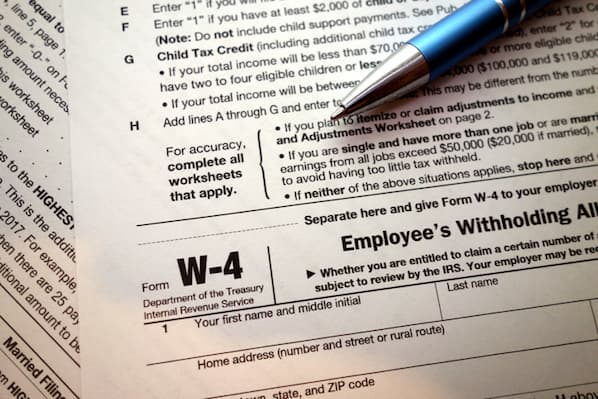
Your Complete Guide to the 2022 W-4 Form
If you‘ve started a new job recently, you were probably asked to fill out a Form W-4. This important IRS document tells your employer how much federal income tax to withhold from each of your paychecks. While the form itself may seem complicated, taking a few minutes to fill it out accurately can save you from an unpleasant surprise when you file your tax return.
Many taxpayers don‘t realize just how critical the W-4 is to their financial picture. In fact, a 2022 report from the Treasury Inspector General found that nearly 9 million taxpayers faced penalties totaling over $12 billion for inaccurate withholdings and underpayment of taxes. Taking the time to understand your W-4 can help ensure you‘re having the right amount withheld during the year.
The IRS rolled out a new design of the W-4 in 2022 that aims to make the withholding system more accurate and transparent. With the new form, it‘s more important than ever to understand how it works and how to use it to your advantage. In this complete guide, we‘ll break down everything you need to know to master your 2022 W-4.
What is a W-4 Form?
Officially titled "Employee‘s Withholding Certificate," Form W-4 is an IRS document that you complete for your employer to determine the amount of federal income tax to withhold from your pay. The taxes taken out of each paycheck are sent to the IRS by your employer and counted toward your annual income tax bill.
When you file your yearly tax return, the IRS will compare your total tax liability to the amount that was withheld. If too much was withheld, you‘ll receive a refund. If not enough was withheld, you‘ll owe additional taxes and possibly underpayment penalties. That‘s why it‘s so important to accurately complete your W-4 and update it when needed.
What Changed on the 2022 W-4?
The Tax Cuts and Jobs Act (TCJA) enacted in late 2017 made significant changes to tax rates, deductions, and credits starting in 2018. However, the old W-4 form still relied on the concept of withholding allowances that was based on personal exemptions – which the TCJA eliminated.
As a result, the IRS redesigned Form W-4 in 2022 to fully reflect TCJA changes and make withholding more accurate and transparent. According to the IRS, the new design "replaces complicated worksheets with more straightforward questions that make accurate withholding easier for employees."
Key changes on the 2022 W-4 include:
-
No withholding allowances: The new form eliminates allowances altogether. Instead, you‘ll provide specific dollar amounts for the tax credits and deductions you expect to claim.
-
New marital status options: Previously, you could choose "married" or "married but withhold at higher single rate." Now, there are three options: single or married filing separately, married filing jointly, or head of household.
-
Account for multiple jobs: In a new section, you can indicate if you work more than one job or have a spouse who works, adjusting your withholding accordingly.
-
Claim dependents: On the old form, you could claim withholding allowances for children and dependents. The new W-4 asks you to enter specific dollar amounts for the child tax credit and credit for other dependents.
-
Other adjustments: New lines allow you to specify any additional income not subject to withholding, claim deductions other than the standard deduction, and request any extra withholding per pay period.
How to Complete the 2022 W-4 Form
With the switch to a new format, it‘s crucial to carefully follow the instructions when filling out your W-4. Let‘s go through each step one-by-one:
Step 1: Personal Information & Filing Status

In this section, provide your basic information including name, address, and Social Security number. Choose your filing status from single/married filing separately, married filing jointly, or head of household.
If you‘re married, note that you now have the option to select "married filing separately" on the W-4 even if you plan to file jointly. This can result in more accurate withholding if you and your spouse have significantly different incomes.
Step 2: Account for Multiple Jobs

This new section applies if you have more than one job or are married filing jointly and both spouses work. The goal is to ensure your combined withholding matches your total tax liability, avoiding the under-withholding that commonly occurred in these situations in the past.
You have three options to complete this section:
- Use the estimator on the IRS website for the most accurate calculation
- Use the Multiple Jobs Worksheet on page 3 for a manual calculation
- Check the box if you and your spouse each have only one job with similar pay
Step 3: Claim Dependents

If you have children under 17 or other dependents you‘ll claim on your tax return, you can enter the estimated full-year amount of the child tax credit and credit for other dependents. This will directly impact your withholding rather than increasing your allowances like on the old form.
Here‘s an example: Let‘s say you have two children who will qualify for the full $2,000 child tax credit. You would enter $4,000 on line 3.
Step 4: Other Adjustments

This section allows you to make further modifications to your withholding:
-
4a: Enter additional income not from jobs, like interest, dividends, or retirement income, that should be factored into your withholding.
-
4b: If you expect to claim deductions other than the standard deduction, such as itemized deductions, enter the full-year total. This will reduce your withholding.
-
4c: Enter any additional tax you want withheld each pay period, such as self-employment tax or taxes on extra income.
Step 5: Sign & Submit

Once you‘ve completed the form, sign and date at the bottom. Submit your W-4 to your employer‘s payroll or HR department. Remember, you can submit a new W-4 any time your personal or financial situation changes.
When to Adjust Your W-4
While everyone should complete a W-4 when starting a new job, there are several life events or changes in your financial situation when you should consider resubmitting the form. These include:
- Getting married or divorced
- Having a baby or adopting a child
- Your spouse starts or stops working
- You start a second job or side hustle
- You receive a significant raise or experience a reduction in income
- You have large investment gains or losses
- You purchase a home and start paying mortgage interest
- You can no longer claim a dependent
In general, any change that affects your tax situation is a good reason to review your W-4. It‘s also a smart idea to do a "paycheck checkup" using the IRS‘s withholding estimator tool each year to make sure you‘re on track.
Presumptive Data & Examples
To see how the new W-4 works in practice, let‘s look at a few examples with hypothetical taxpayers:
Example 1
Jane is single with no children and earns $50,000 per year at her job. She has no additional income and plans to claim the standard deduction on her tax return. Jane would fill out her W-4 as follows:
- Step 1: Select "Single or Married Filing Separately." Enter name, address, SSN.
- Steps 2-4: Leave blank.
- Step 5: Sign, date and submit to employer.
Jane‘s withholding will be based on the standard tax brackets and rates for single filers.
Example 2
Mike and Sarah are married and both work full-time. Mike earns $75,000 and Sarah earns $60,000. They have one child who is 10 years old, and they plan to claim the standard deduction. For the most accurate withholding, they should fill out the Multiple Jobs Worksheet, but let‘s assume they checked the box in Step 2 instead.
Mike‘s W-4:
- Step 1: Select "Married Filing Jointly." Enter name, address, SSN.
- Step 2: Check the box to indicate that both spouses work with similar pay.
- Step 3: Enter $2,000, the full-year amount of the child tax credit.
- Step 4: Leave blank.
- Step 5: Sign, date and submit.
Sarah‘s W-4 would be filled out the same way. By checking the box in Step 2, they‘ll have a little extra withheld to account for their combined income. And claiming the full child tax credit will reduce their withholding slightly.
Example 3
Amit is single and earns $100,000 per year from his tech job. He also does independent contracting on the side which he expects to earn an additional $20,000 from this year. He anticipates he‘ll be able to itemize $15,000 in deductions. Amit‘s W-4 would look like this:
- Step 1: Select "Single or Married Filing Separately." Enter name, address, SSN.
- Step 2: Leave blank since he only has one job.
- Step 3: Leave blank.
- Step 4a: Enter $20,000 for additional income not subject to withholding.
- Step 4b: Enter $15,000 for deductions.
- Step 5: Sign, date and submit.
Having the extra income entered in 4a will increase Amit‘s withholding to cover the additional taxes owed on that money. Entering his anticipated deductions in 4b will reduce his withholding slightly.
W-4 Withholding FAQs
To wrap up our guide, let‘s address some frequently asked questions about the W-4 and tax withholding.
What if I start a new job but don‘t fill out a W-4?
If you fail to submit a Form W-4, your employer will withhold taxes at the highest rate — as if you were single with no adjustments. This will likely result in over-withholding and a big refund, but it‘s better to proactively determine your withholding by completing the form.
How many W-4 forms do I need to fill out?
You should complete a W-4 form for each employer you work for to ensure the proper amount of taxes are withheld from each of your paychecks. If you change jobs during the year, you‘ll need to submit a new W-4 at each new job.
Do I need to fill out a new W-4 every year?
You are not required to fill out a new W-4 form each year if your tax situation doesn‘t change. However, the IRS recommends doing a "paycheck checkup" every year to verify that you‘re having the right amount withheld. If you need to make changes, you can submit a new W-4 form to your employer at any time.
Will my employer see all the information I put on my W-4?
Employers are required to keep copies of their employees‘ W-4s but should keep them confidential. Your employer will not see certain amounts you report on your W-4 (like other income, deductions or credits) – only the final amount of any extra withholding.
How can I estimate if I‘m having the right amount withheld?
The IRS offers a Tax Withholding Estimator tool that can help you determine if your withholding is accurate based on your individual tax situation. To use the estimator, you‘ll need your most recent pay stubs and tax return.
The 2022 W-4 form may seem intimidating at first, but taking the time to understand how it works is one of the most important things you can do for your financial health. By carefully completing the form and making adjustments when needed, you can ensure a smoother tax filing process and avoid unpleasant billing surprises.
For more information on the W-4 and withholding, check out the following resources: