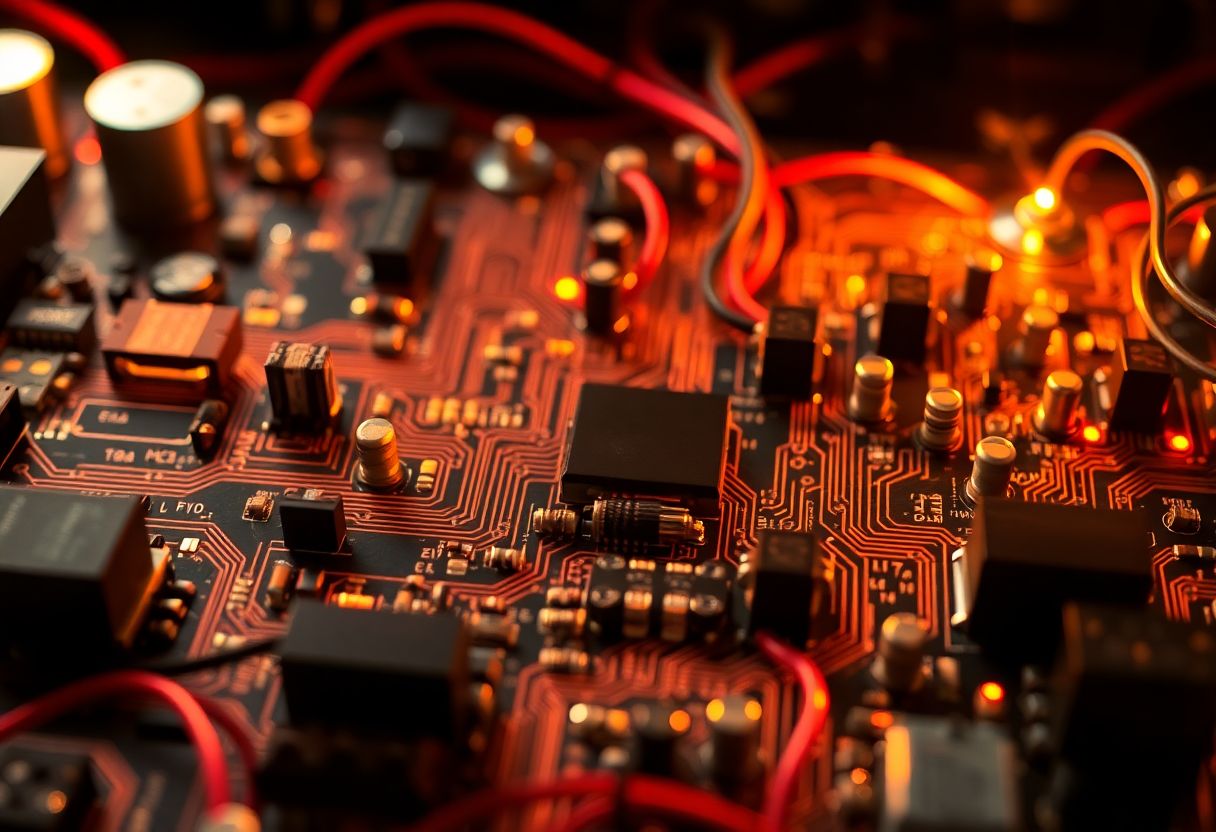
The Fascinating World of Electronics: How They Work and Shape Our Future
In today's digital age, electronics have become an integral part of our daily lives, powering everything from the smartphones in our pockets to the satellites orbiting Earth. But have you ever wondered how these marvels of technology actually work? Let's embark on a journey into the captivating realm of electronics, unraveling their inner workings and exploring their profound impact on our world.
The Fundamentals: Electricity and Electronics
To truly understand electronics, we must first grasp the distinction between electricity and electronics. Electricity is the lifeblood of our modern world, a form of energy involving the flow of electric charge. It's what illuminates our homes, drives our electric vehicles, and heats our ovens. Electrical devices typically harness larger currents, often measured in amperes (amps).
Electronics, on the other hand, is the art and science of controlling and manipulating electrical signals to process information or perform specific tasks. Electronic devices generally utilize much smaller currents, often measured in milliamps or even microamps. If we were to use an analogy, electricity would be the mighty river, while electronics would be the intricate network of canals and locks that control and direct its flow with precision.
The Building Blocks: Electrons and Circuits
At the heart of electronics lie two fundamental concepts: electrons and circuits. Electrons are negatively charged subatomic particles that orbit the nucleus of an atom. In the world of electronics, we harness the movement of these tiny particles to carry information and energy.
A circuit, in essence, is a closed loop through which electrons can flow. It's akin to a racetrack for electrons, with various components acting as obstacles, accelerators, or redirectors. These circuits form the backbone of all electronic devices, from the simplest LED light to the most complex supercomputer.
Analog vs. Digital Electronics: Two Sides of the Same Coin
Electronics can be broadly categorized into two types: analog and digital. Analog electronics deal with continuous signals, representing data as continuously variable physical quantities. Think of old-fashioned radios or record players, where the signal is a continuous wave.
Digital electronics, on the other hand, work with discrete signals, representing data as a series of 1s and 0s. This binary system forms the basis of all modern computing devices, from smartphones to supercomputers. If we were to visualize these two types, analog would be a smooth curve, while digital would be a staircase. Both can represent the same information, but in fundamentally different ways.
Essential Electronic Components: The Building Blocks of Innovation
To truly appreciate how electronics work, we need to understand the key components that make up electronic circuits. Let's explore some of these crucial elements:
Resistors are components that limit or control the flow of electric current. They're like narrow sections in a water pipe that reduce flow. In practical terms, resistors are used to control voltage levels, divide voltages, limit current, and provide proper biasing for active devices in an electronic circuit.
Capacitors store and release electrical energy. They're analogous to a water tower that stores water for later use. In electronic circuits, capacitors are used for filtering, smoothing, coupling, decoupling, and timing applications. They play a crucial role in stabilizing power supplies and creating resonant circuits in radio frequency applications.
Diodes allow current to flow in only one direction, acting like a one-way valve in a plumbing system. This property makes diodes essential for converting alternating current (AC) to direct current (DC), protecting circuits from reverse polarity, and creating voltage references.
Transistors are arguably the most important electronic components, capable of amplifying or switching electronic signals. They operate like a faucet, controlling the flow of electrons. Transistors form the basis of all modern digital logic circuits and are the key components in microprocessors, memory chips, and countless other electronic devices.
Integrated Circuits (ICs) combine multiple electronic components on a single chip, like mini-cities of electronic components. Modern ICs can contain billions of transistors, enabling complex computations and functions in a tiny package. They're the reason we can have powerful computers that fit in our pockets.
How Electronic Circuits Work: The Dance of Electrons
Electronic circuits are the highways and byways through which electrons travel, performing their intricate dance to bring our devices to life. Here's a more detailed look at how they function:
The journey begins with a power source, which provides the initial energy (voltage) to drive electrons through the circuit. This could be a battery, a solar cell, or mains electricity converted to a suitable voltage.
As the electrons flow, they encounter various components, each manipulating the flow in some way. Resistors might slow them down, capacitors might store some for later, diodes might ensure they only flow in one direction, and transistors might control larger flows with smaller ones.
These components are connected by wires or printed tracks on circuit boards, creating pathways for the electrons to follow. The specific arrangement of these components determines how the electrons flow and what tasks the circuit performs.
The control of this electron flow is where the magic happens. By carefully designing the circuit, engineers can make electrons perform complex tasks, from simple calculations to processing high-definition video.
Finally, the manipulated electrical signals produce the desired result. This could be sound from a speaker, light from an LED, or data processing in a computer. The possibilities are virtually endless, limited only by the ingenuity of the designers and the laws of physics.
Real-World Applications: Electronics in Action
The applications of electronics in our daily lives are so ubiquitous that we often take them for granted. Let's explore some key areas where electronics play a crucial role:
In the realm of communications, electronics have revolutionized how we interact with the world. Smartphones, perhaps the most personal electronic devices we own, are marvels of miniaturization and integration. They combine cellular technology, Wi-Fi, Bluetooth, GPS, high-resolution displays, and powerful processors in a pocket-sized package. Each of these functions relies on complex electronic circuits working in harmony.
Computing is another area where electronics shine. Personal computers, laptops, tablets, and servers all rely on intricate electronic circuits to process and store vast amounts of data. The microprocessors at the heart of these devices contain billions of transistors, each playing a part in the complex calculations that bring our digital world to life.
In transportation, electronics have made vehicles safer, more efficient, and more enjoyable to use. Car engine management systems use electronic sensors and controllers to optimize fuel injection, reducing emissions and improving performance. GPS navigation systems rely on electronics to receive and process satellite signals, providing real-time location data. Even traffic control systems use electronics to monitor traffic flow and adjust signal timings for optimal traffic movement.
Healthcare has been transformed by electronics. MRI machines use powerful electromagnets and radio waves, controlled by sophisticated electronics, to create detailed images of the body's internal structures. Pacemakers, tiny electronic devices implanted in the chest, use electrical pulses to help control abnormal heart rhythms. Blood glucose monitors allow diabetics to easily check their blood sugar levels, a task that once required a trip to the doctor's office.
The entertainment industry has been revolutionized by electronics. Video game consoles provide immersive gaming experiences through powerful graphics processors and motion sensors. Digital cameras use electronic image sensors to capture light and convert it into digital data, allowing for instant review and easy sharing of photos. E-readers use electronic paper technology to mimic the appearance of ink on paper, providing a comfortable reading experience with the convenience of digital storage.
Even our homes are becoming smarter thanks to electronics. Smart refrigerators can track their contents and suggest recipes or create shopping lists. Microwave ovens use electronic controls to precisely control cooking times and power levels. Washing machines employ electronics to optimize water usage and cleaning cycles based on the load size and fabric type.
The Evolution of Electronics: From Vacuum Tubes to Quantum Computing
The field of electronics has come a long way since its inception, with each era bringing new innovations and possibilities. Let's take a journey through time to see how electronics have evolved:
The Vacuum Tubes Era (1900s-1950s) marked the birth of electronic devices. Vacuum tubes, the first electronic components, controlled electron flow by heating a filament in a vacuum. They were used in early radios, televisions, and computers. However, they were large, fragile, and consumed a lot of power.
The Transistor Revolution (1950s-1960s) brought a seismic shift in electronics. Invented in 1947 at Bell Labs, transistors were smaller, more reliable, and more efficient than vacuum tubes. They could amplify or switch electronic signals and paved the way for smaller, more portable electronic devices.
The Integrated Circuit Age (1960s-present) dawned with the invention of the integrated circuit by Jack Kilby in 1958. This allowed multiple transistors to be fabricated on a single chip of silicon, dramatically reducing the size and cost of electronic devices while increasing their complexity and capability. The integrated circuit laid the foundation for the digital revolution.
The Microprocessor Era (1970s-present) began with the introduction of the first commercial microprocessor by Intel in 1971. Microprocessors, which contained the entire central processing unit of a computer on a single chip, enabled the development of personal computers and ushered in the information age.
Today, we're on the cusp of a new era in electronics, with nanotechnology and quantum computing pushing the boundaries of what's possible. Researchers are exploring ways to manipulate individual atoms and molecules to create electronic components at the nanoscale. Meanwhile, quantum computing promises to harness the principles of quantum mechanics to perform certain types of calculations exponentially faster than classical computers.
The Future of Electronics: Pushing the Boundaries of Innovation
As we look to the future, several exciting trends are shaping the world of electronics:
Quantum Computing is perhaps the most revolutionary development on the horizon. By harnessing the principles of quantum mechanics, quantum computers have the potential to solve certain types of problems exponentially faster than classical computers. This could have profound implications for fields such as cryptography, drug discovery, and complex system modeling.
Neuromorphic Computing aims to design computer chips that mimic the structure and function of the human brain. These chips could potentially perform certain tasks, such as pattern recognition and decision making, much more efficiently than traditional computer architectures.
Flexible Electronics is an emerging field that focuses on creating electronic circuits on flexible substrates. This could lead to a wide range of new applications, from wearable electronics that conform to the body to large-area electronics that can be rolled up like a newspaper.
The Internet of Things (IoT) is already beginning to transform our world, connecting everyday objects to the internet to create smart homes, smart cities, and smart industries. As IoT technologies continue to evolve, we can expect to see even greater integration of electronics into every aspect of our lives.
Molecular Electronics takes miniaturization to its logical extreme, using individual molecules as electronic components. While still largely in the research phase, molecular electronics could potentially lead to computers millions of times more powerful than those we have today, all while consuming far less energy.
Conclusion: The Ongoing Electronic Revolution
As we've explored in this journey through the world of electronics, these tiny marvels of human ingenuity have profoundly shaped our modern world. From the basic principles of electron flow to the complex integrated circuits in our smartphones, electronics have enabled technologies that would have seemed like science fiction just a few decades ago.
Understanding how electronics work isn't just about satisfying curiosity—it's about appreciating the incredible innovation behind the devices we often take for granted. It's about glimpsing the potential of future technologies and perhaps even inspiring the next generation of innovators who will shape the electronic landscape of tomorrow.
As we continue to push the boundaries of what's possible with electronics, we're entering an era where the lines between the physical and digital worlds are increasingly blurred. The future promises even more exciting developments, with electronics becoming smaller, faster, more efficient, and more integrated into every aspect of our lives.
So the next time you use your smartphone, turn on your TV, or benefit from any of the countless electronic devices in your life, take a moment to marvel at the intricate dance of electrons that makes it all possible. You're witnessing the culmination of over a century of scientific discovery and engineering innovation, all working in harmony to bring the power of electronics to your fingertips.
The electronic revolution is far from over. As we stand on the brink of new frontiers in quantum computing, molecular electronics, and beyond, one thing is certain: the world of electronics will continue to amaze, inspire, and transform our lives in ways we can scarcely imagine. The future is electronic, and it's brighter than ever.