Unleashing the Potential of ChatGPT: A Comprehensive Guide to Mastering Prompt Frameworks
In the ever-evolving landscape of artificial intelligence, the emergence of language models like ChatGPT has revolutionized the way we interact with and leverage technology. These powerful AI systems have the remarkable ability to engage in natural language conversations, answer questions, and assist with a wide range of tasks, from creative writing to problem-solving. However, the true potential of ChatGPT lies not just in its sheer size and capabilities, but in the wisdom embedded within the prompts it encounters.
As an AI and language model expert, I‘ve had the privilege of delving deep into the world of prompt engineering, exploring the intricate art of crafting effective prompts that unlock the full potential of ChatGPT. In this comprehensive guide, I‘ll share my insights and strategies to help you become a master of prompt frameworks, empowering you to harness the power of this remarkable technology and achieve remarkable results.
Understanding the Importance of Prompt Engineering
Prompt engineering is the process of crafting prompts that guide language models like ChatGPT to produce the desired output. It‘s a crucial skill that separates the casual users from the true power users of these AI systems. A well-designed prompt can elicit more relevant, accurate, and insightful responses from ChatGPT, enabling you to leverage the model‘s capabilities to their fullest extent.
Think of prompt engineering as the art of communication with an AI assistant. Just as you would carefully choose your words when speaking to a human, the prompts you provide to ChatGPT can significantly impact the quality and relevance of the responses you receive. By mastering the art of prompt engineering, you can unlock a world of possibilities, from streamlining your workflow to tackling complex problems with unprecedented efficiency.
The Evolution of Prompt Engineering
Prompt engineering has come a long way since the early days of chatbots and virtual assistants. As language models have become more sophisticated, the techniques and strategies for crafting effective prompts have evolved as well.
In the past, prompts were often limited to simple, straightforward commands or queries. However, with the advent of large language models like ChatGPT, the scope of prompt engineering has expanded exponentially. Today, we can craft multi-part prompts, incorporate specific instructions or constraints, and even engage in prompt chaining to achieve increasingly complex and nuanced outputs.
Moreover, the field of prompt engineering has become a subject of intense research and innovation. Academics, industry experts, and AI enthusiasts alike are constantly exploring new techniques and strategies to push the boundaries of what‘s possible with language models. From prompt tuning to prompt-based task learning, the landscape of prompt engineering is constantly evolving, and staying ahead of the curve is crucial for anyone looking to harness the full power of ChatGPT.
The Rise of ChatGPT and the Demand for Prompt Expertise
The launch of ChatGPT in 2022 has been a game-changer in the world of AI and language models. Developed by OpenAI, this remarkable system has captured the attention of the public and the industry alike, showcasing the incredible potential of large language models to engage in natural language conversations, answer questions, and assist with a wide range of tasks.
However, the true power of ChatGPT lies not just in its impressive capabilities, but in the way it has driven a surge of interest and demand for prompt engineering expertise. As more individuals and businesses discover the transformative potential of this technology, the need for skilled prompt engineers has skyrocketed.
From content creators and marketers to developers and researchers, everyone is seeking to unlock the full potential of ChatGPT through the art of prompt crafting. And as the demand for prompt engineering expertise continues to grow, those who invest the time and effort to master this skill will be poised to reap significant benefits, both in terms of professional opportunities and the ability to leverage ChatGPT to achieve their goals.
Introducing the C.R.E.A.T.E. Framework for Prompt Engineering
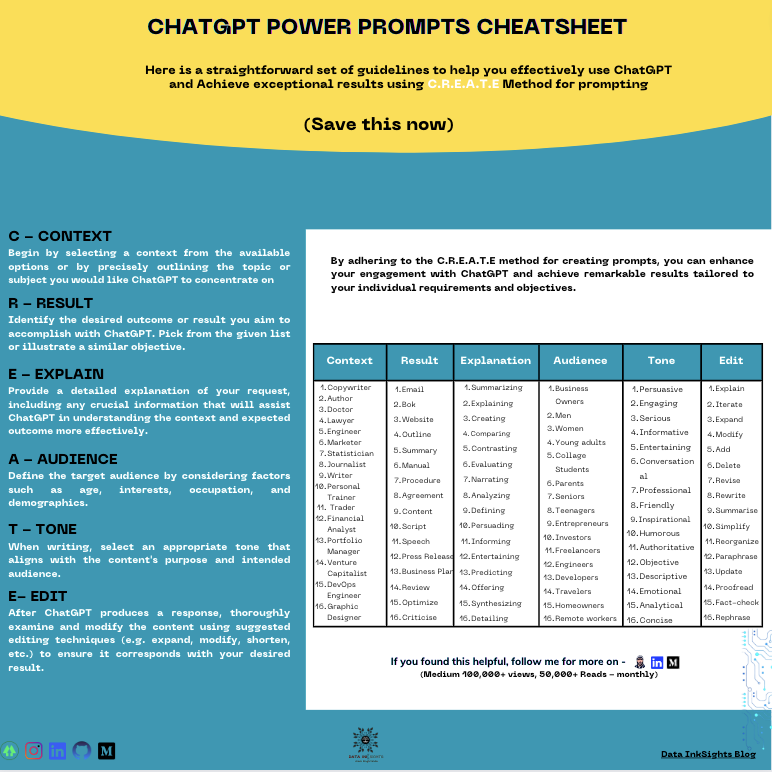
To help you navigate the complex world of prompt engineering and unlock the full potential of ChatGPT, I‘ve developed the C.R.E.A.T.E. framework, a comprehensive and structured approach to creating effective prompts.
1. Context
The first step in the C.R.E.A.T.E. framework is to establish the context for your prompt. This involves clearly defining the domain, subject matter, or specific focus area you want ChatGPT to address. By providing a clear context, you can help the language model understand the relevant information and tailor its responses accordingly.
For example, if you‘re a marketing professional looking to generate content for a social media campaign, your context might be "social media marketing." This would signal to ChatGPT that you‘re interested in responses related to that particular field, rather than, say, financial analysis or legal advice.
2. Result
The next step is to clearly define the desired outcome or result you aim to achieve with your prompt. This could be a specific type of content, such as a blog post, a product description, or a script for a video. Alternatively, it could be a desired action, such as summarizing key information, providing recommendations, or generating ideas.
By specifying the desired result, you‘re giving ChatGPT a clear target to work towards, ensuring that the responses it generates are aligned with your objectives.
3. Explain
Once you‘ve established the context and result, it‘s time to provide a detailed explanation of your request. This is where you can include any crucial information that will assist ChatGPT in understanding the task at hand and producing the desired output.
Your explanation might include details about the target audience, the tone you want to convey, the specific information you need, or any other relevant details that will help the language model tailor its response to your needs.
4. Audience
The fourth element of the C.R.E.A.T.E. framework is to define the target audience for your prompt. This involves considering factors such as age, interests, occupation, and demographics, as well as any specific needs or pain points they may have.
By understanding your audience, you can craft prompts that resonate more effectively, using language and content that speaks directly to their concerns and preferences.
5. Tone
The fifth step in the C.R.E.A.T.E. framework is to select an appropriate tone for your prompt. This could range from persuasive and engaging to informative and authoritative, depending on the context and desired result.
The tone you choose should align with the purpose of your prompt and the expectations of your target audience. For example, a prompt for a sales pitch might require a more persuasive tone, while a prompt for a technical manual might call for a more formal and informative approach.
6. Edit
The final step in the C.R.E.A.T.E. framework is to edit and refine your prompt based on the responses you receive from ChatGPT. This involves carefully examining the output, identifying areas for improvement, and making adjustments to ensure that the final result meets your desired objectives.
Editing might involve expanding on certain points, modifying the language to be more clear or concise, or even restructuring the prompt entirely to elicit more targeted and relevant responses.
By following the C.R.E.A.T.E. framework, you can craft prompts that consistently produce high-quality, relevant, and tailored responses from ChatGPT, unlocking the full potential of this powerful language model.
Advanced Prompt Engineering Techniques
While the C.R.E.A.T.E. framework provides a solid foundation for prompt engineering, there are additional techniques you can explore to further enhance your interactions with ChatGPT.
Prompt Chaining
Prompt chaining involves breaking down a complex task into a series of smaller, more manageable prompts. By guiding ChatGPT through a sequence of prompts, you can achieve more sophisticated and nuanced outputs.
For example, let‘s say you‘re a content creator looking to generate a blog post on the topic of sustainable fashion. Instead of providing a single, broad prompt, you could break it down into a series of steps:
- Prompt 1: "Provide an overview of the current state of the sustainable fashion industry, including key trends and challenges."
- Prompt 2: "Based on the industry overview, identify three specific sustainable fashion brands that are leading the way in innovation and environmentally-friendly practices."
- Prompt 3: "For each of the three brands identified, write a 200-word profile highlighting their unique approach to sustainability, their product offerings, and their impact on the industry."
- Prompt 4: "Synthesize the information from the brand profiles into a cohesive 1,000-word blog post, including an introduction, a conclusion, and appropriate transitions between sections."
By breaking down the task in this way, you‘re giving ChatGPT a clear roadmap to follow, allowing it to generate a more comprehensive and well-structured output.
Prompt Injection
Prompt injection allows you to incorporate specific instructions or constraints directly into the prompt, enabling you to tailor the language model‘s responses to your exact requirements.
For example, you might include the following instructions in your prompt: "Provide a 500-word product description for a new eco-friendly backpack, using a persuasive and engaging tone, and highlighting the product‘s sustainable materials and features."
By including these specific parameters, you‘re guiding ChatGPT to produce a response that aligns precisely with your needs, rather than relying on the model to interpret your intent.
Prompt Tuning
Prompt tuning involves iteratively refining and optimizing your prompts based on the language model‘s responses, gradually improving the quality and relevance of the outputs.
This process might involve experimenting with different phrasings, adding or removing specific details, or even introducing new constraints or instructions. By closely analyzing the responses you receive and making adjustments accordingly, you can hone your prompts to become increasingly effective over time.
Prompt tuning is particularly useful when working on complex or open-ended tasks, where the initial prompt may not fully capture the desired outcome. By continuously refining your approach, you can guide ChatGPT to produce more accurate, insightful, and tailored responses.
Practical Applications of ChatGPT Prompt Frameworks
The versatility of ChatGPT prompt frameworks extends across a wide range of domains, making them invaluable tools for individuals and businesses alike. Here are some practical applications:
Content Creation
Whether you‘re a writer, marketer, or content creator, prompt frameworks can help you streamline the content creation process, from ideation to final polishing. By crafting prompts that guide ChatGPT to generate high-quality, on-brand content, you can save time, improve consistency, and unlock new creative possibilities.
For example, a marketing professional might use prompt frameworks to generate social media captions, product descriptions, or even entire blog posts, tailoring the prompts to their specific needs and brand voice.
Task Automation
By leveraging prompt frameworks, you can automate a variety of tasks, such as email generation, data analysis, and even code writing, saving time and increasing productivity. This is particularly useful for repetitive or time-consuming tasks that don‘t require a high degree of human creativity or decision-making.
For instance, a financial analyst might use prompt frameworks to generate standardized report templates, summarize market data, or even draft investment recommendations, freeing up their time to focus on more strategic and analytical work.
Problem-Solving
ChatGPT can be a powerful ally in tackling complex problems, from business strategy to scientific research. Prompt frameworks can help you structure your inquiries and extract more insightful and actionable responses from the language model.
Imagine a team of engineers using prompt frameworks to explore potential solutions to a technical challenge, or a group of researchers leveraging ChatGPT to synthesize and analyze large datasets in their field of study. The possibilities are endless when it comes to harnessing the problem-solving capabilities of ChatGPT.
Education and Training
Prompt frameworks can be used in educational settings to enhance learning, facilitate discussions, and provide personalized feedback and support for students. Teachers and instructors can use ChatGPT to generate practice questions, provide explanations, and even offer customized learning plans based on individual student needs.
Moreover, prompt frameworks can be valuable tools for professional development and training, enabling individuals to explore new concepts, seek guidance, and engage in self-reflection and personal growth.
Personal Development
Individuals can use prompt frameworks to explore their own thoughts and ideas, engage in self-reflection, and even seek guidance on personal or professional challenges. By crafting prompts that tap into their unique perspectives and experiences, people can gain new insights, find inspiration, and unlock their full potential.
For example, someone might use prompt frameworks to generate journal entries, brainstorm career goals, or even explore creative writing projects, all while leveraging the power of ChatGPT to enhance their self-discovery and personal growth.
The possibilities are endless, and as you continue to explore and refine your prompt engineering skills, you‘ll discover new and innovative ways to leverage ChatGPT in your daily life and work.
The Future of Prompt Engineering and ChatGPT
As the field of artificial intelligence continues to evolve, the importance of prompt engineering will only grow. Language models like ChatGPT are poised to become increasingly sophisticated, capable of understanding and responding to more complex and nuanced prompts.
In the years to come, we can expect to see advancements in areas such as:
Prompt-based Task Learning
Researchers are exploring ways to enable language models to learn how to perform complex tasks directly from prompts, rather than relying on traditional training methods. This could lead to more versatile and adaptable AI systems that can quickly learn and apply new skills based on the prompts they receive.
Prompt-guided Content Generation
As language models become more adept at understanding context and generating coherent, human-like text, we‘ll likely see a rise in prompt-driven content creation. Users will be able to craft highly specific prompts to generate everything from marketing copy to creative fiction, with the language model handling the heavy lifting.
Prompt-driven Decision-making
In the realm of strategic planning and problem-solving, prompt frameworks could become invaluable tools for guiding language models to assist in decision-making processes. By structuring inquiries and constraints through prompts, users can leverage the analytical and reasoning capabilities of ChatGPT to explore options, evaluate trade-offs, and make more informed decisions.
Personalized Prompt Optimization
As language models become more attuned to individual user preferences and needs, we may see the emergence of personalized prompt optimization. ChatGPT and similar systems could adapt their responses based on a user‘s unique prompting style, past interactions, and desired outcomes, further enhancing the user experience and the relevance of the generated content.
By staying at the forefront of prompt engineering, you can position yourself and your organization to capitalize on the transformative potential of ChatGPT and other cutting-edge language models. Embrace the power of prompt frameworks, and unlock a world of possibilities.
Conclusion
In the dynamic landscape of artificial intelligence, the art of prompt engineering has emerged as a critical skill for effectively leveraging language models like ChatGPT. By mastering the C.R.E.A.T.E. framework and exploring advanced prompt engineering techniques, you can unlock the full potential of these remarkable tools, driving innovation, productivity, and problem-solving across a wide range of domains.
As you continue to explore and experiment with prompt frameworks, remember that the key to success lies in your ability to think creatively, adapt to changing circumstances, and continuously refine your approach. Embrace the challenge, stay curious, and let your imagination soar. The future of AI is in your hands, and the possibilities are truly limitless.
So, what are you waiting for? Start crafting your prompts, unleash the power of ChatGPT, and watch as your ideas and projects come to life in ways you never thought possible. The world of AI is yours to shape, and the future is ours to create.