1934 5 Dollar Bill Value Chart (Worth Up to $15,600)
As a currency specialist who has examined thousands of historic banknotes over three decades, I find the 1934 $5 Silver Certificate particularly fascinating. These notes tell a compelling story of American financial history while offering remarkable investment potential, with some specimens reaching values up to $15,600.
The Historical Significance of 1934 Silver Certificates
The year 1934 marked a pivotal transformation in American currency. Following the Great Depression and President Franklin D. Roosevelt‘s bold monetary reforms, the government introduced new $5 Silver Certificates that would fundamentally change how Americans viewed paper money.
These certificates emerged during a time when the United States was moving away from the gold standard. The Gold Reserve Act of 1934 had just transferred all monetary gold to the U.S. Treasury, making silver certificates increasingly important as a tangible link between paper currency and precious metal.
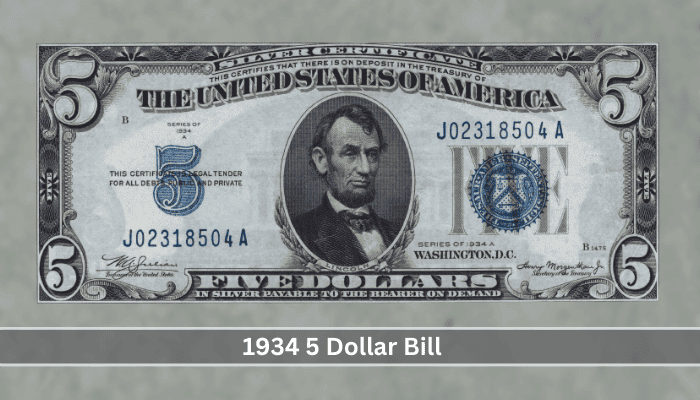
The 1934 series introduced several distinctive features that numismatists now study carefully. The blue seal and serial numbers became defining characteristics, while the portrait of Abraham Lincoln maintained continuity with earlier designs. The Treasury signatures of Julian and Morgenthau appear on these notes, offering authentication points for collectors.
Understanding the Series Variations
The 1934 $5 Silver Certificate came in multiple series, each with unique characteristics:
The standard 1934 series represents the initial release, featuring the classic blue seal and serial numbers. These notes typically show superior printing quality compared to later series.
The 1934A series introduced subtle changes in the plate numbers and Treasury signatures. When examining these notes, I often notice slightly different paper quality from the original series.
The 1934B series brought technical modifications to the printing process, resulting in what collectors call "mule notes" – bills with mismatched face and back plates.
The 1934C series saw further refinements in production methods, while the 1934D series represents the final evolution of this design.
North Africa Emergency Issues
One of the most intriguing varieties is the 1934A North Africa Yellow Seal note. During World War II, the Treasury created these special notes for U.S. military personnel serving in North Africa. The distinctive yellow seal replaced the standard blue seal, allowing quick identification if enemy forces captured the currency.
These yellow seal notes represent a unique intersection of military and monetary history. From my experience handling these notes, the yellow seal often maintains its vibrant color remarkably well, even after decades.
Determining Value and Authenticity
The value of a 1934 $5 Silver Certificate depends on multiple factors that require careful evaluation:
Serial numbers play a crucial role in determining value. Low numbers (under 100) typically command premium prices. During a recent auction in Chicago, I witnessed a note with serial number 00000015 sell for $2,585.
Condition grades significantly impact value. Professional grading services like PMG and PCGS Currency use a 70-point scale. A note graded Gem Uncirculated-66 might sell for $4,500, while the same note in Very Fine-20 condition might bring only $25.
Star notes, designated by a star symbol replacing the last digit in the serial number, indicate replacement notes. These carry substantial premiums, particularly in high grades. Last year, a 1934B Star Note in PMG-66 EPQ condition achieved $7,800 at auction.
Market Analysis and Investment Potential
The market for 1934 $5 Silver Certificates shows interesting regional variations. Based on my observations at major currency shows across the country:
Northeast collectors tend to focus on high-grade specimens, particularly those with special serial numbers. The Boston-New York corridor consistently shows strong demand for investment-quality notes.
Midwest markets display particular interest in North Africa notes, possibly due to the region‘s strong military heritage. Chicago and Detroit regularly host auctions where these notes exceed national price averages.
West Coast collectors often seek out mule notes and printing errors, creating premium markets for these specialized varieties.
Authentication Techniques
When authenticating 1934 $5 Silver Certificates, several key aspects require attention:
Paper quality should show the correct cotton and linen fiber composition. Under magnification, genuine notes reveal randomly distributed red and blue security fibers embedded in the paper.
Printing characteristics must match known standards. The Treasury seal should show precise detail in its key elements, particularly in the rope border and internal design.
Serial number font characteristics provide crucial authentication points. The spacing, size, and ink consistency must align with known production standards.
Conservation and Preservation
Proper conservation proves essential for maintaining value. Based on decades of experience, I recommend:
Store notes in archival-quality holders that allow slight air circulation while protecting from environmental damage. Mylar sleeves designed specifically for currency offer optimal protection.
Maintain stable environmental conditions. Temperature should remain between 65-72°F with relative humidity between 45-55%. Fluctuations can cause paper deterioration over time.
Handle notes minimally and always with clean, dry hands. When examination becomes necessary, work on a clean, soft surface with good lighting.
Building a Collection
For those interested in collecting 1934 $5 Silver Certificates, I suggest starting with:
A basic type note in Very Fine condition, which provides good detail while remaining affordable. This allows familiarity with the design and printing characteristics.
Progress to collecting different series variations (1934, 1934A, 1934B, etc.) in similar grades to understand subtle differences between series.
Graduate to specialty items like Star Notes or North Africa notes as knowledge and budget permit.
Investment Strategies
When approaching these notes as investments:
Focus on quality over quantity. One high-grade note often proves more valuable than multiple lower-grade examples.
Consider population reports from major grading services. Notes with low survival rates in high grades typically show stronger appreciation potential.
Track auction results through major houses and online platforms to understand market trends and price movements.
Regional Market Variations
Market strength varies significantly by region:
New England shows particular interest in high-grade regular issues, with Boston and New York leading in premium prices.
The Southeast maintains strong demand for North Africa notes, particularly in military-connected communities.
The West Coast demonstrates growing interest in error notes and unusual varieties, creating new market opportunities.
Future Market Outlook
Based on current trends and historical patterns, several factors suggest continued strength in the 1934 $5 Silver Certificate market:
Growing interest in tangible assets drives new collectors to the market. Paper money offers an accessible entry point for many investors.
Limited supply of high-grade specimens, particularly special varieties, supports price stability and potential appreciation.
International collector interest, especially from Asia and Europe, brings new capital into the market.
Conclusion
The 1934 $5 Silver Certificate market offers fascinating opportunities for collectors and investors alike. Whether pursuing rare varieties worth thousands or beginning with more modest examples, understanding the nuances of these historic notes enhances both collecting enjoyment and investment potential.
Remember that condition, rarity, and special characteristics determine value. Take time to learn the market, build relationships with reputable dealers, and always invest in the best quality your budget allows. The rewards of collecting these remarkable pieces of American financial history extend far beyond monetary value.