4 Most Valuable Antique Typewriters: Inside the $110,000+ Market for Mechanical Treasures
The gentle percussion of metal striking paper, the satisfying ding of a carriage return, and the distinctive aroma of ink ribbons – these sensory experiences transport collectors back to an era when typewriters represented the pinnacle of written communication technology. As an antique typewriter collector and expert with over 25 years in the field, I‘ve witnessed these mechanical marvels transform from obsolete office equipment into highly sought-after collectibles, with the rarest examples commanding prices exceeding $110,000.
The Evolution of the Antique Typewriter Market
The market for antique typewriters has undergone a remarkable transformation since the early 2000s. What began as a niche collecting field dominated by technology historians and mechanical enthusiasts has blossomed into a sophisticated market drawing investors, museums, and passionate collectors worldwide.
This surge in interest stems from several factors. First, these machines represent incredible feats of mechanical engineering, with many featuring innovations that influenced modern keyboard design. Second, they carry profound historical significance as tools that revolutionized business communication and opened new professional opportunities, particularly for women entering the workforce. Third, many early typewriters showcase extraordinary Victorian-era craftsmanship, with hand-painted decorations and ornate metalwork that transcend their utilitarian purpose.
Market Analysis: Current Valuations and Trends
Recent auction data reveals fascinating patterns in the antique typewriter market. Premium examples from the 1870s-1890s have seen average value increases of 35% since 2019. European manufacturers, particularly German and Danish models, typically command 20-40% higher prices than their American counterparts due to their limited production numbers and superior mechanical refinement.
The highest values cluster around machines that combine historical significance, mechanical innovation, and exceptional preservation. Documented provenance, original finish, and complete functionality can double or triple a typewriter‘s market value. This premium on originality reflects collectors‘ growing sophistication and preference for unrestored examples that maintain their historical integrity.
The Four Most Valuable Antique Typewriters
1. Rasmus Malling-Hansen Writing Ball (1870)
The Writing Ball stands as the crown jewel of antique typewriter collecting, with a recent example selling for an astounding $110,059 in 2019. This remarkable machine represents the first commercially produced typewriter, predating the more familiar Sholes & Glidden by several years.
Reverend Rasmus Malling-Hansen, a Danish inventor and educator, created this revolutionary device while serving as principal at Copenhagen‘s Royal Institute for the Deaf and Dumb. His innovative design featured 52 keys arranged on a brass sphere, with each key mounted on a spring-loaded piston that struck downward toward a central printing point.
Of the 180 Writing Balls manufactured, only 34 survive today. Thirty reside in museums worldwide, while four remain in private collections. This extreme rarity, combined with the machine‘s historical significance and innovative engineering, makes it the most valuable typewriter in existence.
Authentication requires extensive documentation, as several modern replicas exist. Key verification points include the brass serial number plate, period-correct materials analysis, and manufacturing technique examination. The electromagnetic components in later models must match known factory specifications.
2. Sholes and Glidden/Remington No.1 (1874)
The Sholes and Glidden typewriter, marketed as the Remington No.1, marks a pivotal moment in business history. This machine introduced the QWERTY keyboard layout – a design that persists on modern devices nearly 150 years later. A pristine example sold for $29,900 in 2014, reflecting its historical importance.
Christopher Latham Sholes developed the QWERTY layout to prevent key jamming by separating frequently used letter pairs. While this arrangement actually slowed typing speed, it proved so effective at preventing mechanical issues that it became the global standard.
Early examples feature elaborate Victorian decoration, including hand-painted flowers, gold pinstriping, and decorative decals. These ornate elements reflect the machine‘s initial marketing as a luxury item for wealthy businesses and individuals. The Remington No.1‘s success established the basic form that typewriters would follow for the next century.
3. Crandall New Model (1886)
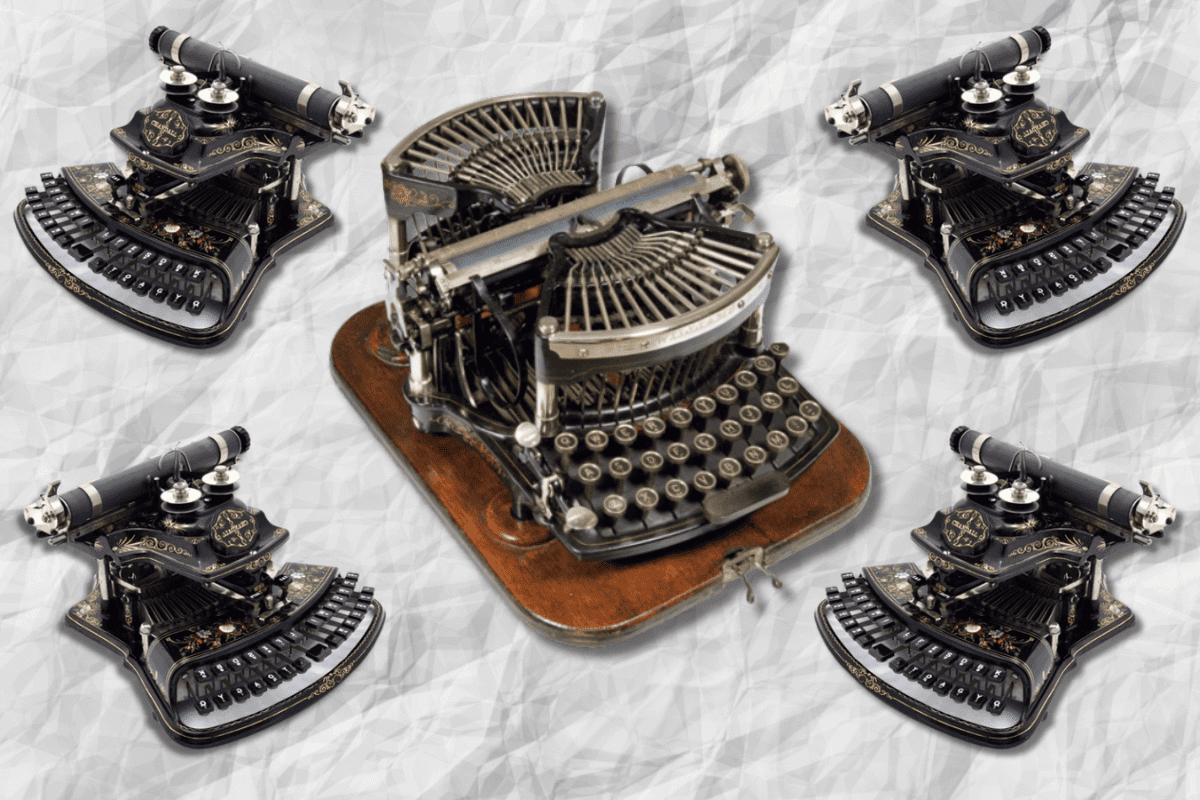
The Crandall New Model represents the perfect marriage of functionality and artistry. Recent sales have reached $4,000 for exceptional examples, with prices trending upward as collectors recognize its significance.
Each machine required over 40 hours of hand-decoration, featuring mother-of-pearl inlays, delicate rose patterns, and gold leaf accents. Beyond its aesthetic appeal, the Crandall introduced several technical innovations, including proportional spacing and interchangeable type-sleeves for different fonts and languages.
The two-level keyboard and visible typing mechanism solved common complaints about earlier designs. The type-sleeve system proved particularly revolutionary, allowing quick font changes decades before other manufacturers offered similar capabilities.
4. Williams 1 (1891)
The Williams 1, which recently sold for $1,450, earned its nickname "The Rightwriter" through innovative engineering that solved the persistent problem of visible typing. Its grasshopper action mechanism allowed typists to see their work immediately, a significant advantage over competitors.
The direct inking system and ergonomic keyboard layout delivered superior performance, while the robust construction ensured many examples survive in working condition today. The Williams 1 represents an excellent entry point for serious collectors, combining historical significance with relative affordability.
Authentication and Preservation Techniques
Proper authentication requires extensive knowledge of period-correct materials, manufacturing techniques, and historical documentation. Key verification points include:
Serial number documentation must match factory records, when available. Material analysis should confirm period-appropriate metals, finishes, and decorative elements. Manufacturing techniques must align with known factory practices for the era.
Conservation demands careful attention to environmental conditions. Maintain temperature between 65-70°F and relative humidity at 45-55%. Protect machines from direct sunlight and UV exposure, which can damage rubber components and fade decorative elements.
Clean only with appropriate methods: dry brush cleaning for dust, specialized solvents for stubborn deposits, and professional restoration when necessary. Never use modern lubricants or harsh chemicals, which can damage original finishes and mechanical components.
Investment Considerations and Market Dynamics
The antique typewriter market shows strong investment potential, with premium examples appreciating 8-12% annually over the past decade. However, successful collecting requires understanding several key factors:
Condition impacts value exponentially – machines in original, working condition command significant premiums over restored examples. Documented provenance can increase value 25-40%, particularly for rare models or those with interesting historical connections.
Regional variations affect both availability and pricing. European machines typically bring higher prices in their home markets but may represent excellent value for international collectors. Asian markets show increasing interest, particularly in decorative Victorian-era machines.
Future Market Outlook and Collecting Recommendations
The antique typewriter market continues to evolve, driven by several factors:
Rising interest from younger collectors attracted to mechanical devices and analog technology. Limited supply of premium examples, particularly pre-1890 machines. Growing appreciation for mechanical craftsmanship in an increasingly digital world.
For beginning collectors, focus on later models (1900-1920) from major manufacturers. These machines offer historical significance and mechanical interest at more accessible price points. Build relationships with reputable dealers and join collector organizations to access better examples.
Advanced collectors should target pre-1890 examples, particularly those with original finish and documentation. Consider European manufacturers, which often combined superior engineering with exceptional decorative elements. Invest in professional restoration only when necessary, as original condition commands significant premiums.
Conclusion
The antique typewriter market offers fascinating opportunities for collectors and investors alike. These machines combine historical significance, mechanical innovation, and artistic beauty in uniquely compelling ways. Whether you‘re drawn to their historical importance, mechanical ingenuity, or decorative appeal, antique typewriters provide tangible connections to a transformative period in communication history.
As market appreciation continues and premium examples become increasingly scarce, careful authentication and preservation grow ever more important. By understanding market dynamics, focusing on quality, and maintaining proper conservation standards, collectors can build significant collections while preserving these remarkable machines for future generations.