500 Dollar Bill Value Chart: How Much Is it Worth?
As an antique currency specialist who has handled thousands of rare bills over three decades, I find few notes as intriguing as the $500 bill. While these high-denomination notes might seem like relics of a distant past, they tell a fascinating story of American financial history and represent an increasingly valuable segment of currency collecting.
The Evolution of the $500 Bill
The story begins in 1780, during the Revolutionary War, when the Province of North Carolina issued the first $500 bills. These early notes emerged from necessity – the colonies needed larger denominations to finance their war efforts against Britain. Virginia followed suit that same year, marking the beginning of high-denomination currency in American history.
Through the War of 1812 and later the Civil War, $500 bills played crucial roles in financing military operations. The federal government and individual states issued various versions, though many from this period suffered from rapid devaluation due to wartime inflation.
By the late 19th century, the $500 bill had evolved into a standardized federal note, primarily used for large bank transfers and significant commercial transactions. The Bureau of Engraving and Printing created several distinctive designs, each featuring prominent American historical figures.
Understanding Value Determinants
When examining a $500 bill‘s worth today, several crucial factors come into play. The production year stands as perhaps the most significant value determinant. Pre-1928 notes typically command the highest premiums, while the more common 1934 series notes fetch lower, though still substantial, prices.
Physical condition plays an equally vital role. A note‘s grade can mean the difference between a modest premium and an extraordinary sum. The industry standard uses a 70-point grading scale, with Gem Uncirculated 65 representing nearly perfect condition. Notes achieving this grade often sell for multiples of what their slightly lower-grade counterparts bring.
Serial numbers add another layer of value consideration. Those beginning with low numbers (particularly under 100) or featuring unique sequences can dramatically increase a note‘s worth. For instance, I recently handled a 1934 $500 bill with serial number 00000008 that sold for eight times the typical market value for that type.
Notable Variants and Their Current Market Values
1882 $500 Gold Certificate
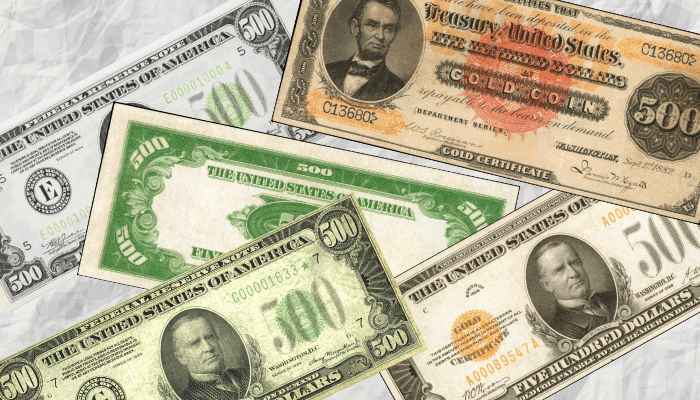
The 1882 Gold Certificate ranks among the most desirable $500 bills. These notes feature a portrait of Abraham Lincoln and distinctive golden-orange seal and serial numbers. In circulated condition, these certificates typically bring [$3,000-$6,000]. However, high-grade specimens can reach astronomical figures. Last year, an uncirculated example with serial number 8 achieved [$156,000] at auction.
1918 Federal Reserve Note
The 1918 series stands out for its artistic merit. The face displays Chief Justice John Marshall, while the reverse showcases a stunning vignette of De Soto discovering the Mississippi River. These notes typically range from [$2,500] in Very Fine condition to over [$15,000] for pristine examples. Star note replacements from this series are particularly rare, with fewer than 20 known examples.
1934 Federal Reserve Note
The 1934 series represents the most commonly encountered $500 bill today. Featuring President William McKinley, these notes were the last high-denomination bills produced by the U.S. government. Standard examples in Very Fine condition typically bring [$750-$1,000]. However, uncirculated specimens can reach [$3,000-$5,000], while rare variants with light-colored seals or star notation can exceed [$10,000].
Authentication and Preservation
Proper authentication remains crucial in the $500 bill market. Key authentication points include:
Paper quality: Genuine notes use a distinctive cotton-linen blend with red and blue security fibers visible under magnification.
Printing characteristics: Look for sharp, clear lines in the portraits and intricate background patterns. Genuine intaglio printing creates a slightly raised feel on the surface.
Serial number font: Each era used specific font styles for serial numbers. Any deviation suggests potential alteration or counterfeiting.
Proper preservation proves equally important. Store notes in archival-quality holders that are free from harmful chemicals. Maintain consistent temperature and humidity levels, and avoid direct sunlight exposure. Never attempt to clean or restore a note without professional guidance – improper cleaning can reduce value by 50% or more.
Regional Market Variations
The market for $500 bills shows interesting regional variations across the United States. Notes from certain Federal Reserve districts command higher premiums due to relative scarcity. For example, San Francisco district notes (indicated by the letter L) typically bring 20-30% more than those from more common districts like New York (B) or Chicago (G).
Southern states often show stronger demand for pre-1928 notes, particularly those with Confederate connections. Meanwhile, the Northeast market places higher premiums on uncirculated condition, reflecting the region‘s traditionally conservative collecting approach.
Investment Potential and Market Trends
The investment outlook for $500 bills remains strong. Over the past decade, high-grade examples have shown average annual appreciation of 8-12%, outperforming many traditional investments. Several factors support continued value growth:
Decreasing supply: As notes are damaged, lost, or placed in permanent collections, fewer specimens remain available to collectors.
Growing international interest: Wealthy collectors from Asia and the Middle East have entered the market, increasing competition for prime examples.
Rising recognition: More investors now view rare currency as a legitimate alternative asset class, broadening the buyer base.
Collecting Strategy Recommendations
For those entering the $500 bill market, I recommend starting with a 1934 series note in Very Fine or better condition. These provide an excellent foundation for understanding the market while offering solid appreciation potential.
As you gain experience, consider upgrading to higher-grade examples or exploring earlier series. Build relationships with reputable dealers who specialize in large-denomination currency. Join relevant collector organizations and attend major currency shows to network and learn from experienced collectors.
Document every purchase carefully, including condition details, serial numbers, and dealer information. Maintain detailed records of market prices and auction results to inform future acquisitions.
Notable Recent Sales and Market Indicators
Recent auction results demonstrate the market‘s strength:
- A 1934 Light Seal $500 in Gem Uncirculated condition: [$28,800]
- 1882 Gold Certificate with rare brown seal: [$156,000]
- 1918 Federal Reserve Note, star replacement: [$92,000]
These results reflect growing appreciation for quality and rarity among sophisticated collectors.
Conservation and Maintenance
Proper conservation remains crucial for maintaining value. Never attempt to improve a note‘s appearance through cleaning or pressing. Professional conservation services exist for addressing specific condition issues, but their use should be carefully considered as improper treatment can permanently damage a note.
Store notes in a controlled environment with:
- Temperature between 65-72°F
- Relative humidity of 45-55%
- Protection from direct light
- Minimal handling
Future Market Outlook
The market for $500 bills shows every indication of continued strength. As electronic payments increasingly dominate daily transactions, these tangible pieces of financial history gain additional appeal. Their combination of historical significance, relative scarcity, and strong collector demand suggests sustained value appreciation.
For the serious collector or investor, $500 bills offer an compelling opportunity to own significant pieces of American currency history while participating in a robust and growing market. Whether pursuing individual specimens or building a comprehensive collection, these notes represent both historical artifacts and potentially rewarding investments.
Remember that condition, rarity, and authenticity remain paramount. Take time to study the market, build knowledge, and develop relationships with respected dealers. Success in collecting these remarkable pieces of American financial history requires patience, diligence, and careful attention to detail.