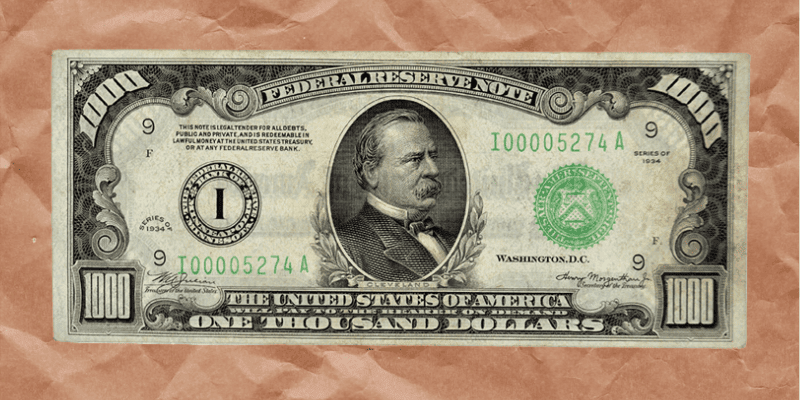
Is There a 1000 Dollar Bill? And How Much Is it Worth Today
As I hold a genuine 1934 $1000 Federal Reserve Note in my hands, the weight of history feels tangible. After three decades as a specialized currency collector and authenticator, these rare pieces still fill me with wonder. The question "Is there a 1000 dollar bill?" brings us to one of the most fascinating chapters in American monetary history.
The Birth of the $1000 Bill
The story begins in the midst of the American Revolution, when the Continental Congress faced the monumental task of funding a war against the British Empire. In 1778, the first $1000 bills emerged as a desperate measure to finance the revolutionary cause. These earliest notes, lacking precious metal backing, represented more hope than actual value. The harsh reality of wartime inflation quickly diminished their worth, leading to the famous phrase "not worth a Continental."
Following the Revolutionary period, the young nation learned valuable lessons about currency stability. The next chapter in the $1000 bill‘s history wouldn‘t unfold until another defining moment in American history – the Civil War. In 1862, the Legal Tender Act authorized new $1000 notes, this time with proper government backing. These Civil War-era notes marked the first truly stable high-denomination currency in American history.
The Federal Reserve Era Transforms the $1000 Bill
The early 20th century brought significant changes to American currency. The establishment of the Federal Reserve System in 1913 led to a new generation of $1000 bills. The 1918 Federal Reserve Notes introduced a design featuring Alexander Hamilton, though these saw limited public circulation. Most 1918 series notes moved between banks rather than reaching ordinary citizens.
The 1928 series brought perhaps the most recognized version of the $1000 bill, featuring President Grover Cleveland‘s portrait. This design would persist through the 1934 series, which would prove to be the final iteration of the $1000 bill. Production officially ceased in 1945, though the Treasury didn‘t officially discontinue high-denomination notes until 1969.
Design Elements and Security Features
The artistry of these notes deserves special attention. The 1934 series, which I‘ve examined countless times, demonstrates remarkable craftsmanship. The portrait of Cleveland shows exceptional detail, with fine line work that made counterfeiting extremely difficult. The reverse features intricate geometric patterns and detailed scrollwork, hallmarks of American currency design.
Security features included:
- Distinctive cotton-linen paper with red and blue security fibers
- Precise intaglio printing creating raised ink surfaces
- Serial numbers with specific font characteristics
- Federal Reserve District identifiers
- Treasury seals varying by series
Current Market Values and Investment Potential
Today‘s market for $1000 bills shows remarkable strength and stability. Standard 1934 notes in Very Fine condition typically command $3,500 to $4,500, while earlier series fetch substantially more. The 1928 series, particularly those with gold certificates, can reach $25,000 to $100,000 for exceptional examples.
Recent notable sales include a remarkable 1890 Treasury Note that achieved $2,040,000 at auction – a testament to the extraordinary value these pieces can achieve. Even more modest examples continue to appreciate steadily, with average annual returns of 8-12% over the past decade.
Authentication: A Critical Skill
Authentication requires meticulous attention to detail. When examining a $1000 bill, I first study the paper quality under proper lighting. Genuine notes possess a distinct texture and weight that‘s difficult to replicate. The printing quality reveals much about authenticity – genuine notes show precise line work, especially in the portrait‘s fine details.
Serial numbers tell their own story. Each series used specific font characteristics and spacing. Under magnification, authentic notes reveal micro-printing that counterfeiters often fail to reproduce accurately. The color and chemical composition of the inks also provide important authentication clues.
Preservation and Collection Management
Proper preservation ensures these valuable pieces maintain their condition and value. Store notes in archival-quality currency holders that prevent harmful chemical reactions. Temperature and humidity control prove crucial – I recommend maintaining a stable environment between 68-72°F with 45-50% relative humidity.
Handle notes only when necessary, using clean, cotton gloves. Keep detailed records of acquisition dates, prices, and condition changes. Photography helps document condition over time and proves valuable for insurance purposes.
Regional Market Variations
The market for $1000 bills shows interesting geographic patterns. Northeast collectors typically pay premium prices, particularly in New York and Boston. The West Coast market centers around San Francisco and Los Angeles, with strong auction presence. Midwest collectors show growing interest, while the Southeast market continues to develop.
Investment Considerations
For those considering $1000 bills as investments, several factors warrant attention. Rarity continues to increase as specimens enter permanent collections or suffer damage. International interest grows steadily, particularly from Asian markets. Institutional buyers, including museums and private foundations, compete for premium examples.
Collecting Guidelines for Newcomers
If you‘re entering this fascinating field, start with well-documented specimens from reputable dealers. Focus initially on 1934 series notes, which offer the best balance of availability and value. Always obtain third-party grading from recognized services like PMG or PCGS Currency.
Legal Status and Banking Regulations
While $1000 bills remain legal tender, banks must report them to the Federal Reserve. Most financial institutions forward any received specimens to the Federal Reserve for retirement. This practice continues to reduce the available supply, though the notes retain their legal tender status.
Future Market Outlook
Several factors suggest continued market strength for $1000 bills. The fixed supply diminishes yearly as notes deteriorate or enter permanent collections. Demand grows as new collectors enter the market, particularly from international sources. Historical significance and artistic merit attract both collectors and investors.
Personal Collecting Insights
Throughout my career, I‘ve witnessed countless fascinating transactions and discoveries. Recently, a client brought in a 1928 gold certificate found in an old family Bible – a $75,000 discovery that had sat unnoticed for decades. These moments remind us that important specimens still surface regularly.
Conservation and Restoration
When dealing with damaged notes, conservation requires careful consideration. Minor repairs can stabilize deterioration, but improper restoration diminishes both historical and monetary value. Always consult qualified conservation experts before attempting any restoration work.
The $1000 bill represents more than just currency – it embodies American financial history, artistry, and cultural heritage. Whether you‘re a serious collector, investor, or simply fascinated by these remarkable pieces of history, understanding their story enriches appreciation for these extraordinary notes. As supplies continue to diminish and interest grows, these notes remain both historical treasures and sound investments.