Most Valuable 1945 Quarter Worth Money (Rarest Sold for $20,400)
A 1945 Washington Quarter might look ordinary at first glance, but these silver coins tell a remarkable story of American resilience during World War II‘s final year. While most circulated examples trade for modest sums, exceptional specimens have sold for over $20,000 at auction. As an antique coin specialist with 25 years of experience, I‘ll guide you through everything you need to know about these fascinating pieces of history.
Historical Significance of the 1945 Quarter
The year 1945 marked a pivotal moment in American history as World War II drew to a close. The U.S. Mint faced unique challenges during this period, operating with reduced staff while maintaining coin production for both military and civilian needs. The silver used in these quarters often came from reclaimed sources, including melted-down foreign coins acquired through the Lend-Lease program.
The Philadelphia Mint produced 74,372,000 quarters that year, while Denver contributed 12,341,600 and San Francisco added 17,004,001 to the total. These numbers might seem substantial, but they represent a significant reduction from pre-war production levels. The decreased mintage, combined with the historical significance of 1945, makes these quarters particularly interesting to collectors today.
Design Elements and Artistic Merit
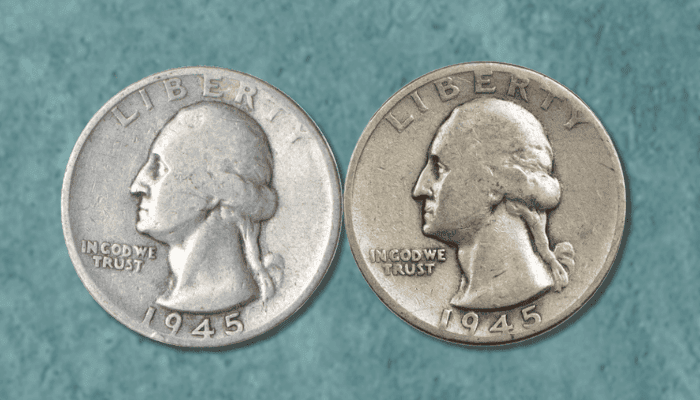
John Flanagan‘s portrait of George Washington on the obverse remains one of the most enduring designs in American coinage. The 1945 quarters showcase this artwork at a time when the Mint still maintained high striking standards despite wartime constraints. The obverse features Washington‘s left-facing profile, with "LIBERTY" above and the date below. The motto "IN GOD WE TRUST" appears to the left of Washington‘s neck.
The reverse design displays a majestic eagle with wings spread, perched atop a bundle of arrows intertwined with an olive branch – symbols representing America‘s readiness for both war and peace. The words "UNITED STATES OF AMERICA" arch above, while "QUARTER DOLLAR" appears below. The Latin phrase "E PLURIBUS UNUM" fills the space above the eagle.
Mint Varieties and Characteristics
Each mint facility produced quarters with distinct characteristics that collectors should understand:
Philadelphia Mint quarters (no mint mark) typically show the strongest strikes of the year. The detail in Washington‘s hair and the eagle‘s feathers tends to be sharp and well-defined. These coins often exhibit excellent luster when uncirculated, with a cartwheel effect that numismatists prize.
Denver Mint quarters (D mint mark) are particularly noteworthy for their superior striking quality in 1945. The mint mark appears on the reverse, below the wreath. Denver coins from this year often show remarkable detail preservation, even in higher mint state grades.
San Francisco Mint quarters (S mint mark) sometimes display slightly softer strikes than their Philadelphia or Denver counterparts. However, they often compensate with exceptional luster and eye appeal. The S mint mark can be found in the same position as the D on Denver issues.
Grading and Value Analysis
Understanding grade-specific values helps collectors make informed decisions. In circulated grades (Good-4 through Very Fine-20), 1945 quarters typically command $5-15, primarily based on their silver content. However, the value progression in mint state grades tells a fascinating story:
MS-60 through MS-63 examples bring $45-150, depending on mint mark and eye appeal. At MS-65, prices jump significantly to $175-300, reflecting the scarcity of gems. The real premium begins at MS-67, where prices range from $3,500 to $7,200. The finest known examples, graded MS-68, have realized astronomical prices:
- A 1945-D MS-68 quarter sold for $20,400 at Stack‘s Bowers in 2021
- A 1945 Philadelphia MS-68 brought $16,450 at Heritage Auctions
- A 1945-S MS-67+ achieved $7,200 in a 2020 auction
Authentication and Counterfeit Detection
With high-value examples commanding premium prices, authentication becomes crucial. Here are the key points to verify:
The weight must be exactly 6.25 grams, and the diameter should measure 24.3mm. The silver content should test at 90% pure. The reeded edge must contain exactly 119 reeds – a detail often overlooked by counterfeiters.
Surface texture provides important authentication clues. Genuine 1945 quarters display flow lines characteristic of silver coins struck under high pressure. Under magnification, the fields should show natural mint luster without artificial enhancement.
Investment Potential and Market Trends
The market for premium 1945 quarters has shown remarkable strength over the past decade. Population reports indicate fewer than 100 examples graded MS-67 or higher across all three mints combined. This scarcity, coupled with growing collector interest in World War II-era coins, suggests continued appreciation potential.
Investment-grade specimens in MS-65 and above have appreciated approximately 150% since 2010. Even circulated examples maintain stable value due to their silver content, providing a price floor that protects against significant downside risk.
Conservation and Preservation
Proper storage and handling make a crucial difference in maintaining value. Store your 1945 quarters in inert holders that don‘t contain PVC or other harmful plasticizers. Handle coins only by their edges, wearing cotton gloves when possible.
Climate control plays a vital role – maintain constant temperature and humidity levels to prevent environmental damage. For investment-grade pieces, consider professional conservation only when absolutely necessary, and always work with recognized experts.
Regional Market Variations
Market strength varies significantly by region. Northeast collectors typically focus on highest-grade examples, while West Coast buyers show particular interest in San Francisco mint issues. The Midwest market remains strong for circulated examples, particularly those with original toning.
Southern states have seen growing interest in 1945 quarters as part of complete World War II-era sets. International markets, particularly in Canada and the United Kingdom, demonstrate increasing demand for premium examples.
Building a Collection
For collectors beginning to focus on 1945 quarters, I recommend starting with a circulated example from each mint. This provides a foundation for understanding strike characteristics and wear patterns. As your knowledge grows, consider acquiring mint state examples in the MS-63 to MS-65 range, where value opportunities still exist.
Advanced collectors might focus on assembling a matched set in MS-66 or better, though this requires patience and substantial resources. Whatever your collecting goals, take time to study authentication points and grade characteristics before making significant purchases.
Final Thoughts
The 1945 Washington Quarter represents more than just a coin – it‘s a tangible connection to one of the most significant years in American history. Whether you‘re drawn to its historical significance, investment potential, or numismatic interest, these coins offer something for every collector. Remember to purchase from reputable dealers, verify authenticity, and always prioritize quality within your budget. With proper research and patience, you can build a meaningful collection of these fascinating pieces of American history.