Most Valuable 1972 Lincoln Penny Worth Money (Rarest Sold For $14,400)
When examining your pocket change, a 1972 Lincoln penny might seem unremarkable at first glance. However, as an antique coin specialist with over two decades of experience, I can tell you that some of these pennies hold extraordinary value, with the rarest examples selling for tens of thousands of dollars. The most notable sale reached an impressive $14,400 at auction, highlighting just how valuable these seemingly common coins can become.
The Historical Significance of the 1972 Penny
The year 1972 marked a significant period in American coinage. These pennies were produced during a time when the United States Mint still used a 95% copper composition, making them among the last of their kind before the transition to zinc-based cents in 1982. The rising copper prices during this era would eventually force this change, but not before creating some of the most interesting varieties in modern American numismatics.
The Philadelphia Mint produced 2,933,255,000 pennies without mint marks, while Denver contributed 2,665,071,440 pieces marked with ‘D‘, and San Francisco added 376,939,108 coins with ‘S‘ mint marks. Additionally, San Francisco produced 3,260,996 proof specimens for collectors. These numbers might suggest the coins are common, but certain varieties and conditions make some 1972 pennies extraordinarily valuable.
Understanding the 1972 Penny‘s Physical Characteristics
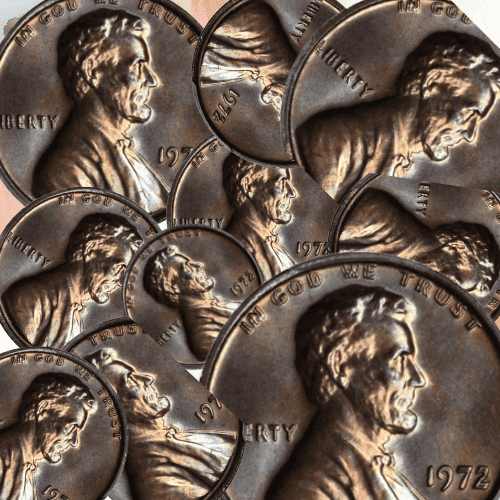
Each 1972 penny weighs precisely 3.11 grams and measures 19.05 millimeters in diameter. The obverse features Victor D. Brenner‘s iconic portrait of Abraham Lincoln, while the reverse displays Frank Gasparro‘s rendering of the Lincoln Memorial. The composition consists of 95% copper and 5% zinc and tin, giving these coins their distinctive reddish-brown color when newly minted.
The Most Valuable Varieties
Double Die Obverse (DDO) FS-101
The crown jewel of 1972 penny varieties is the Double Die Obverse FS-101. This dramatic error shows significant doubling on all obverse lettering and the date. In June 2019, a specimen graded MS67+ Red by PCGS achieved the record price of $14,400 at auction. This variety consistently commands premium prices:
- Mint State 67+ Red specimens: [$8,000-$14,400]
- Mint State 66 Red examples: [$1,300-$1,700]
- Mint State 65 Red pieces: [$850-$900]
Regular Strike Philadelphia Mint
Non-error Philadelphia issues can still bring significant premiums in top grades:
- MS67 Red specimens: [$250-$3,500]
- MS66 Red examples: [$25-$60]
- MS65 Red pieces: [$16-$18]
Denver Mint (D)
The Denver Mint products show interesting value patterns:
- MS67 Red specimens have sold for [$550-$4,250]
- MS66 Red examples typically bring [$30-$50]
- MS65 Red pieces command [$16-$20]
San Francisco Mint (S)
Regular San Francisco issues show strong premium potential:
- MS67 Red specimens: [$185-$1,955]
- MS66 Red examples: [$32-$65]
- MS65 Red pieces: [$16-$18]
Authentication and Grading Insights
From my years of experience examining these coins, proper authentication requires careful attention to specific details. When authenticating a 1972 DDO, I always examine:
- The doubling characteristics on "LIBERTY" and "IN GOD WE TRUST"
- The date doubling, particularly on the "7" and "2"
- The overall strike quality and copper surface
For regular issues, grading focuses on:
- Original red color preservation
- Strike strength, particularly on Lincoln‘s beard and coat details
- Field preservation, especially in front of Lincoln‘s face
- Contact mark severity and placement
Market Analysis and Regional Variations
The market for 1972 pennies shows interesting geographic patterns. In my experience dealing across the country, I‘ve noticed:
East Coast collectors tend to focus on absolute quality, often paying premiums for the finest known examples. The New York and Boston markets particularly value original red color and strong strikes.
Midwest collectors show strong interest in varieties, especially the DDO. Chicago and Detroit have developed into major trading centers for error coins.
West Coast buyers often seek investment-grade pieces, with San Francisco and Los Angeles showing particular interest in proof issues and high-grade regular strikes.
Investment Strategy Recommendations
For collectors looking to invest in 1972 pennies, I recommend a targeted approach:
For modest budgets ([$100-$500]), focus on acquiring MS65 Red regular issues and circulated DDO examples. These provide good value and potential for appreciation.
Medium-range investors ([$500-$2,000]) should consider MS66 Red DDO varieties or top-grade regular issues. These coins have shown consistent growth over the past decade.
High-end collectors ([$2,000+]) might target MS67 Red DDO specimens or registry-quality regular issues. These coins have demonstrated strong returns and remain in high demand.
Conservation and Preservation Methods
Proper conservation remains crucial for maintaining value. In my conservation laboratory, I recommend:
Temperature control between 65-72°F with humidity at 35-45%. Store coins in inert holders free from PVC or other harmful plasticizers. Handle only by edges using clean cotton gloves or thoroughly washed hands.
Never clean or attempt to improve a coin‘s appearance. The original surfaces, particularly for red specimens, contribute significantly to value and marketability.
Notable Recent Sales and Market Trends
Recent significant transactions demonstrate strong market interest:
2023 saw multiple MS67 Red DDO examples trade above [$10,000], indicating sustained demand for premium specimens. Regular issue MS67 Red coins have shown steady appreciation, with several examples breaking [$3,000] at major auctions.
The market particularly values original color and strike quality. Coins with full red color and sharp strike details consistently outperform similar grade pieces lacking these characteristics.
Authentication Resources and Expert Services
For collectors seeking authentication, I recommend:
- PCGS and NGC for third-party grading
- CONECA for variety attribution
- ANA for educational resources
These organizations provide reliable services and maintain databases of verified varieties and authentications.
Building a Specialized Collection
From my experience helping collectors build sets, I suggest starting with:
- A basic type set of Philadelphia, Denver, and San Francisco issues in MS63-65 Red
- Adding circulated DDO examples as opportunities arise
- Gradually upgrading to higher grades and better varieties
- Maintaining detailed records of purchases, prices, and market observations
Future Market Outlook
The market for 1972 pennies shows promising signs for continued growth. Factors supporting this outlook include:
- Increasing rarity of original red specimens
- Growing recognition of variety importance
- Strong demand from registry set collectors
- Rising interest in modern rarities
Conclusion
The 1972 Lincoln penny represents a fascinating intersection of numismatic history, error collecting, and investment potential. While many examples trade for minimal premiums, the finest specimens and significant varieties can command extraordinary prices. Whether you‘re a beginning collector or seasoned investor, understanding these coins‘ characteristics, varieties, and market dynamics can help you make informed decisions in building your collection.
Remember, patience and knowledge remain your best tools in navigating this market. Focus on quality over quantity, maintain proper conservation practices, and always verify authenticity when dealing with premium varieties. The market for 1972 pennies continues to evolve, offering opportunities for collectors at all levels to participate in this exciting segment of numismatics.