Most Valuable 2003 2 Dollar Bill (Worth Up to $24,950) – A Collector‘s Guide
In the world of currency collecting, modern treasures sometimes hide in plain sight. The 2003 $2 bill stands as a perfect example – while millions pass these bills off as ordinary currency, certain specimens command astronomical prices reaching up to $24,950. As a currency specialist with over two decades of experience, I‘ll guide you through the fascinating world of these valuable notes.
The Hidden Value of Modern Currency
The 2003 $2 bill series might seem too recent to hold significant value, yet specific varieties have become prized collectibles. While most circulated 2003 $2 bills trade at face value, particular specimens with unique characteristics fetch remarkable premiums in today‘s market.
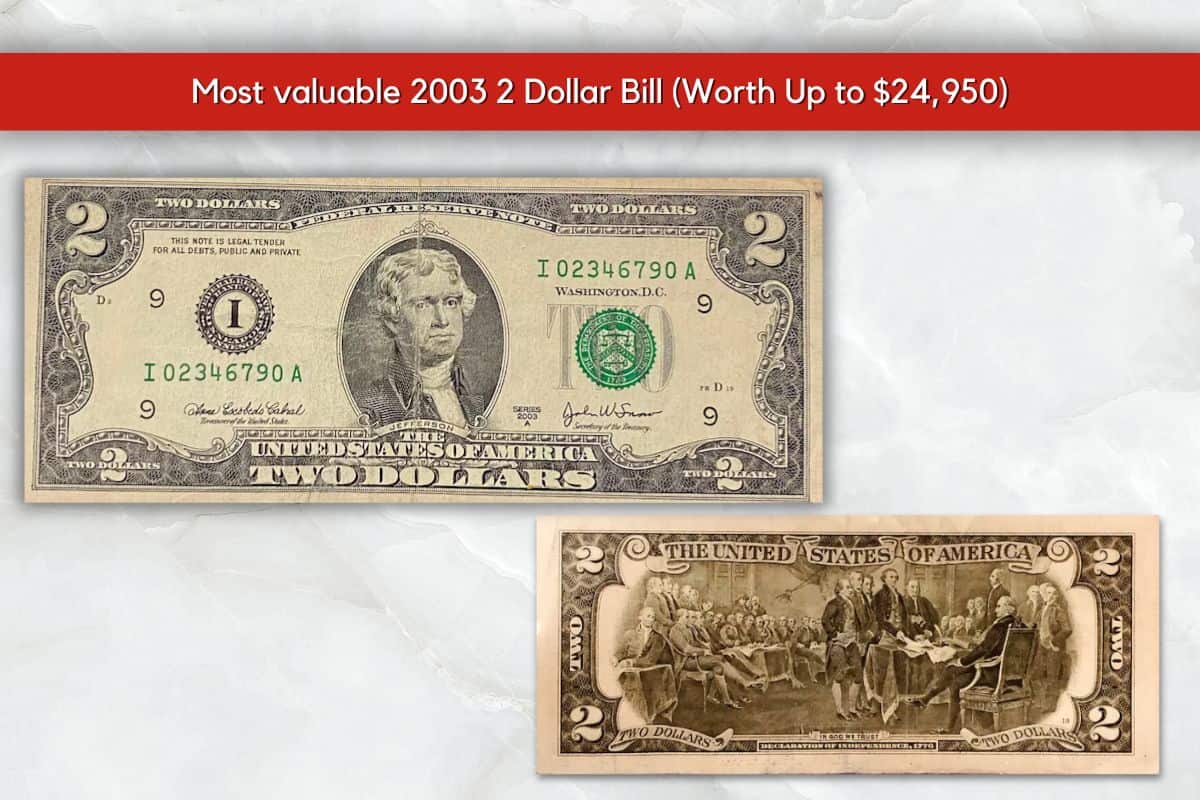
The series comes in two distinct varieties: the standard 2003 and the 2003A. The standard 2003 bears signatures from Rosario Marin and John W. Snow, while the 2003A displays signatures from Anna Escobedo Cabral and John W. Snow. This distinction marks just the beginning of what makes these bills special.
Understanding Premium Values
The most valuable 2003 $2 bill ever sold – a Kansas City Federal Reserve Note with PMG65 EPQ grade and serial number 1 star designation – commanded an astounding $24,950. This sale demonstrates the incredible potential these bills hold when specific factors align.
Several key elements determine a 2003 $2 bill‘s value:
Serial numbers play a crucial role in determining worth. Low serial numbers, particularly those under 100, command significant premiums. The market particularly values radar numbers (like 12344321) and solid serial numbers (like 11111111). Binary patterns (10101010) also attract serious collector interest.
Star notes represent another premium category. These replacement notes, designated by a star symbol in the serial number, were printed in limited quantities. The 2003A star notes from Atlanta and San Francisco districts prove especially valuable, with uncirculated specimens regularly trading above $150 in MS63 condition.
Federal Reserve district markings significantly impact value. Bills from certain districts command higher prices due to relative scarcity. St. Louis issues, for instance, can fetch up to $35 in MS63 condition, while Minneapolis notes typically start around $5 in similar condition.
Authentication and Grading
Proper authentication requires careful examination of multiple security features. The paper itself should display specific characteristics – genuine bills use currency paper with red and blue security fibers. Under UV light, these fibers fluoresce in distinct patterns.
The printing quality provides crucial authentication clues. Genuine bills show crisp, clear microprinting around Jefferson‘s portrait. The Federal Reserve seal should display sharp, distinct points and clear lettering. Serial numbers must maintain consistent spacing and alignment.
Professional grading services use a 70-point scale to evaluate condition. The most valuable specimens typically grade MS63 or higher. Factors affecting grade include:
- Paper quality and crispness
- Print clarity and alignment
- Margin evenness
- Corner sharpness
- Color integrity
- Surface preservation
Current Market Analysis
Recent market data reveals strong appreciation trends for premium specimens. Complete district sets in uncirculated condition regularly command $3,000-4,000. Star notes from scarcer districts show particularly strong price momentum.
Error notes represent another high-value category. Missing seal prints, misaligned signatures, and paper fold errors can multiply a bill‘s value significantly. One notable error note – a 2003 double denomination error – sold for $12,650 in 2023.
Regional Market Variations
Different regions display distinct collecting patterns and value variations. Northeast markets typically emphasize condition, with premium prices for gem uncirculated specimens. West Coast collectors often focus on San Francisco district issues, driving higher prices for these varieties.
Midwest markets show particular interest in star notes, while Southern states demonstrate growing demand for complete district sets. Understanding these regional preferences helps collectors maximize value when buying or selling.
Investment Strategies
Building a valuable collection requires strategic focus. Consider these approaches:
Focus on acquiring high-grade specimens whenever possible. Condition drives value dramatically – the difference between an MS63 and MS65 grade can multiply value several times.
Target scarcer varieties like star notes and low serial numbers. While these command premium prices initially, they typically appreciate faster than standard issues.
Consider building complete sets. Full district collections, particularly in matching high grades, attract serious collector interest and often sell at premium prices.
Conservation and Storage
Proper preservation proves crucial for maintaining value. Store bills in archival-quality holders that don‘t contain harmful chemicals. Maintain consistent temperature and humidity levels – rapid environmental changes can damage paper currency.
Handle bills minimally and always with clean, dry hands. When examination proves necessary, work in proper lighting conditions and on a clean surface. Never attempt to clean or press bills – such efforts typically reduce value significantly.
Finding Valuable Specimens
Several strategies can help locate valuable 2003 $2 bills:
Develop relationships with local banks and request new $2 bills. While most will be common varieties, occasional star notes and low serial numbers appear in bank stock.
Network with established dealers and attend currency shows. Many rare varieties first surface through dealer networks before reaching public auctions.
Monitor online markets carefully. Major auction houses and specialized currency dealers regularly offer premium specimens. Understanding current market values helps identify opportunities when they arise.
Future Outlook
The market for premium 2003 $2 bills continues strengthening. Several factors drive this trend:
Growing collector interest in modern varieties creates steady demand. As awareness of valuable modern notes increases, competition for premium specimens intensifies.
Limited availability of high-grade examples, particularly star notes and error varieties, supports value appreciation. Many early collectors stored these bills improperly, making pristine specimens increasingly scarce.
Rising general interest in paper money collecting brings new participants to the market. This expanding collector base typically drives values higher for scarcer varieties.
Essential Resources
Success in collecting valuable 2003 $2 bills requires staying informed. Consider these resources:
Join established numismatic organizations like the Professional Currency Dealers Association (PCDA) or the Society of Paper Money Collectors (SPMC). These groups provide valuable networking opportunities and market intelligence.
Subscribe to major price guides and auction reports. Understanding current market values proves essential for making informed purchasing decisions.
Build relationships with reputable dealers and fellow collectors. These connections often lead to opportunities for acquiring premium specimens before they reach the general market.
Final Thoughts
The 2003 $2 bill market offers significant opportunities for knowledgeable collectors. While most examples trade at face value, understanding what makes certain specimens valuable can lead to remarkable finds. Focus on condition, variety, and authentication while building market knowledge. With patience and dedication, you might discover your own four-figure bill hiding in plain sight.
Remember that collecting valuable currency requires both knowledge and strategy. Take time to learn the market, build proper networks, and develop authentication skills. The effort invested in understanding these fascinating notes can lead to both financial and personal rewards in your collecting journey.