The Complete Guide to 1867-1967 Canadian Penny Values: An Expert Analysis
As a professional numismatist specializing in North American coinage for over two decades, I‘ve witnessed the fascinating evolution of the 1867-1967 Canadian Centennial penny market. This comprehensive guide will walk you through everything you need to know about these historically significant coins, from precise valuations to expert collecting strategies.
Historical Significance and Minting Context
The 1967 Centennial penny stands as more than just currency – it represents a pivotal moment in Canadian history. Commemorating 100 years of Canadian confederation, the Royal Canadian Mint produced these special pennies with extraordinary attention to detail and symbolic meaning.
The decision to feature Alex Colville‘s rock dove design marked a significant departure from traditional penny imagery. Colville, renowned for his precise realist style, created a design that captured both movement and serenity – the dove in flight representing peace and progress as Canada entered its second century.
During 1967, the Ottawa Mint facility worked at full capacity, ultimately producing 345,140,645 of these pennies. The massive mintage reflected both the coin‘s commemorative importance and Canada‘s growing economic strength during the 1960s.
Physical Characteristics and Design Elements
The 1967 Centennial penny exhibits several distinctive features that set it apart from standard Canadian cents:
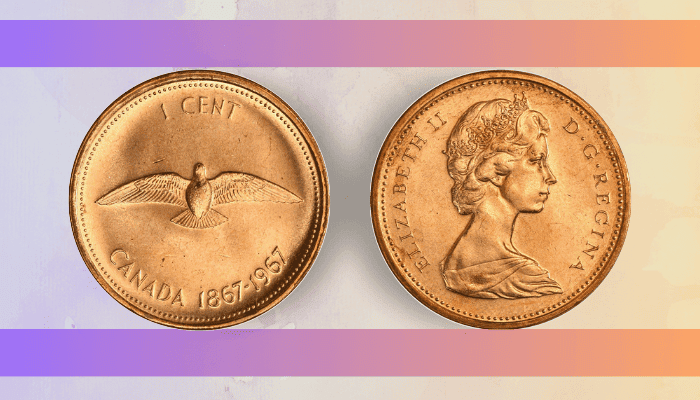
The obverse displays Arnold Machin‘s portrait of Queen Elizabeth II, noteworthy for its youthful depiction and fine detail work in the Queen‘s hair and jewelry. The inscription reads "ELIZABETH II D G REGINA" in precise serif lettering.
On the reverse, Colville‘s rock dove commands attention. The bird‘s wings spread in graceful flight, with each primary feather carefully delineated. The dual dates "1867-1967" appear below, while "CANADA" and "1 CENT" frame the design.
The coin‘s specifications remain consistent with other Canadian cents of the era:
- Weight: 3.24 grams
- Diameter: 19.05 millimeters
- Composition: 98% copper, .5% tin, 1.5% zinc
- Edge: Plain
- Thickness: 1.65 millimeters
Comprehensive Value Analysis
Current market values vary dramatically based on condition and specific varieties. Here‘s a detailed breakdown:
Circulated Grades:
Poor to Very Good: $.01-.02
Fine: $0.03-0.04
Very Fine: $0.50-0.75
Extremely Fine: $1.00-2.00
Uncirculated Grades:
MS-60 to MS-62: $2.00-5.00
MS-63: $8.00-12.00
MS-64: $15.00-25.00
MS-65: $40.00-60.00
MS-66: $150.00-200.00
MS-67: $300.00-400.00
MS-68 (extremely rare): $1,000+
Recent auction results demonstrate strong demand for premium examples. A superb MS-67 specimen sold for $312 at Heritage Auctions in 2023, while an MS-68 example achieved $1,150 at a specialized Canadian coin auction in Toronto.
Authentication and Grading
Authenticating 1967 Centennial pennies requires careful attention to several key points:
Strike Quality: Genuine examples show sharp detail in the dove‘s wing feathers and the Queen‘s hair. Under magnification, look for clear separation between design elements.
Surface Texture: Original mint luster should appear uniform and undisturbed. Machine-produced flow lines should radiate from the center on both sides.
Weight and Dimensions: Use precise digital calipers and scales to verify specifications. Counterfeits often fail basic measurement tests.
Common authentication challenges include:
- Artificially toned specimens
- Cleaned and retoned examples
- Weight variances from environmental damage
- Altered surfaces attempting to simulate higher grades
Notable Varieties and Errors
Several significant varieties command premium prices:
Double Date Error: The most valuable variety shows clear doubling in the "1867-1967" dates. MS-65 examples regularly trade above $200.
Die Crack Varieties: Multiple die crack patterns exist, with the most dramatic commanding 50-100% premiums over standard examples.
Off-Center Strikes: Specimens showing 5-20% off-center strikes generate significant collector interest, with prices ranging from $50 to several hundred dollars depending on severity.
Market Dynamics and Investment Potential
Current market trends suggest steady appreciation potential, particularly for high-grade specimens. Several factors influence long-term value:
Population Data: PCGS and NGC population reports show surprisingly few examples in grades above MS-66, creating natural scarcity in premium grades.
Collector Demographics: Growing interest from both Canadian and international collectors has expanded the buyer base.
Historical Significance: The centennial connection provides additional appeal beyond normal numismatic considerations.
Investment strategies should consider:
- Focusing on MS-65 and better grades
- Prioritizing original, problem-free examples
- Acquiring certified specimens for significant purchases
- Maintaining proper documentation and provenance
Conservation and Storage
Proper preservation requires attention to several critical factors:
Environmental Control:
- Maintain stable temperature between 65-70°F
- Keep relative humidity below 50%
- Avoid direct sunlight exposure
- Minimize handling
Storage Solutions:
- Use mylar flips or inert plastic holders
- Avoid PVC-containing materials
- Consider certified slabs for valuable specimens
- Implement proper album storage systems
Documentation:
- Photograph both sides of significant specimens
- Record purchase information and certification numbers
- Maintain condition notes and observations
- Track market value changes
Regional Market Variations
Values can vary significantly by region:
Eastern Canada: Generally commands premium prices, particularly in urban centers.
Western Canada: Slightly lower average values but strong collector base.
United States: Growing interest, especially in border states.
International: Emerging market in Asia and Europe.
Building a Specialized Collection
For collectors focusing on 1967 Centennial pennies, consider these approaches:
Grade Set Collection:
- Acquire examples in consecutive grades
- Document grade progression
- Study surface characteristics
- Compare certification service results
Variety Collection:
- Focus on documented varieties
- Search for undiscovered variations
- Study die states and progression
- Document new findings
Type Collection:
- Include business strikes
- Add proof-like specimens
- Acquire special mint set examples
- Consider related memorabilia
Future Market Outlook
Several factors suggest continued market strength:
Growing Historical Significance:
- Increasing distance from centennial year
- Rising appreciation of design artistry
- Connection to Canadian identity
Market Fundamentals:
- Stable precious metal values
- Strong collector base
- Limited high-grade supply
- Increasing international interest
Investment Considerations:
- Focus on quality over quantity
- Maintain proper documentation
- Build relationships with specialists
- Stay informed about market trends
Conclusion
The 1867-1967 Canadian Centennial penny represents both historical significance and numismatic opportunity. While common in circulated grades, premium examples offer substantial potential for appreciation. Success in collecting these pieces requires careful attention to grade, variety, and condition, combined with proper preservation techniques and market awareness.
Whether you‘re a beginning collector or seasoned numismatist, these coins offer multiple collecting approaches and investment opportunities. Focus on acquiring the best examples within your budget, maintain proper documentation, and remember that patience often rewards careful collectors with both personal satisfaction and financial returns.