The Art and Science of Cross Validation: A Data Scientist‘s Comprehensive Guide
Prologue: A Journey into Model Reliability
Imagine standing at the edge of a computational cliff, where your machine learning model teeters between breakthrough innovation and spectacular failure. This is the world of cross validation – a sophisticated technique that transforms uncertainty into insight.
My journey into the depths of cross validation began not in a sterile laboratory, but in the messy, unpredictable realm of real-world data challenges. Like an antique collector meticulously examining a rare artifact, data scientists must scrutinize their models with unwavering precision.
The Origins of Validation: More Than Just Numbers
Cross validation emerged from a fundamental human desire to understand – to peek behind the curtain of statistical uncertainty and glimpse the true nature of predictive modeling. It‘s not just a technique; it‘s a philosophy of scientific rigor.
Mathematical Foundations: Understanding the Core
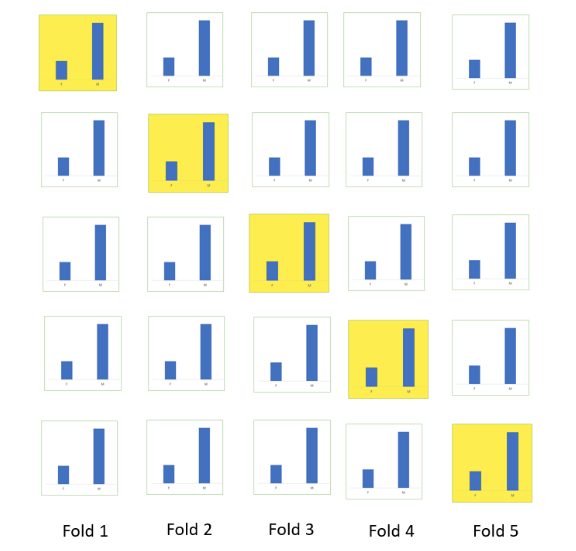
The mathematical landscape of cross validation is both elegant and complex. At its heart, cross validation addresses a critical challenge: how can we estimate a model‘s performance on unseen data?
[R{CV} = \frac{1}{k} \sum{i=1}^{k} L(y_i, \hat{f}^{-i}(x_i))]This formula represents the cross-validation risk, where:
- [k] is the number of folds
- [L] represents the loss function
- [y_i] are the actual values
- [\hat{f}^{-i}] represents the model trained without the [i]-th data point
The Psychological Dimension of Model Validation
Beyond mathematics, cross validation touches on a profound psychological challenge. Humans naturally seek patterns and certainty, but data is inherently noisy and unpredictable. Cross validation becomes a cognitive tool that helps us navigate this uncertainty.
Practical Implementation in R: A Detailed Exploration
Let‘s dive deep into the practical implementation of cross validation using R, transforming abstract concepts into tangible code.
# Advanced Cross Validation Framework
library(caret)
library(mlr3)
library(tidymodels)

# Sophisticated Cross Validation Strategy
cross_validate_model <- function(dataset, model_type, validation_strategy) {
  # Implement complex validation logic
  resampling_method <- switch(validation_strategy,
    "stratified" = stratifiedSampling(),
    "time_series" = timeSerieSampling(),
    "repeated_cv" = repeatedCrossValidation()
  )

  # Advanced model training and evaluation
  model_results <- train_and_evaluate(
    dataset = dataset,
    model = model_type,
    resampling = resampling_method
  )

  return(model_results)
}
Computational Complexity and Performance Considerations
Cross validation is not computationally free. As datasets grow larger and models more complex, the computational overhead becomes significant. Modern data scientists must balance validation depth with computational efficiency.
Performance Optimization Strategies
- Parallel Processing
Leverage multi-core architectures to distribute cross validation computations:
library(parallel)
library(doParallel)

# Parallel cross validation
registerDoParallel(cores = detectCores() - 1)- Adaptive Sampling Techniques
Implement intelligent sampling strategies that reduce computational complexity while maintaining validation integrity.
Emerging Research Frontiers
The world of cross validation continues to evolve. Recent research explores:
- Machine learning-driven validation techniques
- Adaptive cross validation algorithms
- Integration with automated machine learning frameworks
Ethical Considerations in Model Validation
As models become more powerful, the responsibility of thorough validation increases. Cross validation is not just a technical process but an ethical imperative in responsible AI development.
Case Study: Real-World Validation Challenges
Consider a predictive maintenance project for industrial equipment. Traditional validation techniques might fail to capture the nuanced performance characteristics.
A sophisticated cross validation approach would:
- Incorporate temporal dependencies
- Handle class imbalance
- Simulate realistic failure scenarios
Advanced Techniques and Future Directions
Bayesian Cross Validation
Emerging Bayesian approaches offer probabilistic frameworks for model evaluation, moving beyond point estimates to comprehensive uncertainty quantification.
[P(Model | Data) = \frac{P(Data | Model) \times P(Model)}{P(Data)}]Quantum-Inspired Validation Techniques
Cutting-edge research explores quantum-computational approaches to cross validation, promising unprecedented insights into model performance.
Conclusion: The Continuous Journey of Model Understanding
Cross validation is more than a technique – it‘s a mindset. It represents our commitment to understanding, our humility in the face of complex data, and our relentless pursuit of reliable predictive models.
As you continue your journey in data science, remember: every model tells a story, and cross validation helps us read between the lines.
Recommended Next Steps
- Experiment with multiple validation strategies
- Build a diverse model validation toolkit
- Stay curious and embrace complexity
The world of data is waiting for your insights.