The Complete Guide to NFC Mobile Payments for Businesses
Introduction
The world of payments is rapidly evolving. With the rise of digital wallets and mobile commerce, consumers are increasingly turning to their smartphones to make everyday purchases. At the forefront of this shift is near field communication (NFC) technology, which powers the contactless mobile payments that are quickly becoming the new normal.
Consider this: In 2020, over 760 million people worldwide used their smartphone to make a proximity mobile payment. That figure is projected to surpass 1.3 billion by 2023, representing nearly a third of all smartphone users.
For businesses, the message is clear: Offering fast, secure, and convenient payment options like NFC is no longer optional – it‘s essential to remaining competitive and meeting customer expectations. In this comprehensive guide, we‘ll dive into exactly how NFC payments work, the benefits they offer to businesses and consumers, and what you need to know to start accepting them at your own organization.
What Is NFC and How Does It Work?
Near field communication, or NFC, is a short-range wireless technology that enables two devices to quickly and securely exchange information when held in close proximity. It operates on the 13.56 MHz frequency and has a range of just a few centimeters, making it ideal for secure applications like contactless payments.
Here‘s how an NFC payment transaction typically works:
-
The customer opens their digital wallet app (such as Apple Pay, Google Pay, or Samsung Pay) and authenticates using their passcode, fingerprint, or face recognition.
-
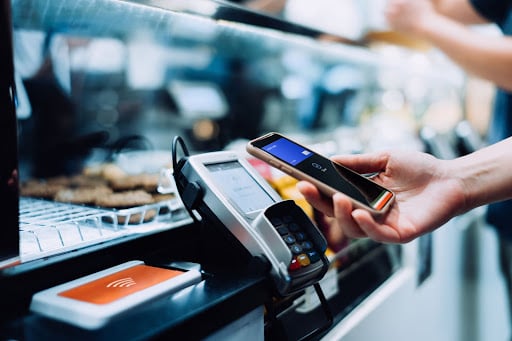
The customer selects the card they want to pay with and holds their device near the merchant‘s NFC-enabled payment terminal.
-
Using its built-in NFC chip and antenna, the customer‘s device transmits encrypted payment data to the terminal. This data includes a unique digital token that represents the customer‘s card information, but not the actual card number.
-
The payment terminal receives the token and additional transaction details, which it sends to the merchant‘s payment processor for authorization.
-
If approved, the payment processor notifies the terminal and the customer‘s device that the transaction was successful. This all happens in just a few seconds.
Central to the security of NFC payments is the concept of tokenization. Rather than transmitting the customer‘s actual debit or credit card number, NFC payments use a process called tokenization to replace sensitive data with a randomly generated number (the token) that can only be used for a specific transaction. Even if intercepted, this token would be useless to a potential fraudster.
NFC payments also utilize a dedicated chip, known as the secure element, to safely store payment information apart from the rest of the phone‘s memory. This provides an additional layer of protection against hacking attempts or malware. When combined with biometric authentication and encryption, these measures make NFC payments extremely difficult to compromise.
The Business Case for Accepting NFC Payments
With the technical foundations of NFC payments in mind, let‘s look at some of the key reasons why a growing number of businesses are choosing to accept them.
Faster Checkouts, Higher Volume
Perhaps the most compelling benefit of NFC payments is the potential to dramatically speed up the checkout process. Since customers can pay with just a tap of their device, contactless transactions are significantly faster than those involving cash, cards, or even traditional mobile payments.
How much faster? According to Visa, contactless transactions take less than half a second, compared to 7-10 seconds for chip cards and 10-15 seconds for magstripe cards. This may not sound like much, but the time savings can add up quickly – especially in high-volume environments like quick-service restaurants and retailers. Faster transaction times lead to shorter lines, more sales, and ultimately, higher revenue.
Major brands that have embraced NFC payments are already seeing the impact on their bottom line:
-
Pharmacy chain Walgreens reported an 18% increase in in-store sales after rolling out NFC-enabled terminals chainwide. They also saw a 14% lift in customer retention.
-
Quick-service restaurant Panera Bread saw a 54% increase in mobile payment usage in the first year after launching NFC payments, with those customers having a 33% higher average order value.
-
Grocery chain Wegmans experienced a 53% jump in contactless payment usage after enabling NFC as part of a point-of-sale upgrade. Wait times also decreased as more customers tapped to pay.
Enhanced Security and Fraud Prevention
Another key advantage that NFC payments provide to businesses is a higher level of transaction security compared to traditional methods. The combination of tokenization, biometric authentication, and secure element technology makes it extremely difficult for fraudsters to access customer data or make unauthorized purchases.
This is critical in an era of escalating payment fraud and data breaches. In 2020 alone, identity fraud losses totaled $56 billion and personal data was exposed in 1,001 breaches. The costs of fraud and chargebacks can quickly eat into a business‘s profitability, making secure payment acceptance a necessity.
NFC payments help mitigate these risks in several ways:
-
Tokenization ensures that even if payment data is intercepted, it can‘t be used for other purchases. Each token is unique to a specific device and transaction.
-
Biometric authentication, such as Apple‘s Face ID or Samsung‘s fingerprint scanner, prevents lost or stolen devices from being used to make fraudulent NFC payments.
-
The secure element isolates sensitive payment data from the phone‘s operating system, protecting it from hacking attempts or malware.
-
The tap-and-go nature of NFC payments eliminates the opportunity for physical card skimming or point-of-sale tampering.
Together, these safeguards give businesses and customers greater peace of mind around payment security. And with card networks like Visa and Mastercard extending their fraud liability protections to NFC transactions, the financial risks of accepting contactless payments are further minimized.
Improved Customer Experience
Beyond speed and security, NFC payments also offer businesses a powerful way to elevate the overall customer experience. In a world where consumers are increasingly choosing brands based on convenience, enabling them to pay quickly and easily with their smartphone or wearable device can be a major differentiator.
Consider that 85% of consumers say that they expect to prefer digital payments over cash or cards in the future. What‘s more, 63% say they would switch to a new store that offered mobile payment options, all else being equal. For younger consumers like millennials and Gen Z, mobile payments are quickly becoming the norm.
By meeting this growing demand for digital payment options, businesses can create a smoother, more seamless purchasing experience that boosts customer satisfaction and loyalty. Some additional benefits include:
- Enabling customers to leave their wallet at home and pay with their phone or smartwatch
- Linking NFC payments to loyalty programs for automatic rewards earning and redemption
- Personalizing offers and promotions based on customer payment data and habits
- Providing e-receipts and purchase history through the customer‘s mobile wallet
All of these factors can help businesses build stronger relationships with their customers and differentiate themselves in an increasingly competitive market. As more consumers come to expect the speed and convenience of contactless payments, those merchants that adopt NFC technology will be better positioned to win their business.
Preparing for the Contactless Future
The evidence is clear: NFC mobile payments are the future of in-person transactions. The combination of speed, security, and convenience they offer is simply unmatched by traditional payment methods like cash and cards. As digital wallet adoption continues to accelerate, businesses that embrace this technology will gain a significant edge.
But the benefits of NFC payments go beyond just keeping up with changing consumer preferences. By enabling faster checkouts, reducing fraud, and enhancing the customer experience, contactless payments can have a measurable impact on a business‘s bottom line. Early adopters in industries like retail, restaurants, and grocery are already realizing higher sales, increased efficiency, and improved customer loyalty.
If you‘re not already accepting NFC payments at your business, now is the time to start planning your contactless strategy. This will likely involve upgrading your point-of-sale terminals to NFC-enabled models, as well as training your staff on how to process digital wallet transactions. You‘ll also want to consider how NFC payments fit into your overall customer experience and marketing efforts.
The good news is that getting started with NFC payments is easier than ever. Most major payment processors and point-of-sale providers now offer NFC-ready solutions that can be quickly integrated into your existing systems. And with ongoing support from the card networks and mobile wallet providers, you‘ll have access to the latest security features and promotional tools.
As you embark on your contactless journey, keep these key statistics in mind:
- Global NFC transaction volume is projected to increase from $50 billion in 2020 to over $130 billion by 2025.
- 67% of retailers now accept some form of contactless payment, up from 40% in 2019. (National Retail Federation)
- 92% of U.S. retailers expect growth in contactless payment usage to continue. (National Retail Federation)
- 75% of consumers say they will continue to use contactless payments post-pandemic. (Mastercard)
The future of payments is contactless, and it‘s arriving faster than anyone predicted. Is your business ready?
Conclusion
NFC mobile payments represent a watershed moment for businesses of all types. By enabling faster, more secure, and more convenient transactions, contactless payments are rapidly becoming the preferred choice for consumers around the world.
As we‘ve seen, the benefits of accepting NFC payments are clear: higher checkout volume, reduced fraud risk, and an elevated customer experience. Forward-thinking brands are already leveraging this technology to drive growth and differentiate themselves in the market.
If you‘re a business owner or leader, the time to start prioritizing your contactless payment strategy is now. By partnering with a trusted payment processor, upgrading your point-of-sale infrastructure, and training your team on digital wallet acceptance, you can position your organization to thrive in a mobile-first future.
The shift to contactless is no longer a question of if, but when. With the right approach, you can turn this transformation into a powerful opportunity to enhance your operations, deepen your customer relationships, and ultimately boost your bottom line. The contactless future is here – make sure your business is ready for it.