The Fascinating World of Anemometers: Measuring the Invisible
Wind is an invisible force that shapes our world in countless ways. From powering renewable energy to influencing weather patterns, understanding wind is crucial in many fields. At the heart of this understanding lies a simple yet ingenious device: the anemometer. This article delves deep into the world of anemometers, exploring their various forms, functions, and the critical role they play in our modern world.
What is an Anemometer?
An anemometer is a device used to measure wind speed and, in some cases, wind direction. The term "anemometer" comes from the Greek words "anemos" (wind) and "metron" (measure). These instruments are fundamental tools in meteorology, wind energy assessment, aviation, and numerous other fields where understanding wind patterns is essential.
The Evolution of Anemometer Design
The history of anemometers is a testament to human ingenuity and our ever-growing need to understand and quantify the natural world around us. The journey began in the 15th century when Leon Battista Alberti created the first known mechanical anemometer. This early device was more focused on measuring wind force rather than speed, but it laid the groundwork for future innovations.
In 1664, Robert Hooke, the renowned English natural philosopher, created an early mechanical anemometer, further advancing the field. However, it was John Thomas Romney Robinson's invention of the cup anemometer in 1846 that truly revolutionized wind measurement. This design, with its rotating cups, became the standard for wind speed measurement for over a century and is still widely used today.
As technology progressed, so did anemometer design. The late 19th century saw William Henry Dines develop the pressure-tube anemometer, introducing a new method of wind measurement. The 20th century brought electronic anemometers, including hot-wire and sonic types, which offered greater precision and the ability to measure in three dimensions.
Today, we have advanced laser-based and ultrasonic anemometers that can measure wind with unprecedented accuracy. These modern devices are pushing the boundaries of what's possible in wind measurement, offering insights that were unimaginable just a few decades ago.
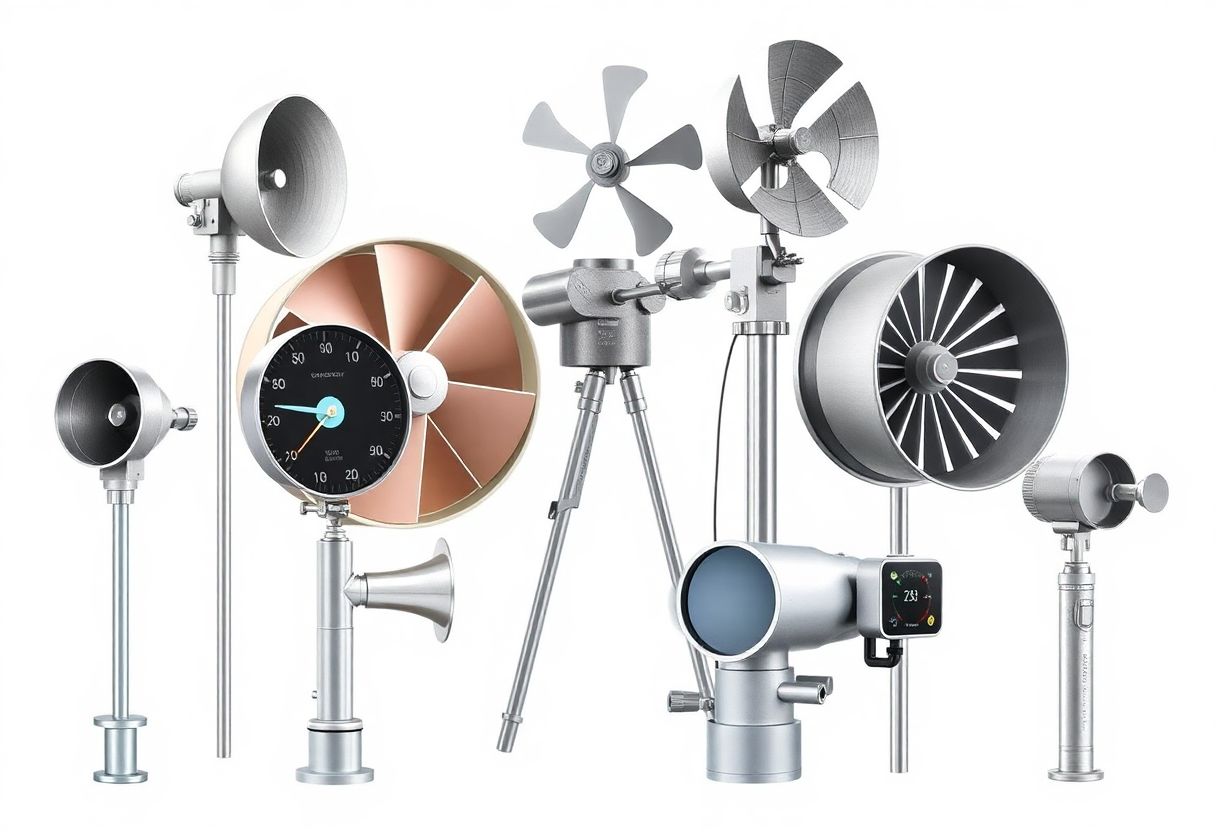
Types of Anemometers and Their Appearances
Cup Anemometer
The cup anemometer is perhaps the most recognizable type of anemometer. Its design is elegantly simple yet highly effective. Typically, it consists of three or four hemispherical cups mounted on horizontal arms, which are attached to a vertical shaft. As the wind blows, it catches the cups, causing the entire assembly to rotate.
The beauty of this design lies in its simplicity. The rotation speed of the cups is directly proportional to the wind speed, allowing for easy measurement. Cup anemometers are robust, reliable, and can withstand a wide range of weather conditions, making them ideal for long-term outdoor installations.
Modern cup anemometers often incorporate electronic sensors to measure rotation speed, providing digital output that can be easily integrated into weather stations or data logging systems. Despite being one of the oldest designs, cup anemometers remain a staple in meteorological stations worldwide due to their reliability and cost-effectiveness.
Propeller Anemometer
Also known as a windmill anemometer, the propeller anemometer resembles a small wind turbine. It typically features a propeller with two to four blades mounted on a horizontal shaft. Many designs include a tail vane that aligns the propeller with the wind direction, allowing for simultaneous measurement of wind speed and direction.
Propeller anemometers are particularly useful in applications where wind direction is as important as speed. They're commonly used in wind resource assessment for potential wind farm sites, where understanding wind patterns is crucial for optimizing turbine placement and estimating energy production.
The propeller design allows for quick response to changes in wind speed, making these anemometers suitable for measuring gusts and turbulent wind conditions. Some advanced models use lightweight materials for the propeller, further improving responsiveness and accuracy.
Hot-Wire Anemometer
Hot-wire anemometers represent a leap in precision for air flow measurement, especially in confined spaces. Unlike the mechanical designs of cup and propeller anemometers, hot-wire anemometers rely on the principle of convective heat transfer.
The core of a hot-wire anemometer is a very thin wire, often made of platinum, stretched between two prongs. This wire is heated electrically to a temperature above the ambient air. As air flows over the wire, it cools, and the rate of cooling is directly related to the air speed.
The appearance of a hot-wire anemometer is quite different from its mechanical counterparts. The wire itself is almost invisible to the naked eye, usually housed in a probe-like structure. This design allows for measurements in very small spaces and with minimal disruption to the airflow being measured.
Hot-wire anemometers are prized for their high sensitivity and fast response times, making them ideal for measuring rapid fluctuations in air speed. They're commonly used in HVAC systems, aerodynamics research, and other applications requiring precise airflow measurement.
Ultrasonic Anemometer
Ultrasonic anemometers represent the cutting edge of wind measurement technology. Unlike traditional mechanical anemometers, ultrasonic models have no moving parts, relying instead on the behavior of sound waves in moving air.
A typical ultrasonic anemometer consists of two or three pairs of small transducers (which act as both speakers and microphones) mounted on arms arranged in a specific geometric pattern. The device sends ultrasonic pulses between the transducers and measures the time it takes for these pulses to travel.
Wind affects the travel time of these sound waves, with tailwinds speeding them up and headwinds slowing them down. By measuring these time differences with high precision, the anemometer can calculate both wind speed and direction.
The appearance of ultrasonic anemometers is distinctly modern, often featuring sleek, futuristic designs. Their lack of moving parts makes them highly durable and suitable for use in harsh environments. They're increasingly used in weather stations, on ships, and in other applications where reliability and accuracy are paramount.
Laser Doppler Anemometer
At the most advanced end of the spectrum, we find the laser Doppler anemometer. This high-tech option is primarily used in research settings and specialized industrial applications.
A laser Doppler anemometer typically consists of a complex arrangement of lasers, lenses, and detectors. The basic principle involves splitting a laser beam and directing the beams into the airflow. Tiny particles in the air scatter the light, and the scattered light is detected. By analyzing the Doppler shift in the scattered light, the system can determine the wind speed with extreme precision.
While most laser Doppler anemometers are large, stationary setups in laboratories, some portable versions have been developed for field use. These devices are used in advanced fluid dynamics research, high-precision industrial applications, and anywhere that requires non-intrusive, highly accurate wind speed measurements.
How Anemometers Work: From Basic Principles to Complex Technologies
Understanding how anemometers work is key to appreciating their diverse appearances and applications. Let's explore the working principles of different types in more detail.
Cup Anemometer: The Classic Design
The cup anemometer operates on the simple principle of wind energy conversion to rotational motion. As the wind catches the cups, it creates a force that causes the assembly to rotate. The genius of the design lies in the shape of the cups: they catch more wind when facing into it than when moving with it, ensuring consistent rotation.
The rotation speed is directly proportional to the wind speed. In older models, this was measured by a mechanical counter. Modern versions often use optical sensors or small generators to produce electrical signals proportional to the rotation speed. These signals are then processed to give a wind speed reading.
Hot-Wire Anemometer: The Sensitive Option
Hot-wire anemometers operate on the principle of convective heat transfer. The thin wire is heated to a constant temperature above the ambient air. As wind flows over the wire, it cools it down. The cooling rate depends on the wind speed – faster wind causes more cooling.
The anemometer maintains the wire at a constant temperature by adjusting the electrical current flowing through it. The amount of current required to maintain the temperature is directly related to the wind speed. This relationship allows for very precise wind speed measurements, especially at low speeds.
Ultrasonic Anemometer: The High-Tech Solution
Ultrasonic anemometers use the principle of sound wave propagation in moving air. The device sends ultrasonic pulses between pairs of transducers and measures the time it takes for these pulses to travel. Wind affects this travel time – a tailwind will speed up the pulse, while a headwind will slow it down.
By measuring the time differences in multiple directions (usually three), the anemometer can calculate both wind speed and direction. The lack of moving parts and the use of digital signal processing allow for very high accuracy and fast response times.
Real-World Applications of Anemometers
Anemometers play crucial roles in many fields, far beyond their common association with weather stations. Here are some key areas where anemometers are indispensable:
-
Meteorology: Anemometers are fundamental to weather forecasting, climate research, and storm tracking. They provide critical data for understanding atmospheric conditions and predicting weather patterns.
-
Wind Energy: In the growing field of wind power, anemometers are used for site assessment, helping to determine the best locations for wind turbines. They're also crucial for ongoing monitoring of wind farm performance and optimization of turbine operation.
-
Aviation: Airports use anemometers to monitor wind conditions for safe takeoffs and landings. Aircraft themselves often have onboard anemometers for in-flight wind speed measurement.
-
Agriculture: Farmers use wind speed data for decisions about crop spraying and frost prevention. Understanding wind patterns can also help in planning windbreaks and managing soil erosion.
-
Sports: Many outdoor sports rely on accurate wind measurements. Sailing competitions use anemometers to ensure fair racing conditions, while sports like golf, archery, and ski jumping use wind data to adjust for environmental factors.
-
Construction: Wind speed monitoring is crucial for the safe operation of cranes and other tall equipment. Engineers also use wind data in designing structures to withstand wind loads.
-
Environmental Monitoring: Anemometers play a role in air pollution studies, helping researchers understand how pollutants disperse in the atmosphere. They're also used in wildfire behavior prediction and management.
The Future of Anemometer Design
As technology continues to advance, we're seeing exciting developments in anemometer design:
-
Miniaturization: The trend towards smaller, more portable devices is leading to the development of smartphone-compatible anemometers and even anemometers small enough to be mounted on drones for atmospheric research.
-
Integration: Modern weather stations often integrate multiple sensors into a single device. We're seeing the development of "weather station on a chip" technologies that could revolutionize personal weather monitoring.
-
Advanced Materials: Researchers are exploring the use of new materials like graphene for ultra-sensitive wind measurements. Self-cleaning surfaces are being developed to reduce maintenance needs in harsh environments.
-
AI and Machine Learning: The integration of artificial intelligence is opening new possibilities in wind prediction and analysis. Machine learning algorithms can use historical wind data to make more accurate forecasts and automatically calibrate instruments for optimal performance.
Conclusion: The Diverse World of Anemometers
From the spinning cups of a traditional anemometer to the invisible laser beams of cutting-edge designs, anemometers come in a fascinating array of shapes and sizes. Their appearance is a testament to human ingenuity in measuring the invisible yet powerful force of wind.
As we've explored, each type of anemometer has its unique strengths and applications. The classic cup anemometer remains a reliable workhorse for many applications, while advanced ultrasonic and laser Doppler anemometers push the boundaries of accuracy and capability.
Understanding anemometers opens up a new way of perceiving the air we move through every day. These clever devices turn the invisible force of wind into valuable data that helps us understand and interact with our environment in countless ways.
As technology continues to evolve, so too will anemometer design. We can look forward to even more accurate, versatile, and integrated wind measurement solutions in the future. Whether you're a weather enthusiast, a professional in a wind-dependent field, or simply curious about the world around you, the world of anemometers offers a fascinating glimpse into the intersection of natural forces and human innovation.