Transformers: The Unsung Heroes of Our Electrical World
In our modern, electrified society, we often take for granted the invisible infrastructure that powers our daily lives. At the heart of this complex system lies a device both elegant in its simplicity and profound in its impact: the transformer. This remarkable invention has been quietly revolutionizing our world for over a century, yet its inner workings remain a mystery to many. In this comprehensive exploration, we'll unveil the secrets of transformers, delving into their function, mechanics, and the pivotal role they play in powering our planet.
The Essence of Transformation: What Does a Transformer Do?
At its core, a transformer is an electrical device that transfers energy between two or more circuits through electromagnetic induction. Its primary function is to increase or decrease the voltage of an alternating current (AC) supply without altering its frequency. This seemingly simple task is the linchpin of our entire electrical distribution system, enabling the efficient transmission of power across vast distances and its safe delivery to our homes and businesses.
The Vital Role of Transformers in Power Distribution
To truly appreciate the importance of transformers, we must first understand the fundamental challenge of power distribution. Electricity generated at power plants typically emerges at voltages around 20,000 volts. However, transmitting this electricity over long distances at such voltages would result in significant energy losses due to resistance in the transmission lines.
The solution? Step up the voltage for transmission and then step it down for use. This is where transformers shine. By increasing the voltage to hundreds of thousands of volts for long-distance transmission, we can reduce the current flowing through the lines. Since power loss is proportional to the square of the current (P = I²R, where P is power loss, I is current, and R is resistance), this reduction in current dramatically decreases energy loss during transmission.
For example, increasing the voltage by a factor of 10 reduces the current by the same factor, resulting in a 100-fold decrease in power loss. This efficiency gain is what makes our sprawling power grids feasible.
The Inner Workings: How Does a Transformer Perform Its Magic?
To understand how transformers work, we need to delve into the principles of electromagnetic induction, a phenomenon discovered by Michael Faraday in 1831. This discovery laid the groundwork for the development of transformers and, indeed, much of our modern electrical technology.
The Core Components
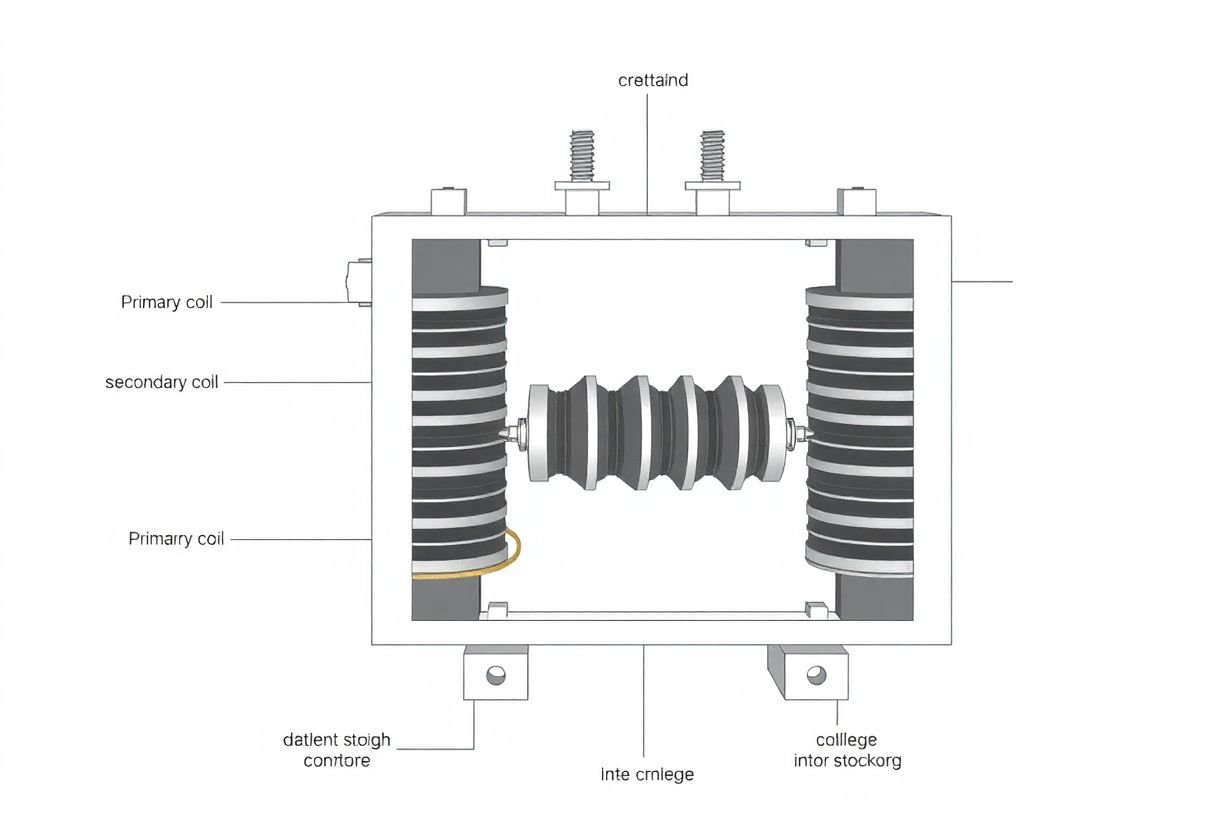
A transformer consists of three main parts:
- The primary coil: This is the input winding that receives the initial AC voltage.
- The secondary coil: This is the output winding that delivers the transformed AC voltage.
- The core: Usually made of laminated steel, it provides a path for the magnetic field.
The Dance of Electrons and Magnetic Fields
When an alternating current flows through the primary coil, it creates a changing magnetic field. This field is concentrated and directed by the iron core, which provides a low-reluctance path for the magnetic flux. The changing magnetic field then induces a voltage in the secondary coil through electromagnetic induction.
The ratio of the number of turns in the primary coil to the number in the secondary coil determines whether the transformer steps up or steps down the voltage. This relationship is expressed by the transformer equation:
Vp / Vs = Np / Ns
Where Vp and Vs are the primary and secondary voltages, and Np and Ns are the number of turns in the primary and secondary coils, respectively.
For instance, if the primary coil has 1000 turns and the secondary has 100 turns, the voltage will be stepped down by a factor of 10. Conversely, if the secondary has more turns than the primary, the voltage will be stepped up.
The Transformer Zoo: A Diverse Family of Devices
While all transformers operate on the same basic principles, they come in a variety of types, each tailored for specific applications:
Step-Up Transformers
These are the workhorses of our long-distance transmission systems. Found in power plants, they boost voltages to levels as high as 765,000 volts for ultra-high voltage transmission lines. This extreme voltage allows for the efficient transmission of power over hundreds of miles with minimal losses.
Step-Down Transformers
As electricity approaches its final destination, it passes through a series of step-down transformers. At substations, massive transformers reduce transmission voltages to distribution levels, typically around 7,200 volts. Further down the line, pole-mounted transformers step this down to the 120/240 volts used in most U.S. homes.
Isolation Transformers
These specialized transformers are designed to transfer power between circuits while keeping them electrically isolated. They're crucial in medical equipment, audio systems, and other applications where electrical noise or safety concerns are paramount.
Autotransformers
Unlike conventional transformers, autotransformers use a single winding for both the primary and secondary circuits. They're more compact and efficient for small voltage adjustments and are commonly used in voltage regulators and motor starters.
Instrument Transformers
These precision devices are used to step down high voltages or currents for measurement purposes. They're essential components in electrical meters, protective relays, and other monitoring equipment in power systems.
Transformers in Action: From Power Plants to Pocket Devices
The ubiquity of transformers in our daily lives is truly remarkable. Let's explore some of their most common applications:
The Power Grid: A Network of Transformation
Our entire electrical grid is essentially a vast network of transformers. At power plants, step-up transformers boost voltages for long-distance transmission. Substations use a series of transformers to step down these high voltages for regional distribution. Finally, local transformers, often seen mounted on utility poles, make the final voltage reduction for residential and commercial use.
Industrial Might: Powering the World's Factories
In industrial settings, transformers play diverse roles. Electric arc furnaces, used in steel production, rely on massive transformers to provide the enormous currents needed to melt metal. Welding equipment uses transformers to supply the high current, low voltage power essential for joining metals. In the realm of motor control, variable frequency drives often incorporate transformer technology to manage power conversion efficiently.
The Green Revolution: Transformers in Renewable Energy
As we transition to more sustainable energy sources, transformers remain indispensable. Wind turbines generate electricity at varying voltages depending on wind speed, necessitating transformers to stabilize and step up the voltage for grid integration. Solar farms use a hierarchy of transformers, from small units at each inverter to large substation transformers, to match their output to grid requirements.
The Digital Age: Transformers in Electronics
Even as we move towards a more digital world, transformers continue to play a crucial role. Your laptop charger contains a small transformer to convert the 120V AC from your wall outlet to a lower DC voltage. Similarly, the slim phone charger in your pocket uses transformer principles, often in conjunction with advanced switch-mode power supply technology, to provide the precise power your device needs.
The Quest for Efficiency: Minimizing Losses in Transformer Operation
While transformers are remarkably efficient devices, typically operating at 98% efficiency or higher, the sheer scale of our electrical systems means that even small losses can add up to significant amounts of energy. Engineers and researchers are constantly working to minimize these losses:
Understanding Transformer Losses
Transformer losses fall into two main categories:
-
Core losses: These occur in the transformer's iron core and include hysteresis losses (energy lost in repeatedly magnetizing and demagnetizing the core) and eddy current losses (caused by induced currents in the core material).
-
Copper losses: Also known as I²R losses, these result from the resistance of the copper windings.
Strategies for Loss Reduction
To combat these losses, engineers employ several strategies:
-
Advanced core materials: The use of high-grade silicon steel or amorphous metal cores can significantly reduce core losses. For instance, amorphous metal cores can reduce no-load losses by up to 70% compared to traditional silicon steel cores.
-
Optimized core design: Careful design of the core's shape and laminations can minimize flux leakage and reduce eddy currents.
-
Improved winding techniques: Using larger conductor sizes and advanced winding geometries can reduce copper losses.
-
Efficient cooling systems: For large transformers, sophisticated cooling systems help maintain optimal operating temperatures, reducing losses and extending transformer life.
The Cutting Edge: Innovations in Transformer Technology
As our electrical needs evolve, so too does transformer technology. Several exciting developments are pushing the boundaries of what's possible:
Solid-State Transformers: The Digital Revolution
Solid-state transformers (SSTs) represent a paradigm shift in transformer technology. Unlike traditional transformers, SSTs use power electronics to perform voltage conversion. This allows for more precise control of power flow and can even convert between AC and DC.
Key advantages of SSTs include:
- Improved power quality and stability
- Bidirectional power flow capabilities, crucial for integrating renewable energy and energy storage systems
- Reduced size and weight compared to traditional transformers
- The ability to act as a "smart node" in future intelligent power grids
While still in the early stages of deployment, SSTs are expected to play a significant role in the development of smart grids and microgrids.
High-Temperature Superconducting Transformers: A Quantum Leap in Efficiency
High-temperature superconducting (HTS) transformers represent another frontier in transformer technology. These transformers use superconducting materials for their windings, which offer virtually zero resistance when cooled to certain temperatures.
The potential benefits of HTS transformers are substantial:
- Significantly reduced losses, potentially improving efficiency by several percentage points
- Much higher power density, allowing for smaller, lighter transformers
- Improved overload capacity and resilience to grid disturbances
While HTS transformers are still largely in the research and development phase, pilot projects have shown promising results. For instance, a 630 kVA HTS transformer demonstrated by the Chinese Academy of Sciences showed a 52% reduction in total losses compared to a conventional transformer of the same rating.
Nanotechnology: Engineering at the Atomic Scale
Nanotechnology is opening up new possibilities in transformer design:
-
Nanostructured core materials: By manipulating the structure of core materials at the nanoscale, researchers aim to create materials with lower hysteresis losses and higher magnetic permeability.
-
Nanofluids for cooling: Experimental cooling fluids containing nanoparticles have shown improved heat transfer properties, potentially enhancing the cooling efficiency of large transformers.
-
Nanocomposite insulation: New insulating materials incorporating nanoparticles may offer improved dielectric strength and thermal conductivity, allowing for more compact and efficient transformer designs.
The Future of Power: Transformers in a Changing World
As we look to the future, the role of transformers is set to evolve alongside our changing energy landscape:
Smart Grids and IoT Integration
Future transformers will likely incorporate sensors and communication capabilities, becoming active nodes in smart grids. This will allow for real-time monitoring of grid conditions, predictive maintenance, and more efficient power routing.
Renewable Energy Integration
As renewable energy sources become more prevalent, transformers will need to adapt to handle the variable and often bidirectional power flows associated with these technologies. This may lead to more widespread adoption of solid-state transformers and other advanced designs.
Urban Power Solutions
With increasing urbanization and the growth of megacities, there's a growing need for compact, efficient power distribution solutions. This may drive the development of more power-dense transformer technologies, such as HTS transformers or advanced air-core designs.
DC Power Transmission
While AC remains dominant in power transmission, there's growing interest in high-voltage DC (HVDC) transmission for certain applications, particularly for long-distance power transmission and connecting renewable energy sources to the grid. This may lead to new types of power conversion devices that blur the line between traditional transformers and power electronics.
Conclusion: The Enduring Legacy of a Revolutionary Device
From the humming substations that form the backbone of our power grid to the tiny components in our electronic devices, transformers are the unsung heroes of our electrified world. Their elegant simplicity belies their profound impact on modern civilization.
As we face the challenges of the 21st century—climate change, urbanization, and the need for more resilient and sustainable infrastructure—transformers will continue to play a pivotal role. The ongoing evolution of transformer technology, from solid-state devices to superconducting designs, promises to make our power systems more efficient, flexible, and reliable than ever before.
Understanding the principles and applications of transformers not only gives us a deeper appreciation for the complex systems that power our world but also provides crucial insights into the future of energy. As we stand on the cusp of a new era in electrical engineering, the transformer—in its many forms—will undoubtedly remain at the heart of our ever-evolving power landscape.
In the grand tapestry of human innovation, the transformer stands out as a thread that connects our past achievements to our future aspirations. It is a testament to the enduring power of scientific discovery and engineering ingenuity—a device that, though often overlooked, continues to shape the world around us in profound and far-reaching ways.