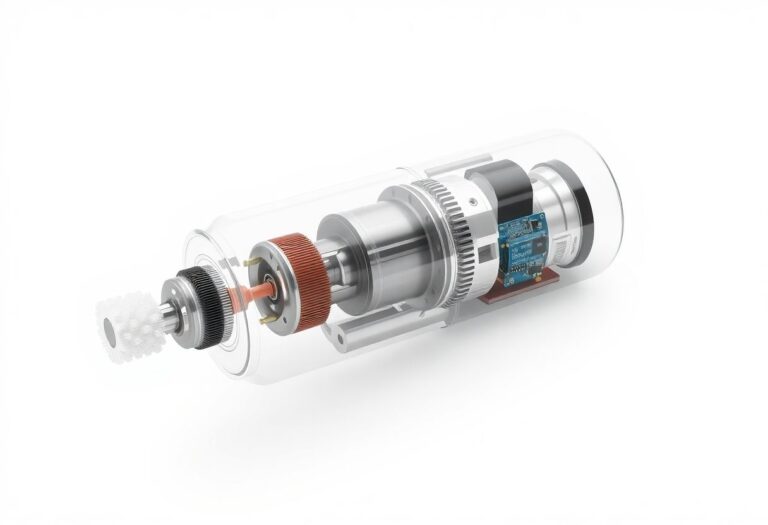
The Fascinating World of Flywheels: Harnessing Rotational Energy for Modern Applications
Imagine a world where the energy from a passing breeze could be efficiently captured and stored, ready to power your home hours or even days later. While this may sound like science fiction, a technology that operates on similar principles has been in use for centuries and is now experiencing a renaissance in the modern era. This technology is the flywheel, a deceptively simple yet incredibly powerful device that harnesses the fundamental physics of rotational motion to store and release energy.
The Basics: What is a Flywheel?
At its core, a flywheel is a heavy wheel that resists changes in its rotational speed. This resistance to change, known as rotational inertia, allows the flywheel to act as a mechanical battery, storing kinetic energy in its rotation and releasing it when needed. The concept is elegantly simple, yet the applications are far-reaching and increasingly sophisticated.
A typical flywheel consists of several key components:
- A heavy circular rim, where most of the mass is concentrated
- Spokes or a solid disk connecting the rim to the central hub
- A shaft running through the center, connecting the flywheel to other mechanical or electrical systems
The design of a flywheel is crucial to its performance. By concentrating mass at the outer rim, engineers maximize the flywheel's moment of inertia, which in turn maximizes its energy storage capacity. This fundamental principle has remained unchanged since the earliest flywheels, but modern materials and designs have dramatically improved their efficiency and capabilities.
The Physics Behind the Spin: Understanding Rotational Dynamics
To truly appreciate how flywheels work, we need to delve into the physics of rotational motion. Several key concepts come into play:
Rotational Inertia (Moment of Inertia)
Just as linear inertia describes an object's resistance to changes in its linear motion, rotational inertia (also called moment of inertia) describes a rotating object's resistance to changes in its rotational motion. The moment of inertia depends not just on the object's total mass, but crucially on how that mass is distributed relative to the axis of rotation.
For a flywheel, the moment of inertia (I) is given by the equation:
I = ∫r^2 dm
Where r is the distance of each particle of mass from the axis of rotation, and dm is the differential mass element. For a simple solid disk, this integrates to:
I = (1/2)MR^2
Where M is the total mass and R is the radius. However, for a flywheel with most of its mass concentrated at the rim, the moment of inertia approaches:
I = MR^2
This is why flywheels are typically designed with heavy rims and lighter spokes or disks – to maximize the moment of inertia for a given total mass.
Angular Momentum
Angular momentum is the rotational analog of linear momentum. It's defined as the product of an object's moment of inertia and its angular velocity:
L = Iω
Where L is angular momentum, I is the moment of inertia, and ω is the angular velocity.
The conservation of angular momentum is a fundamental principle in physics, stating that the total angular momentum of a closed system remains constant unless acted upon by external torques. This principle is what allows a spinning flywheel to maintain its rotational speed in the absence of external forces.
Kinetic Energy
The energy stored in a flywheel is in the form of rotational kinetic energy. The equation for rotational kinetic energy is:
E = (1/2)Iω^2
This equation reveals two critical insights:
- Energy increases linearly with moment of inertia (which depends on mass and size)
- Energy increases with the square of angular velocity
This quadratic relationship with angular velocity is why modern high-performance flywheels focus on achieving extremely high rotational speeds rather than simply increasing mass. Doubling the mass of a flywheel doubles its energy capacity, but doubling its rotational speed quadruples the energy stored.
The Energy Cycle: Storage and Release
Understanding how flywheels store and release energy is key to appreciating their versatility and efficiency:
Energy Storage
To add energy to a flywheel, you need to increase its rotational speed. This is typically accomplished using an electric motor or by mechanically coupling the flywheel to an engine or other power source. As the flywheel spins faster, its rotational kinetic energy increases according to the equation above.
The process of adding energy to a flywheel is governed by the work-energy theorem. The work done on the flywheel (W) is equal to the change in its kinetic energy:
W = ΔE = (1/2)I(ω_f^2 – ω_i^2)
Where ω_f is the final angular velocity and ω_i is the initial angular velocity.
Energy Release
Extracting energy from a flywheel involves the reverse process – connecting it to a generator or mechanical load that applies a torque to slow it down. As the flywheel's rotation decelerates, it transfers its kinetic energy to the connected system.
The power output (P) of a flywheel during energy release is given by:
P = Tω
Where T is the torque applied and ω is the angular velocity.
Efficiency and Energy Retention
Modern flywheels can achieve impressive round-trip energy efficiencies of 80-90%. However, they do experience some energy loss over time due to friction in the bearings and air resistance. These losses are described by the flywheel's self-discharge rate, which is typically expressed as a percentage of stored energy lost per unit time.
To minimize these losses, cutting-edge flywheel designs incorporate several advanced features:
-
Magnetic bearings: These use magnetic levitation to suspend the rotor, virtually eliminating mechanical friction.
-
Vacuum-sealed housings: By removing air from the flywheel chamber, engineers can eliminate air resistance, dramatically reducing energy loss, especially at high speeds.
-
Advanced composite materials: Carbon fiber and other high-strength composites allow flywheels to withstand extreme rotational speeds without failing due to material stress.
With these innovations, some modern flywheels can retain up to 99% of their stored energy over a 24-hour period, a remarkable achievement in energy storage technology.
Applications: From Ancient Pottery to Modern Power Grids
The versatility of flywheels has led to their use in a wide array of applications, spanning from ancient times to the cutting edge of modern technology:
Transportation
In the automotive world, flywheels have found a niche in high-performance applications. Formula 1 racing introduced Kinetic Energy Recovery Systems (KERS) in 2009, using flywheels to capture braking energy and provide short bursts of additional power for overtaking. This technology has since been adapted for use in some high-end sports cars and is being explored for more mainstream vehicles.
Public transportation has also benefited from flywheel technology. Some cities have experimented with "gyrobuses" – buses that use large flywheels instead of batteries for energy storage. These vehicles can rapidly recharge at stops, spinning up their flywheels to store energy for the next leg of their journey.
In rail transport, flywheels help smooth out power delivery in electric trains and can capture significant amounts of braking energy as trains decelerate into stations. This regenerative braking system can reduce overall energy consumption by up to 30% in some urban rail systems.
Power Grid Stabilization
One of the most promising modern applications of flywheels is in power grid stabilization. Flywheels excel at rapidly absorbing or releasing energy, making them ideal for several critical grid functions:
-
Frequency regulation: Flywheels can respond to grid frequency fluctuations in milliseconds, helping to match electricity supply and demand on a second-by-second basis. This fast response time is crucial for maintaining grid stability, especially as more variable renewable energy sources are integrated into the power system.
-
Short-term backup power: In the event of a power outage, flywheel systems can provide instantaneous backup power, bridging the gap until longer-term solutions like diesel generators can come online. This capability is particularly valuable for data centers and other facilities that require uninterrupted power supply.
-
Renewable energy integration: Flywheels can help smooth out the variable output from wind and solar installations, storing excess energy during peak production and releasing it during lulls. This capability helps to make renewable energy more reliable and grid-friendly.
A notable example of grid-scale flywheel implementation is the 20 MW facility in Stephentown, New York, operated by Beacon Power. This installation uses 200 high-speed flywheels to provide frequency regulation services to the New York power grid, demonstrating the viability of flywheel technology for utility-scale applications.
Industrial Applications
In the industrial sector, flywheels continue to play a crucial role in various manufacturing processes:
-
Machine tools: Large flywheels help maintain consistent speeds in equipment like punch presses, shears, and hammers that have varying power demands throughout their operating cycle.
-
Forging and stamping: Flywheels store energy between operations in forging hammers and stamping presses, allowing these machines to deliver high peak powers without requiring an equivalently high-powered electrical supply.
-
Centrifuges: High-speed flywheels are at the heart of centrifuges used in scientific research, medical diagnostics, and even uranium enrichment. In these applications, the flywheel's ability to maintain high rotational speeds with minimal energy input is crucial.
Space Technology
The unique characteristics of flywheels make them particularly attractive for space applications. NASA and other space agencies are actively researching and developing flywheel systems for:
-
Energy storage on satellites and space stations: Flywheels offer several advantages over traditional battery systems in space, including longer lifespan, higher energy density, and the ability to operate effectively in the extreme temperature ranges encountered in orbit.
-
Attitude control and steering of spacecraft: By changing the rotational speed or orientation of flywheels, spacecraft can adjust their attitude or pointing direction without using propellant. This technique, known as momentum wheel or reaction wheel control, is widely used in satellites and other spacecraft.
The International Space Station has even tested an experimental flywheel energy storage system as a potential replacement for some of its battery systems, highlighting the technology's promise for future space exploration.
Advantages and Limitations: A Balanced Perspective
Like any technology, flywheels have their strengths and limitations. Understanding these is crucial for determining where and how flywheels can be most effectively deployed:
Advantages
-
Long lifespan: High-quality flywheels can operate for decades with minimal maintenance, potentially outlasting many other energy storage technologies.
-
High power density: Flywheels can release energy very quickly, making them ideal for applications requiring high power output over short durations.
-
Fast recharge: Flywheels can be "recharged" (spun up) much faster than chemical batteries, often in a matter of minutes rather than hours.
-
Environmental friendliness: Unlike many battery technologies, flywheels don't rely on harmful chemicals or materials, making them easier to recycle and less environmentally impactful.
-
Temperature independence: Flywheel performance remains consistent across a wide temperature range, unlike many chemical batteries which can be sensitive to temperature extremes.
-
Predictable degradation: The performance of a flywheel system tends to degrade in a very predictable manner over time, making maintenance and replacement scheduling more straightforward.
Limitations
-
Safety concerns: High-speed flywheels store a significant amount of energy and can be dangerous if they fail catastrophically. Proper containment and safety systems are essential, especially for large-scale installations.
-
Gyroscopic effects: The spinning mass of a flywheel creates gyroscopic forces that can affect the handling of vehicles or the stability of structures in which they're installed. This effect must be carefully managed in mobile applications.
-
Limited energy density: While flywheels have high power density, their energy density (amount of energy stored per unit mass) is generally lower than some advanced chemical batteries. This can make them less suitable for applications requiring long-duration energy storage.
-
Complexity: High-performance flywheel systems require sophisticated control systems and precise manufacturing, which can increase costs and maintenance requirements.
-
Self-discharge: Even with advanced designs, flywheels experience some energy loss over time due to friction and air resistance, making them less suitable for long-term energy storage compared to some other technologies.
The Future of Flywheel Technology: Innovations on the Horizon
As we look to a future increasingly powered by renewable energy, the need for efficient, responsive energy storage solutions is greater than ever. Flywheels are poised to play a significant role in this evolving energy landscape, with several exciting developments on the horizon:
Grid-Scale Energy Storage
As wind and solar power continue to grow, large-scale flywheel installations could become a crucial component of grid infrastructure. These systems could help balance supply and demand on a second-by-second basis, potentially replacing some fossil fuel "peaker" plants that are currently used to meet rapid changes in electricity demand.
Research is ongoing into scaling up flywheel technology for grid applications. For example, the European Union's EDRFlywheel project is developing a 100 kWh/1.6 MW flywheel energy storage system for grid stabilization, demonstrating the potential for larger, more powerful flywheel arrays.
Electric Vehicle Fast Charging
The rapid growth of electric vehicles (EVs) is creating new challenges for power grids, particularly around fast charging infrastructure. Flywheel systems could play a crucial role here, acting as power buffers at charging stations. By rapidly absorbing energy from the grid and releasing it to vehicles as needed, flywheels could enable ultra-fast charging without placing excessive strain on local power infrastructure.
Companies like Chakratec are already deploying flywheel-based EV charging systems, demonstrating the viability of this approach. Their kinetic power booster can provide up to 100 kW of power for fast charging, even in locations with limited grid capacity.
Hybrid Energy Storage Systems
The future may see flywheels combined with other storage technologies to create more versatile and efficient energy systems. For example:
-
Flywheel-Battery Hybrids: Combining the high power density of flywheels with the high energy density of batteries could create systems that offer both rapid response and long-duration storage.
-
Flywheel-Supercapacitor Systems: Pairing flywheels with supercapacitors could yield energy storage solutions with extremely fast response times and high cycle life, ideal for applications requiring frequent charge-discharge cycles.
Advanced Materials and Designs
Research into stronger, lighter materials could allow flywheels to spin even faster, dramatically increasing their energy density. Some areas of active research include:
-
Carbon nanotubes and graphene: These materials offer exceptional strength-to-weight ratios and could potentially allow for flywheels with much higher rotational speeds.
-
Superconducting magnetic bearings: By eliminating virtually all friction, these could dramatically improve the efficiency and energy retention of flywheel systems.
-
Multi-flywheel arrays: Researchers are exploring designs that use multiple smaller flywheels in parallel, potentially offering better scalability and redundancy than single large flywheel systems.
Conclusion: The Enduring Power of Rotational Energy Storage
From ancient pottery wheels to cutting-edge power grids, flywheels demonstrate the enduring power of a simple idea: storing energy as motion. As we've explored, the basic physics of rotational motion allows these spinning wheels to act as mechanical batteries, smoothing out power fluctuations and bridging gaps between energy supply and demand.
The flywheel's journey from humble mechanical device to high-tech energy storage solution is a testament to the power of scientific understanding and engineering innovation. By harnessing the principles of rotational dynamics, engineers have transformed this ancient technology into a vital tool for our modern energy landscape.
While flywheels may not be the solution to all our energy storage needs, their unique advantages – rapid response, long lifespan, and environmental friendliness – make them a critical technology in our transition to a more sustainable and efficient energy future. As materials science and control systems continue to advance, we can expect to see flywheels spinning their way into an even wider array of applications, helping to power our world in new and innovative ways.
The next time you hear about grid stabilization, Formula 1 racing, or space exploration, remember the humble flywheel – a deceptively simple device that continues to shape our technological landscape through the power of rotational energy storage.