The Fascinating World of Springs: How They Work and Why They Matter
Springs are marvels of engineering that surround us in countless everyday objects and complex machines alike. From the gentle bounce of a mattress to the precision mechanics of a watch, springs play a crucial role in our modern world. This comprehensive guide will delve deep into the science, engineering, and applications of springs, uncovering the hidden complexities of these seemingly simple devices.
The Fundamentals of Spring Mechanics
At its core, a spring is an elastic object designed to store mechanical energy. When a force is applied to a spring, it deforms, storing potential energy in the process. Once that force is removed, the spring returns to its original shape, releasing the stored energy. This simple principle forms the basis of spring functionality, but the physics behind it is both elegant and profound.
Hooke's Law: The Foundation of Spring Behavior
The behavior of most springs is governed by Hooke's Law, named after the 17th-century English scientist Robert Hooke. This fundamental principle states that the force required to extend or compress a spring is directly proportional to the distance of that extension or compression. Mathematically, this is expressed as F = kx, where F is the force, k is the spring constant (a measure of the spring's stiffness), and x is the displacement from the spring's equilibrium position.
Hooke's Law provides a linear model for spring behavior, which holds true for most springs within their elastic limit. However, it's important to note that real-world springs can deviate from this linear relationship, especially under extreme conditions or with certain specialized designs.
Energy Storage and Release in Springs
The ability of springs to store and release energy is what makes them so useful in various applications. When a spring is compressed or stretched, it stores elastic potential energy. This energy is given by the formula PE = ½kx², where PE is the potential energy, k is the spring constant, and x is the displacement from equilibrium.
This stored energy is what allows springs to perform work when they return to their original shape. In a car's suspension system, for example, this energy absorption and release helps smooth out bumps in the road, providing a more comfortable ride.
Types of Springs and Their Applications
Springs come in a variety of forms, each designed for specific applications. Understanding these different types can provide insight into the versatility and importance of springs in engineering and everyday life.
Coil Springs: The Most Common Type
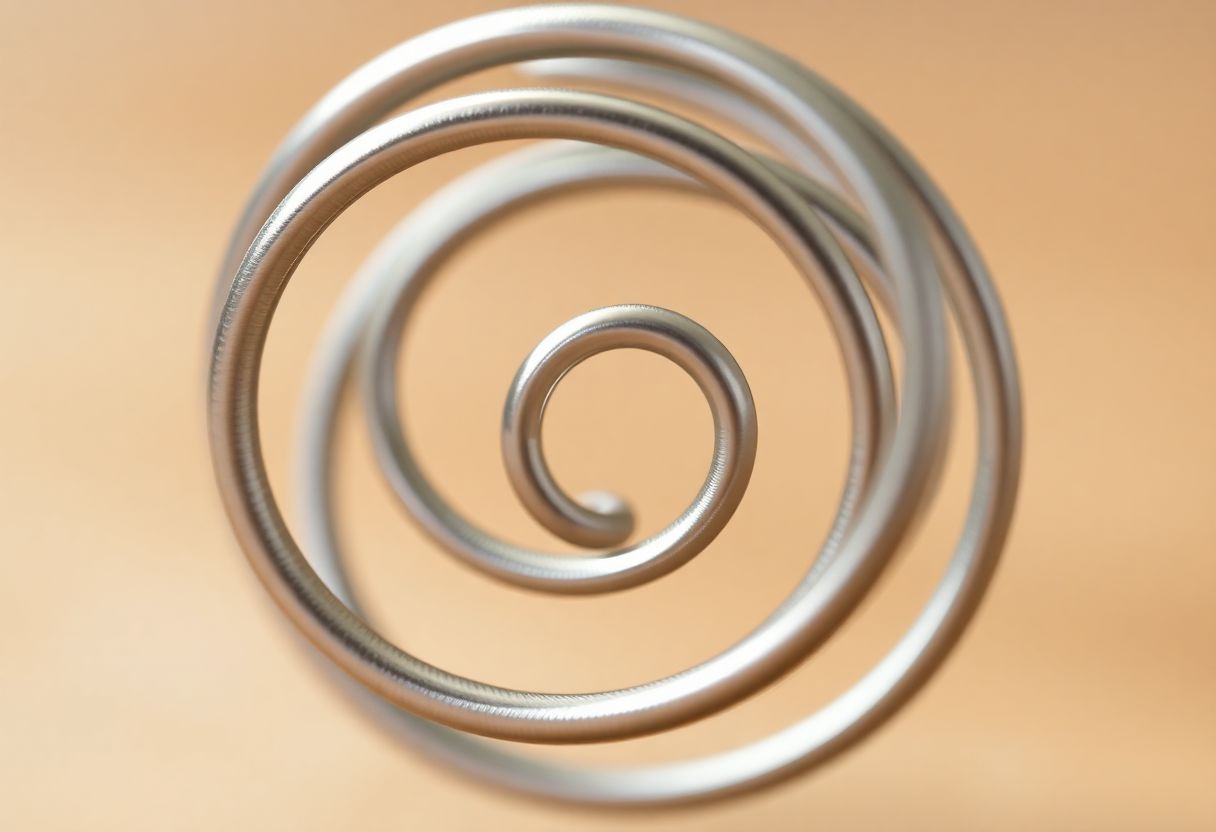
Coil springs, also known as helical springs, are the most recognizable and widely used type of spring. They consist of a wire wound into a helix, creating a cylindrical shape. Coil springs can be designed to resist compression, extension, or both.
Applications of coil springs are numerous and diverse. In automotive engineering, they're crucial components of suspension systems, providing the necessary support and shock absorption for a smooth ride. In mattresses, coil springs offer comfort and support for sleeping. Even in everyday objects like pens and staplers, small coil springs play essential roles in their functionality.
Leaf Springs: Supporting Heavy Loads
Leaf springs consist of several layers of metal strips, called leaves, stacked on top of each other. This design allows them to support heavy loads while providing a degree of flexibility. Historically, leaf springs have been widely used in vehicle suspensions, particularly in heavy-duty vehicles like trucks and some railway cars.
While newer technologies have replaced leaf springs in many modern vehicles, they still find use in certain applications where their ability to distribute weight and absorb shock is advantageous.
Torsion Springs: Twisting for Energy Storage
Torsion springs store energy by twisting around an axis. When a torque is applied, the spring material experiences stress, which is released when the torque is removed. Common applications of torsion springs include door hinges, clothespins, and various mechanical components in machines.
The design of torsion springs allows them to provide resistance to rotational motion, making them ideal for applications where a controlled pivoting or rotating action is required.
Gas Springs: Pneumatic Power
Gas springs, also known as gas struts, use compressed gas to exert force. They consist of a sealed cylinder containing pressurized gas, typically nitrogen, with a sliding piston. Gas springs offer several advantages over traditional metal springs, including adjustable force, compact design, and the ability to maintain constant force throughout their stroke.
Common applications of gas springs include supporting the lifting of car hoods and trunk lids, adjusting the height of office chairs, and controlling the motion of industrial equipment.
Constant Force Springs: Maintaining Steady Pressure
Constant force springs are a unique type designed to exert a nearly constant force over a range of extension. They are typically made from a rolled strip of spring steel that unwinds as it extends. This design allows them to provide a consistent force regardless of the extension length, within their operating range.
Retractable tape measures are a common example of constant force springs in action. They're also used in various industrial applications where a constant tension or force is required, such as in cordless vacuum cleaners and some types of counterbalance systems.
The Science of Spring Materials
The choice of material is crucial in spring design, as it directly affects the spring's performance, durability, and suitability for specific applications. Engineers must consider various factors when selecting spring materials, including strength, elasticity, corrosion resistance, and temperature tolerance.
Steel Alloys: The Workhorse of Spring Materials
Steel alloys are the most common materials used in spring manufacturing due to their excellent combination of strength, elasticity, and cost-effectiveness. Different steel alloys offer varying properties:
- High-carbon steel: Offers high strength and is commonly used for small springs.
- Chrome-silicon steel: Provides excellent fatigue resistance and is often used in valve springs for engines.
- Chrome-vanadium steel: Offers good strength and fatigue resistance, suitable for high-stress applications.
Stainless Steel: Corrosion Resistance for Challenging Environments
Stainless steel springs are used in applications where corrosion resistance is crucial. They're common in marine environments, medical devices, and food processing equipment. While generally not as strong as carbon steel springs, stainless steel springs offer superior resistance to rust and chemical corrosion.
Phosphor Bronze: Electrical Conductivity and Corrosion Resistance
Phosphor bronze, an alloy of copper with small amounts of tin and phosphorus, is often used for springs in electrical applications. It offers good electrical conductivity, corrosion resistance, and fatigue strength. These properties make it ideal for electrical contacts and switches in various devices.
Titanium: High Strength-to-Weight Ratio
Titanium springs are used in specialized applications where weight is a critical factor. They offer an excellent strength-to-weight ratio, making them valuable in aerospace and high-performance automotive applications. However, their high cost limits their use to situations where their unique properties are essential.
Exotic Materials: Pushing the Boundaries of Spring Design
As technology advances, new materials are being explored for spring applications. Shape memory alloys, like Nitinol, can return to a predetermined shape when heated, offering unique possibilities for smart spring designs. Composite materials, combining different substances, are also being developed to create springs with customized properties for specific applications.
The Manufacturing Process: Crafting Precision Springs
The production of springs is a precise process that requires careful control at each stage to ensure the final product meets the required specifications. Understanding this process provides insight into the complexity behind these seemingly simple devices.
Material Selection and Preparation
The first step in spring manufacturing is selecting the appropriate material based on the spring's intended use. The chosen material, typically in wire form, is carefully inspected for quality and consistency.
Wire Formation
For coil springs, the wire is drawn to the correct diameter through a series of dies. This process not only achieves the desired thickness but also work-hardens the material, improving its strength and elasticity.
Coiling
The wire is then wound around a mandrel to form the spring shape. This can be done cold for smaller springs or hot for larger ones. Advanced computer-controlled coiling machines ensure precise and consistent coil formation.
Heat Treatment
After coiling, springs often undergo heat treatment to enhance their properties. This process can involve heating the spring to high temperatures and then cooling it in a controlled manner. Heat treatment can improve the spring's strength, elasticity, and resistance to fatigue.
Grinding
The ends of the spring are often ground flat to ensure even load distribution when the spring is compressed. This step is crucial for springs that will be used in precision applications.
Testing and Quality Control
Finally, the springs undergo rigorous testing to ensure they meet the required specifications. This can include load testing, fatigue testing, and dimensional checks. Only springs that pass these quality control measures are approved for use.
Advanced Spring Concepts: Beyond the Basics
While the fundamental principles of springs are relatively straightforward, advanced applications and emerging technologies are pushing the boundaries of spring design and functionality.
Non-Linear Springs
Not all springs follow the linear relationship described by Hooke's Law. Non-linear springs have a force-displacement curve that isn't a straight line. These springs can be designed to provide variable resistance, offering advantages in certain applications. For example, in some automotive suspensions, non-linear springs provide a softer ride under normal conditions but stiffen up under heavy loads or during sharp maneuvers.
Composite Springs
Composite springs combine different materials or spring types to achieve specific performance characteristics. For instance, a spring might use a combination of metal and rubber to provide both strength and vibration damping. In automotive applications, composite leaf springs made from fiberglass or carbon fiber are being used to reduce weight while maintaining performance.
Smart Springs
The integration of smart materials and sensors is leading to the development of adaptive spring systems. Shape memory alloys can change their properties in response to temperature, allowing for springs that can adjust their stiffness. Piezoelectric materials, which generate electrical charge when stressed, can be incorporated into springs to create self-sensing or energy-harvesting systems.
Spring Dynamics and Oscillation
The behavior of springs in motion is a fascinating area of study that bridges the gap between statics and dynamics in physics and engineering.
Simple Harmonic Motion
When a spring is set into motion, it typically exhibits simple harmonic motion. This is characterized by a sinusoidal oscillation where the restoring force is proportional to the displacement from equilibrium. The frequency of this oscillation (f) is given by the formula:
f = (1/2π) * √(k/m)
Where k is the spring constant and m is the mass attached to the spring. This relationship is fundamental to many applications, from the ticking of mechanical watches to the design of seismographs for detecting earthquakes.
Damping and Resonance
In real-world applications, springs rarely oscillate indefinitely. Damping, often intentionally introduced through devices like shock absorbers, gradually reduces the amplitude of oscillation. Understanding and controlling damping is crucial in applications like vehicle suspensions, where the goal is to quickly absorb shocks without excessive bouncing.
Resonance occurs when a system is excited at its natural frequency, leading to large amplitude oscillations. While this can be problematic in some cases, it's also harnessed in various applications, from musical instruments to certain types of sensors.
Spring Failure Modes and Prevention
Understanding how springs can fail is crucial for both design and maintenance. Common failure modes include:
- Fatigue: Repeated cycling can lead to the formation and growth of microscopic cracks, eventually causing failure.
- Overload: Exceeding the spring's elastic limit can cause permanent deformation or breakage.
- Corrosion: Environmental factors can degrade the spring material over time.
- Stress Relaxation: Some springs may gradually lose force over time, especially at elevated temperatures.
- Buckling: Compression springs can fail by bending sideways if not properly supported.
Preventing these failures involves careful design, material selection, and consideration of the operating environment. Regular inspection and maintenance can help identify potential issues before they lead to failure.
The Future of Spring Technology
As materials science and engineering continue to advance, we can expect to see exciting developments in spring technology:
- Nanoscale Springs: At the microscopic level, researchers are exploring spring-like structures for applications in nanotechnology and molecular machines.
- Biomimetic Springs: Inspired by nature, engineers are developing springs that mimic the elastic properties of biological structures, potentially leading to more efficient and adaptable designs.
- Energy Harvesting: Springs could play a role in capturing and storing energy from ambient vibrations, contributing to the development of self-powered devices.
- 3D Printed Springs: Additive manufacturing techniques are opening up new possibilities for creating springs with complex geometries and customized properties.
Conclusion: The Enduring Importance of Springs
From the simplest paperclip to the most advanced spacecraft, springs continue to play a vital role in countless aspects of our technological world. Their ability to store and release energy in a controlled manner makes them indispensable components in mechanical systems of all scales.
As we've explored in this comprehensive guide, the science and engineering behind springs are far more complex and fascinating than their simple appearance might suggest. The interplay of materials science, physics, and innovative design continues to push the boundaries of what's possible with these fundamental mechanical elements.
Whether you're an engineer working on cutting-edge technology, a student exploring the principles of physics, or simply someone curious about the world around you, understanding springs offers valuable insights into the elegant solutions nature and human ingenuity have devised for managing energy and motion.
As we look to the future, springs will undoubtedly continue to evolve, finding new forms and applications in emerging technologies. Yet, their fundamental principle – the elastic storage and release of energy – will remain a cornerstone of mechanical engineering, a testament to the enduring power of simple physical laws in shaping our complex technological landscape.