The Magic of Induction: How Electric Toothbrushes Charge Without Wires
In the realm of everyday technology, few devices embody the seamless fusion of science and convenience quite like the electric toothbrush. At first glance, these oral hygiene tools may seem unremarkable, but a closer look reveals a fascinating world of electromagnetic wizardry. At the heart of this magic lies the induction charger – a device that powers our toothbrushes without the need for exposed electrical contacts. Let's dive into the captivating science behind this technology and explore why it's become the go-to charging method for our bathroom companions.
The Fundamentals of Induction Charging
Induction charging, often referred to as wireless charging, is a method of transferring electrical energy between two objects without direct physical contact. This technology harnesses the principle of electromagnetic induction, a phenomenon first discovered by the renowned physicist Michael Faraday in 1831.
To grasp the concept of induction charging, we need to understand a few key principles:
Electromagnetic Fields: The Invisible Force
When an electric current flows through a conductor, such as a wire, it generates a magnetic field around it. This field is invisible to the naked eye but can interact with other electrical conductors in its vicinity.
Electromagnetic Induction: Creating Current from Magnetism
The core of induction charging lies in electromagnetic induction. This principle states that a changing magnetic field can induce an electric current in a nearby conductor. It's this induced current that we harness to charge our devices.
Transformers: The Ancestors of Wireless Chargers
Transformers, which have been used in electrical systems for over a century, operate on the principle of electromagnetic induction. They transfer energy between two or more circuits through electromagnetic coupling. Induction chargers can be thought of as a special type of transformer, optimized for charging portable devices.
The Anatomy of an Electric Toothbrush Induction Charger
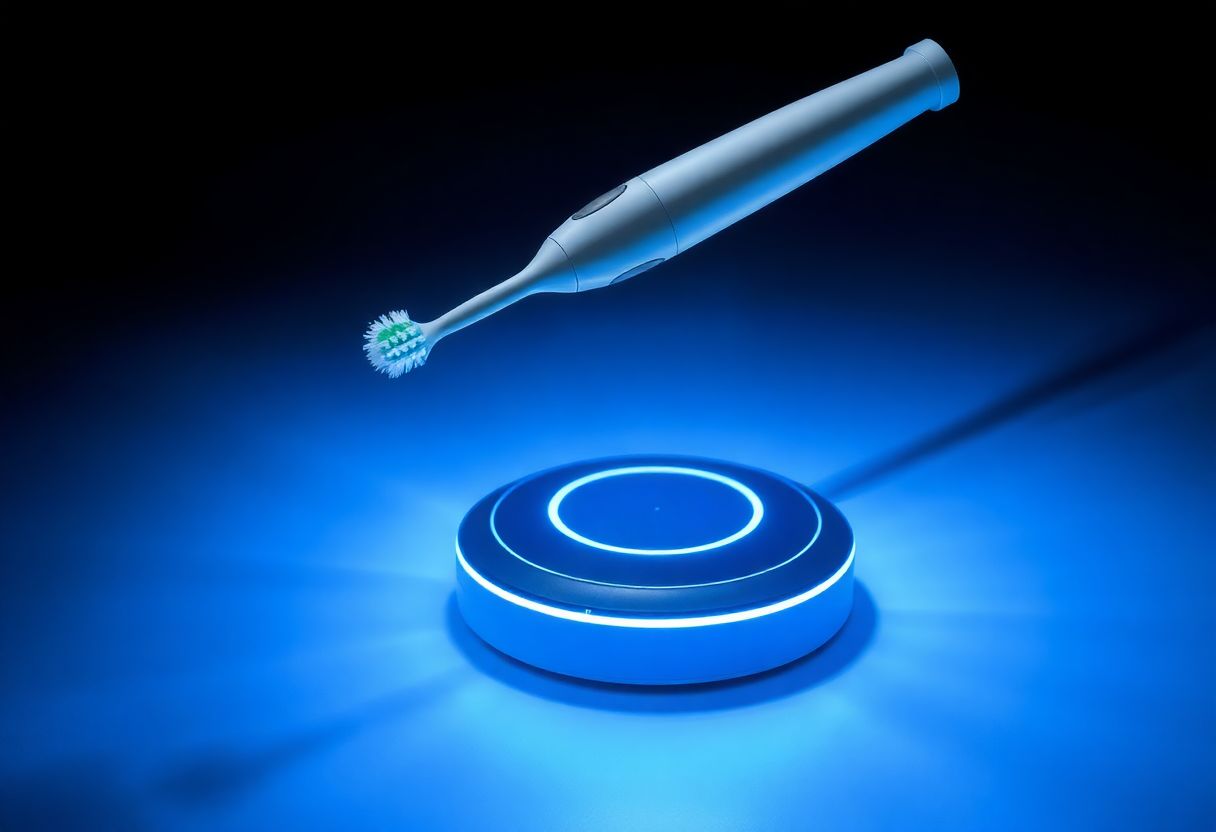
An electric toothbrush charging system consists of two primary components: the charging base and the toothbrush itself. Let's examine each in detail:
The Charging Base: The Power Source
The charging base, which plugs into a wall outlet, houses the primary coil. This coil is typically made of copper wire wound into a tight spiral. When electricity flows through this coil, it creates an oscillating magnetic field.
The Toothbrush: The Power Receiver
The bottom of the toothbrush contains the secondary coil and the rechargeable battery. The secondary coil is designed to resonate with the magnetic field produced by the primary coil in the charging base.
The Charging Process: A Dance of Fields and Currents
When you place your electric toothbrush on its charging base, a sophisticated electromagnetic dance begins:
- The primary coil in the base creates an oscillating magnetic field.
- This field penetrates the plastic housing of both the base and the toothbrush.
- The changing magnetic field induces an alternating current in the secondary coil within the toothbrush.
- This induced current is then converted to direct current using a rectifier circuit.
- The converted current charges the toothbrush's battery.
The Crucial Role of the Transformer Core
One might wonder how the magnetic field efficiently passes through the plastic of both the charging base and the toothbrush. The answer lies in a clever design feature known as the transformer core.
Most electric toothbrush charging systems incorporate a small protruding peg in the charging base. This peg is made of a ferromagnetic material, usually iron or a ferrite compound. The toothbrush has a corresponding hole in its base that fits over this peg when placed on the charger.
This peg acts as a transformer core, serving several critical functions:
- It concentrates the magnetic field, improving the efficiency of energy transfer.
- It provides a low-reluctance path for the magnetic flux, enhancing the coupling between the primary and secondary coils.
- It allows for a waterproof seal around the toothbrush's electronics while still enabling efficient wireless charging.
This split-core design is a prime example of how engineers have adapted traditional transformer technology to meet the unique needs of small, waterproof consumer devices.
The Physics Behind Induction Charging: A Deeper Dive
To truly appreciate the elegance of induction charging, we need to delve deeper into the underlying physics:
Faraday's Law of Induction: The Foundation
Faraday's Law of Induction is the cornerstone of electromagnetic induction. It states that the induced electromotive force (EMF) in a closed circuit is directly proportional to the rate of change of magnetic flux through the circuit. In mathematical terms:
EMF = -N * (dΦ/dt)
Where:
- EMF is the induced electromotive force
- N is the number of turns in the coil
- dΦ/dt is the rate of change of magnetic flux
This law explains why induction chargers use alternating current rather than direct current. A constantly changing current is necessary to create a fluctuating magnetic field, which in turn induces a current in the secondary coil.
Resonant Frequency: Tuning for Efficiency
Modern induction charging systems often operate at specific resonant frequencies to maximize energy transfer efficiency. By tuning the primary and secondary circuits to resonate at the same frequency, typically in the range of 100-300 kHz for consumer devices, engineers can significantly improve the coupling between the coils.
Electromagnetic Coupling: The Key to Power Transfer
The efficiency of energy transfer in an induction charging system depends heavily on how well the magnetic fields of the primary and secondary coils are "coupled" or aligned. Factors affecting coupling include:
- The distance between the coils
- The alignment of the coils
- The size and shape of the coils
- The presence of ferromagnetic materials to guide the magnetic field
Eddy Currents: Friend and Foe
Eddy currents are circular electric currents induced in conductive materials by changing magnetic fields. While they can cause energy loss in some applications, they're essential for the operation of induction chargers. In fact, the induced current in the secondary coil of an induction charger is essentially a controlled eddy current.
Optimizing Induction Charging Efficiency
Engineers employ several techniques to improve the efficiency of induction charging systems:
Coil Design: The Art of Winding
The shape, size, and number of turns in both the primary and secondary coils are carefully optimized. Factors considered include:
- Wire gauge and material (usually copper)
- Coil diameter and thickness
- Number of turns and layers
- Spacing between turns
Ferrite Shielding: Guiding the Invisible
Ferrite materials are often used to direct and concentrate the magnetic field, reducing energy loss. These materials have high magnetic permeability, which means they provide a low-reluctance path for magnetic flux. By strategically placing ferrite shields, engineers can:
- Improve coupling between coils
- Reduce electromagnetic interference (EMI)
- Enhance overall charging efficiency
Resonant Circuits: Harmonizing for Power
By tuning the primary and secondary circuits to resonate at the same frequency, energy transfer can be significantly improved. This involves carefully selecting capacitors and inductors to create a resonant LC circuit.
Adaptive Power Control: Smart Charging
Some advanced induction charging systems incorporate adaptive power control. These systems can adjust their power output based on the charging needs of the connected device, optimizing efficiency and reducing wasted energy.
Safety Considerations in Induction Charging
While induction charging is generally very safe, there are some important considerations:
Electromagnetic Interference (EMI)
Poorly designed induction charging systems can generate electromagnetic interference that may affect other electronic devices. To mitigate this, manufacturers must adhere to electromagnetic compatibility (EMC) standards and employ proper shielding techniques.
Heat Generation
Inefficient energy transfer can lead to heat buildup in both the charger and the device being charged. This heat must be managed to prevent damage to components or discomfort to users. Techniques for heat management include:
- Using materials with good thermal conductivity
- Incorporating heat sinks or cooling systems in high-power applications
- Implementing thermal cut-off switches for safety
Foreign Object Detection
Advanced induction chargers include systems to detect metal objects that could heat up if placed on the charging surface. This is particularly important for higher-power charging systems used with smartphones or other larger devices.
The Future of Induction Charging
As technology advances, we can expect to see significant improvements in induction charging:
Higher Power Transfer
Future systems may be able to charge larger devices more quickly. Research is ongoing into high-power induction charging for applications such as electric vehicles, with some systems capable of transferring power in the kilowatt range.
Greater Distance
Current consumer induction charging typically requires devices to be in close proximity to the charger. However, research is ongoing into mid-range wireless power transfer, potentially allowing devices to charge from several feet away. Technologies being explored include:
- Strongly coupled magnetic resonance
- Beamformed radio frequency (RF) power transfer
- Distributed resonator arrays
Multidevice Charging
Imagine a single charging surface that can power multiple devices simultaneously, regardless of their position. This technology is already emerging in the form of "free-positioning" charging pads for smartphones and is likely to become more widespread and capable in the coming years.
Beyond Toothbrushes: Other Applications of Induction Charging
The principles used in electric toothbrush chargers have been adapted for a wide range of applications:
Smartphone Charging Pads
Many modern smartphones support wireless charging using the Qi standard, which is based on induction charging technology. These charging pads typically operate at higher power levels than toothbrush chargers, up to 15 watts or more for fast charging.
Electric Vehicle Charging
Some electric cars can be charged by parking over large induction pads. These systems operate at much higher power levels, typically in the range of 3.3 to 11 kW for passenger vehicles, with even higher powers possible for commercial vehicles.
Medical Implants
Certain implantable medical devices, such as cochlear implants and ventricular assist devices, can be recharged through the skin using induction. This eliminates the need for wired connections that could introduce infection risks.
Industrial Applications
Induction power transfer is used in various industrial settings, including:
- Automated guided vehicles (AGVs) in warehouses
- Underwater vehicles and sensors
- Hazardous environments where sparks from electrical contacts could be dangerous
DIY Induction Charging: A Simple Experiment
For those interested in exploring electromagnetic induction hands-on, here's a simple experiment you can try at home:
Materials Needed:
- A strong neodymium magnet
- A small coil of wire (you can wrap copper wire around a cardboard tube)
- A sensitive voltmeter or galvanometer
Procedure:
- Connect the ends of the coil to the voltmeter or galvanometer.
- Quickly move the magnet in and out of the coil.
- Observe the meter – you should see a small voltage induced as the magnet moves!
This simple setup demonstrates the basic principle behind your electric toothbrush charger. The moving magnet creates a changing magnetic field, which induces a small current in the coil.
Conclusion: The Invisible Power of Induction
Induction charging, as exemplified by electric toothbrush chargers, is an elegant solution that brings together principles of electromagnetism discovered nearly two centuries ago with modern electronic engineering. This technology offers a unique combination of convenience, safety, and durability that makes it ideal for bathroom electronics and beyond.
As we've explored, the science behind induction charging is both fascinating and complex. From Faraday's fundamental laws to the intricate design of modern charging systems, each aspect plays a crucial role in bringing this technology to our daily lives.
The next time you place your electric toothbrush on its charger, take a moment to appreciate the invisible dance of magnetic fields and electric currents happening beneath the surface. It's a small but significant example of how understanding and harnessing the laws of physics can lead to practical innovations that improve our daily lives.
As wireless charging technology continues to evolve, we can look forward to a future where the hassle of cords and plugs becomes a thing of the past. From smartphones to electric vehicles, and perhaps even entire rooms capable of wireless power delivery, the principles demonstrated in that humble electric toothbrush charger are paving the way for a more connected and convenient world.
In the grand tapestry of technological progress, induction charging may seem like a small thread. Yet, it represents a perfect harmony of scientific principle and practical application – a testament to human ingenuity and our endless quest to improve the world around us, one invisible power transfer at a time.