The Marvels of Iron and Steel: Forging the Foundation of Modern Civilization
Iron and steel have been the backbone of human progress for millennia, shaping our world in ways both visible and subtle. From towering skyscrapers that pierce the clouds to the intricate machinery powering our industries, these remarkable materials have become an integral part of our daily lives. In this comprehensive exploration, we'll delve into the fascinating world of iron and steel, uncovering their properties, production methods, and the myriad ways they continue to impact our society.
The Elemental Foundations: Iron and Carbon
At the heart of our story lies iron, a chemical element with the symbol Fe and atomic number 26. As the fourth most abundant element in Earth's crust, iron has been a constant companion in human development. Pure iron presents itself as a silvery-white metal with a lustrous sheen, relatively soft and malleable. Its ferromagnetic properties allow it to be magnetized, a characteristic that has proven invaluable in numerous applications throughout history.
While iron forms the base, it's the addition of carbon that transforms this simple element into the versatile alloy we know as steel. Steel typically contains less than 2% carbon, along with small amounts of other elements like manganese, silicon, phosphorus, sulfur, and oxygen. This carefully balanced composition results in a material that surpasses iron in strength, durability, and adaptability.
From Earth to Element: The Journey of Iron
Iron's journey from the Earth's crust to its elemental form is a testament to human ingenuity and the power of metallurgy. The process begins with iron ores, natural repositories of iron compounds found in various geological formations. The most common iron ores include hematite (Fe2O3), magnetite (Fe3O4), limonite (FeO(OH)·nH2O), and siderite (FeCO3).
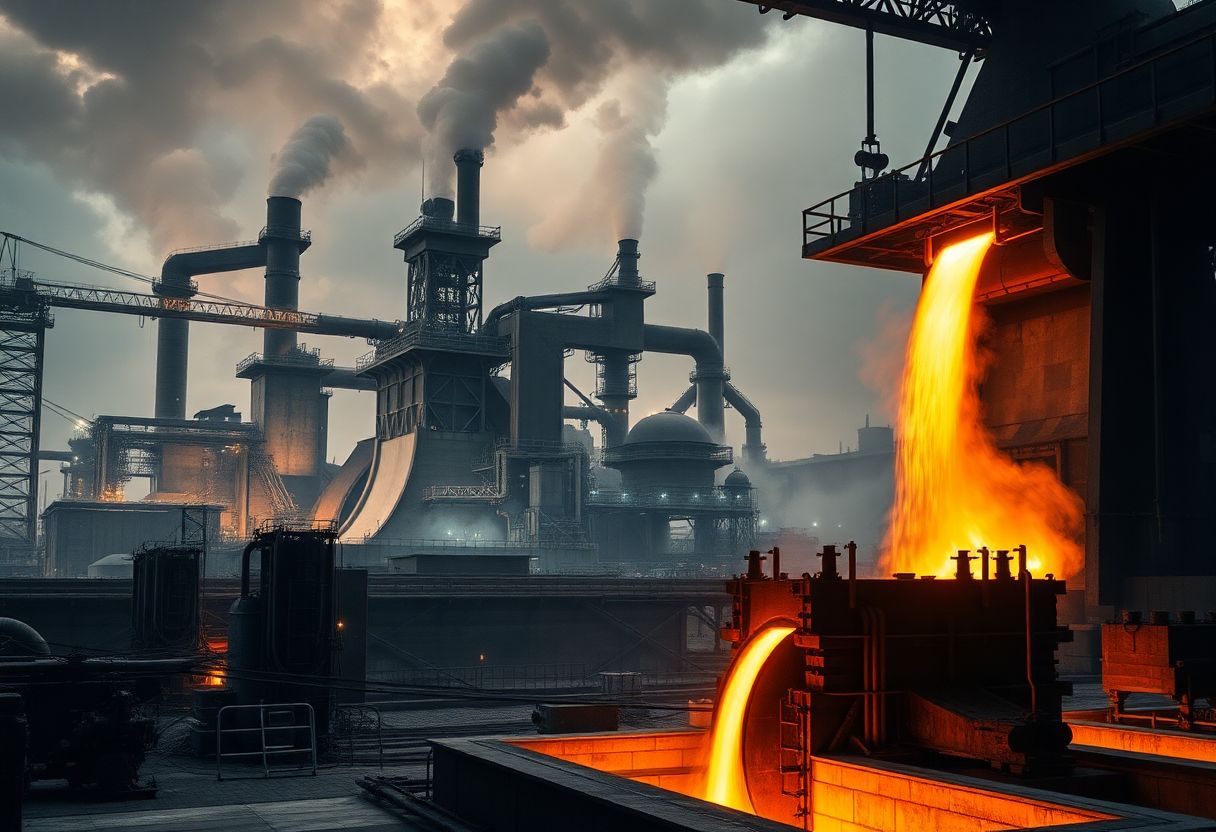
The extraction of iron from these ores involves a series of complex steps. It begins with mining, where iron ore is extracted through surface or underground operations. The ore then undergoes beneficiation, a process of crushing, sorting, and concentrating to increase its iron content. The heart of the extraction process lies in smelting, where the concentrated ore is heated in a blast furnace along with limestone and coke. This reduction process removes oxygen from the iron oxide, resulting in molten iron.
The Many Faces of Iron: A Spectrum of Utility
The versatility of iron is evident in its various forms, each with unique properties and applications. Pig iron, the most basic form produced directly from iron ore, serves as the primary raw material for other iron products and steel. Despite its brittleness, pig iron plays a crucial role in the metallurgical industry.
Cast iron, created by re-melting pig iron often with scrap iron and steel, offers high compressive strength and excellent wear resistance. Its good fluidity when molten makes it ideal for casting complex shapes, finding applications in engine blocks, machine bases, and even traditional cookware.
Wrought iron, though less common in modern construction, remains valued for its high malleability, ductility, and corrosion resistance. Its fibrous nature and low carbon content (less than 0.08%) make it particularly suitable for decorative ironwork and historical restorations.
Steel: The Alloy that Revolutionized the World
Steel stands as perhaps the most influential material in human history, its impact felt across every sector of modern society. The key to steel's remarkable properties lies in the careful balance of iron and carbon, along with other alloying elements. The carbon content in steel typically ranges from 0.05% to 2%, significantly less than in cast iron. This lower carbon content gives steel its characteristic blend of strength and ductility.
The world of steel is vast and varied, with numerous types tailored for specific applications. Carbon steel, the most common type, is classified based on its carbon content. Low carbon steel (0.05-0.25% carbon) finds use in car bodies and pipes due to its softness and ductility. Medium carbon steel (0.29-0.54% carbon), stronger than its low-carbon counterpart, is often employed in machinery parts and axles. High carbon steel (0.55-0.95% carbon), while less ductile, offers superior strength, making it ideal for tools and springs.
Alloy steels introduce significant amounts of elements beyond carbon to enhance specific properties. Manganese increases hardenability, nickel improves toughness and corrosion resistance, chromium enhances hardness and corrosion resistance, and molybdenum improves strength at high temperatures. These alloy steels find critical applications in aircraft parts, automotive components, and power generators.
Stainless steel, renowned for its corrosion resistance, contains at least 10.5% chromium. This forms a protective layer of chromium oxide on the surface, safeguarding the metal against rust and corrosion. Austenitic stainless steels, non-magnetic and highly corrosion-resistant, are ubiquitous in cutlery and medical instruments. Ferritic stainless steels offer a more economical alternative, while martensitic stainless steels can be hardened through heat treatment, making them suitable for high-stress applications.
Tool steels represent the pinnacle of hardness and heat resistance in the steel family. Often containing high amounts of tungsten, molybdenum, vanadium, and cobalt, these steels are indispensable in the production of cutting tools, dies, and machine parts subjected to extreme stress.
The Art and Science of Steelmaking
The production of steel is a testament to human ingenuity, combining ancient knowledge with cutting-edge technology. Basic Oxygen Steelmaking (BOS) accounts for about 70% of global steel production. In this process, molten pig iron is poured into a large vessel, and oxygen is blown into the molten metal. This oxidizes impurities and lowers the carbon content. Alloying elements are then added to achieve the desired composition before the molten steel is poured into molds to solidify.
Electric Arc Furnace (EAF) steelmaking, often used for producing high-quality alloy steels, offers an alternative method. Steel scrap and sometimes direct-reduced iron are loaded into a furnace where powerful electric arcs melt the metal. Oxygen is blown in to purify the steel, followed by the addition of alloying elements to refine the steel to the desired composition.
The properties of steel can be further enhanced through various heat treatments. Annealing, which involves heating and slow cooling, increases ductility and reduces hardness. Quenching, or rapid cooling, increases hardness but can make the steel brittle. Tempering, the process of reheating quenched steel, helps reduce this brittleness. Normalizing, which involves heating above the critical temperature and cooling in air, refines the grain structure of the steel.
Iron and Steel in the Modern World
The impact of iron and steel on our modern world cannot be overstated. In construction, steel frames allow skyscrapers to reach unprecedented heights, while its strength-to-weight ratio makes it ideal for long-span bridges. The transportation industry relies heavily on steel, with the average car comprising about 60% steel by weight. Modern cargo ships are primarily built with steel, and high-strength steels are crucial components in aircraft landing gear.
In the energy sector, steel plays a vital role in both traditional and renewable technologies. Steel towers support massive wind turbine blades, steel pipes transport oil and natural gas across vast distances, and steel containment vessels ensure safety in nuclear reactors.
Even in our homes and offices, steel is omnipresent. From refrigerators and washing machines to office chairs and filing cabinets, steel components are integral to many of the products we use daily. The food industry relies on steel cans for packaging and preserving a wide range of products.
Environmental Challenges and Solutions
Despite its numerous benefits, the iron and steel industry faces significant environmental challenges. Steel production accounts for about 7-9% of global CO2 emissions, making it a major contributor to climate change. The industry is also energy-intensive, often relying on fossil fuels, and requires large amounts of water for cooling and processing.
However, the industry is actively working to reduce its environmental footprint. Steel's 100% recyclability is a significant advantage, and increased recycling rates help reduce energy consumption and emissions. Modern steel plants are implementing more efficient technologies and processes to minimize energy use. Some steelmakers are exploring alternative fuels, such as hydrogen and electricity, to replace coal. Research is also ongoing into carbon capture technologies to mitigate CO2 emissions.
The Future of Iron and Steel
As we look to the future, the iron and steel industry continues to innovate and evolve. Researchers are developing advanced materials like nanostructured steels with ultra-high strength and improved ductility. Transformation-Induced Plasticity (TRIP) steels combine strength and formability, opening new possibilities in automotive and aerospace applications. Perhaps most intriguingly, self-healing steels that can repair micro-cracks autonomously are on the horizon.
The industry is also moving towards more sustainable production methods. Hydrogen-based steelmaking, which uses hydrogen instead of coal as a reducing agent, shows promise in significantly reducing carbon emissions. Electrolysis of iron ore, enabling direct extraction of iron using electricity, is another area of active research. Some companies are exploring the use of sustainable biomass as an alternative to coal in steelmaking.
Digitalization and Industry 4.0 technologies are transforming the iron and steel industry. Predictive maintenance using sensors and artificial intelligence optimizes equipment performance and reduces downtime. Digital twins, virtual models of steel plants, aid in optimization and training. Additive manufacturing, or 3D printing with steel, allows for the production of complex components with reduced waste.
Conclusion
Iron and steel have been fundamental to human progress for millennia, and their importance shows no signs of waning. From the tallest skyscrapers to the tiniest surgical instruments, these versatile materials continue to shape our world. As we face the challenges of the 21st century, including climate change and resource scarcity, the iron and steel industry is evolving, developing new materials and processes that promise to be stronger, more efficient, and more sustainable than ever before.
The story of iron and steel is far from over. It's a tale of human ingenuity, scientific discovery, and technological advancement that continues to unfold. As we look to the future, iron and steel will undoubtedly play a crucial role in building a more sustainable, resilient, and prosperous world for generations to come. From the depths of the Earth to the frontiers of space, iron and steel will continue to be the backbone of human innovation and progress.