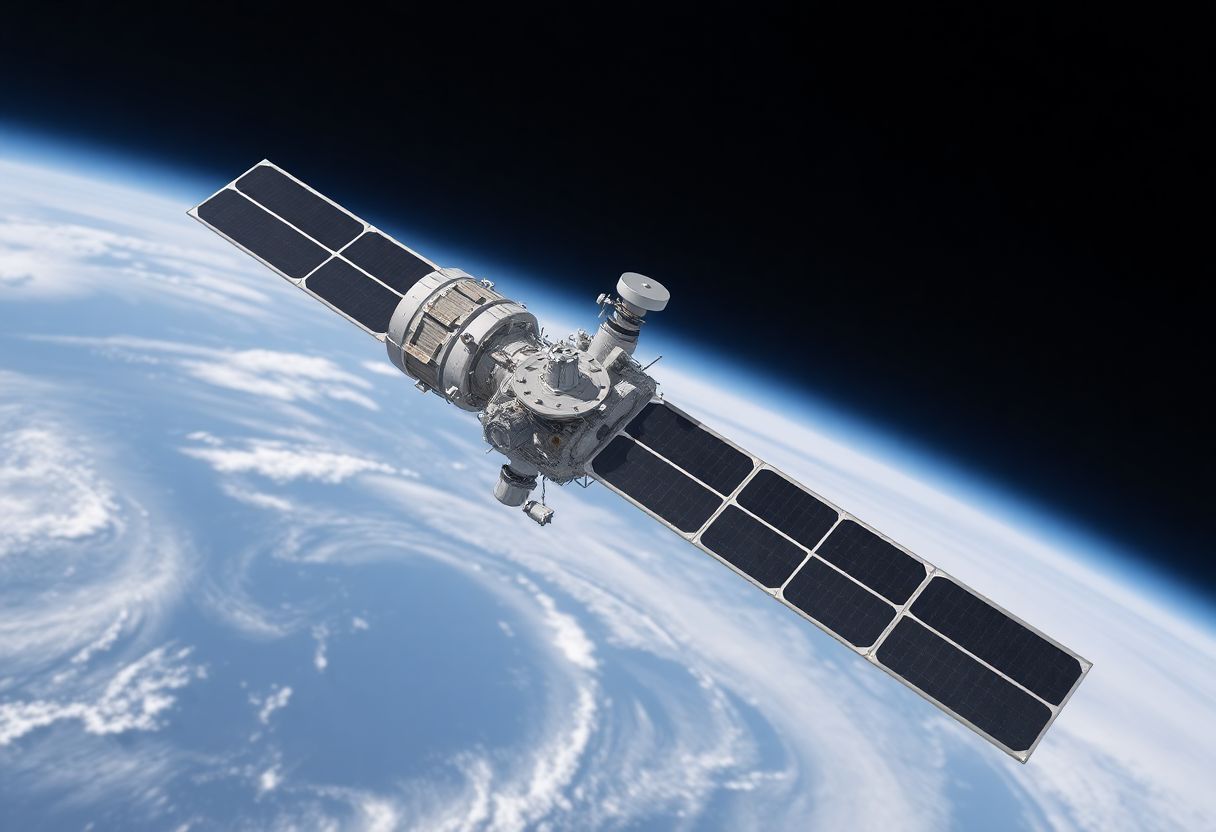
Unveiling the Marvels of Satellite Technology: Our Silent Guardians in the Sky
In an age where instant global communication and precise navigation have become second nature, it's easy to forget the silent sentinels orbiting high above us that make it all possible. Satellites, these technological marvels, have revolutionized our world in ways both seen and unseen. From enabling your smartphone's GPS to predicting tomorrow's weather, satellites have become the unsung heroes of our modern civilization. Let's embark on a journey to understand these incredible machines and their profound impact on our daily lives.
The Basics: What Exactly is a Satellite?
At its core, a satellite is any object that orbits a larger body. While this definition encompasses natural satellites like our Moon, we'll focus on the artificial satellites that humanity has launched into space. These range from tiny CubeSats, no larger than a loaf of bread, to massive communications satellites rivaling the size of a school bus.
Despite their varying sizes and purposes, all satellites share some fundamental characteristics. They orbit Earth (or occasionally other celestial bodies) at specific altitudes and velocities, carry specialized equipment to perform their intended functions, require a power source (usually solar panels), and possess systems for communicating with ground stations on Earth.
The Intricate Anatomy of a Satellite
To truly appreciate how satellites function, we need to dissect their components:
-
The Bus: This is the satellite's main body, housing all other components and providing structural integrity.
-
The Payload: The heart of the satellite, containing the specialized equipment that performs its primary function.
-
Power System: Most satellites utilize solar panels to generate electricity, with batteries for storage during periods in Earth's shadow.
-
Propulsion System: Small thrusters allow for minor orbital and orientation adjustments.
-
Attitude Control System: This keeps the satellite properly oriented, ensuring antennas or cameras point in the right direction.
-
Thermal Control System: Essential for regulating temperature in the extreme conditions of space.
-
Communications System: Enables the satellite to receive commands and transmit data back to Earth.
-
Computer and Data Handling System: The "brain" of the satellite, controlling all functions and processing data.
The Physics of Staying Aloft: How Satellites Maintain Orbit
One of the most fascinating aspects of satellites is how they remain in orbit around Earth. It's a delicate balance between two fundamental forces: gravity and centrifugal force. Earth's gravitational pull constantly tries to draw the satellite back down, while the satellite's forward motion creates an outward centrifugal force that counteracts gravity.
When these forces are in perfect equilibrium, the satellite achieves a stable orbit. In essence, it's perpetually falling around the Earth, moving fast enough horizontally that it never actually hits the ground. This concept, first proposed by Isaac Newton in his "cannonball" thought experiment, forms the basis of modern orbital mechanics.
The speed required to maintain orbit varies depending on the satellite's altitude:
- In Low Earth Orbit (LEO), at 160-2,000 km altitude, satellites zip around the Earth at about 7.8 km/s.
- In Medium Earth Orbit (MEO), between 2,000-35,786 km, the orbital velocity drops to around 3.1 km/s.
- At Geostationary Orbit (GEO), precisely 35,786 km above the equator, satellites move at a speed that matches Earth's rotation, appearing to hover over the same spot on the ground.
A Sky Full of Paths: Types of Satellite Orbits
Satellites follow different orbits depending on their intended purpose:
-
Low Earth Orbit (LEO): Used for Earth observation, some communications, and human spaceflight. Satellites here complete an orbit every 90 minutes.
-
Medium Earth Orbit (MEO): Home to navigation satellites like GPS. These satellites take 2-24 hours to complete an orbit.
-
Geostationary Orbit (GEO): Ideal for communications and weather satellites. At this altitude, satellites appear stationary relative to Earth's surface.
-
Polar Orbit: These satellites pass over Earth's poles, making them perfect for global Earth observation and weather monitoring.
-
Sun-Synchronous Orbit: A special type of polar orbit where satellites pass over the same spot at the same local time each day, useful for spy satellites and consistent Earth observation.
The Multifaceted Roles of Satellites: What Do They Do For Us?
Satellites serve a wide array of purposes, impacting our lives in numerous ways:
1. Communications: Connecting the World
Communication satellites act as mirrors in space, bouncing signals from one part of the Earth to another. This process enables global telephone calls, international television broadcasts, internet connectivity in remote areas, and mobile phone communications.
When you make an international call or watch a live event from another continent, you're likely benefiting from satellite technology. These satellites receive signals from Earth (uplink), amplify them, potentially change their frequency, and then transmit them back down (downlink) to another location on the planet.
2. Navigation: Finding Our Way
Global Navigation Satellite Systems (GNSS) like GPS, GLONASS, and Galileo use a network of satellites to provide precise location and timing information. Each satellite in these constellations continuously broadcasts its position and the time the signal was sent. A receiver, like your smartphone, picks up signals from multiple satellites and calculates its position based on the time differences between when the signals were sent and received.
This technology not only helps you navigate to new locations but also enables precise timing for financial transactions, synchronizes power grids, and aids in search and rescue operations.
3. Earth Observation and Weather Forecasting: Monitoring Our Planet
Satellites equipped with advanced cameras and sensors provide invaluable data about our planet. Weather satellites track cloud patterns, measure atmospheric conditions, and help meteorologists predict weather patterns and severe storms. The satellite imagery you see during weather forecasts comes from these geostationary sentinels constantly watching over Earth's atmosphere.
Earth observation satellites monitor everything from urban growth and deforestation to ocean temperatures and ice cap melting. This data is crucial for understanding and addressing climate change, managing natural resources, and responding to natural disasters.
4. Scientific Research: Expanding Our Knowledge
Many satellites are dedicated to scientific missions, studying everything from distant galaxies to Earth's magnetic field. The Hubble Space Telescope, for instance, has revolutionized our understanding of the universe, capturing breathtaking images of distant galaxies and providing insights into the nature of dark matter and dark energy.
Earth science missions like NASA's OCO-3 (Orbiting Carbon Observatory-3) study climate change by precisely measuring carbon dioxide levels in Earth's atmosphere. Other satellites monitor solar activity and space weather, helping protect our technology-dependent society from potentially disruptive solar storms.
5. Military and Intelligence: Safeguarding National Security
While less discussed publicly, many satellites serve military and intelligence purposes. Reconnaissance satellites provide high-resolution imagery for intelligence gathering, early warning satellites detect missile launches, and military communications satellites ensure secure, global communications for armed forces.
The Evolution of Satellite Technology: A Brief History
The history of artificial satellites is a testament to human ingenuity and the rapid pace of technological advancement:
- 1957: The Soviet Union launches Sputnik 1, the first artificial satellite, marking the beginning of the Space Age.
- 1962: Telstar 1, the first active communications satellite, is launched, enabling the first live transatlantic television broadcast.
- 1964: The first geostationary satellite, Syncom 3, is placed in orbit, revolutionizing global communications.
- 1978: The first GPS satellite is launched, paving the way for modern navigation systems.
- 1990: The Hubble Space Telescope begins its mission, providing unprecedented views of the universe.
- 2000s: The rise of small satellites, including CubeSats, democratizes access to space.
The Small Satellite Revolution: Democratizing Space
Recent years have seen a trend towards smaller, cheaper satellites, revolutionizing the space industry:
CubeSats, standardized satellites built in 10cm cube units, have become popular for scientific research and technology demonstration. Nanosatellites, weighing between 1-10 kg, offer a low-cost option for space-based experiments and observations.
These small satellites are reducing the cost of space missions, allowing universities and small companies to launch their own satellites, and enabling new applications like global internet coverage from space. Companies like SpaceX and OneWeb are launching vast constellations of small satellites to provide global broadband internet access.
Challenges and Future Developments: The Road Ahead
Despite their many benefits, satellites face several challenges:
-
Space Debris: The increasing number of satellites and defunct spacecraft in orbit poses a collision risk, potentially leading to a cascade of collisions known as the Kessler Syndrome.
-
Limited Lifespan: Most satellites have a finite operational life due to fuel depletion and component degradation in the harsh space environment.
-
Signal Interference: As more satellites crowd Earth's orbit, managing radio frequency interference becomes more complex.
To address these challenges and expand capabilities, several exciting developments are on the horizon:
-
Satellite Servicing: Companies are developing spacecraft that can repair or refuel satellites in orbit, extending their operational lifespan.
-
Artificial Intelligence: Implementing AI for more autonomous satellite operations and data processing will enhance efficiency and reduce the need for constant human oversight.
-
Quantum Communications: Using quantum entanglement for ultra-secure satellite communications could revolutionize data security.
-
Mega-Constellations: Large networks of small satellites to provide global internet coverage are already being deployed, with companies like SpaceX's Starlink leading the charge.
Conclusion: Our Silent Guardians
As we've explored, satellites have become an indispensable part of our modern world, silently orbiting above us and enabling technologies we now take for granted. From the phone in your pocket to the weather forecast on your TV, from the preservation of our environment to the exploration of distant galaxies, satellites play a crucial role in countless aspects of our daily lives and scientific endeavors.
As we look to the future, satellites will continue to evolve, becoming smaller, smarter, and more capable. They will play a key role in addressing global challenges like climate change, connectivity, and scientific discovery. The next time you gaze up at the night sky, remember the intricate dance of technology taking place high above, working tirelessly to connect, inform, and empower our world.
In this age of rapid technological advancement, satellites remain our silent guardians, expanding our understanding of the universe and our place within it. As we continue to push the boundaries of what's possible in space, these remarkable machines will undoubtedly play a central role in shaping our future, both on Earth and beyond.