1986 Quarter Value: How Much Is it Worth Today?
As a professional numismatist with decades of experience handling Washington quarters, I‘ve witnessed countless collectors‘ faces light up when discovering a valuable 1986 quarter in their collection. While most 1986 quarters you‘ll encounter are worth their face value, some specimens can command impressive premiums that might surprise you. Let me share my expertise to help you understand what makes these coins valuable and how to identify the specimens worth collecting.
Historical Context of the 1986 Quarter
The 1986 Washington quarter represents an interesting period in American coinage. By this time, the Washington quarter design had been in circulation for over 50 years, having replaced the Standing Liberty quarter in 1932. Originally intended as a one-year commemorative for George Washington‘s 200th birthday, the design‘s popularity led to its permanent adoption.
The composition of these quarters reflects the significant changes implemented in 1965, when rising silver prices forced the U.S. Mint to switch from 90% silver to a copper-nickel clad composition. The 1986 quarter consists of outer layers of 75% copper and 25% nickel bonded to a pure copper core, giving a total composition of 91.67% copper and 8.33% nickel.
Mintage and Production Details
In 1986, three U.S. Mint facilities produced quarters:
- Philadelphia Mint: 551,199,333 pieces
- Denver Mint: 504,298,660 pieces
- San Francisco Mint: 3,010,497 proof coins
These substantial mintage numbers explain why most 1986 quarters aren‘t particularly rare. However, the quality of preservation makes all the difference in value.
Understanding the Design Elements
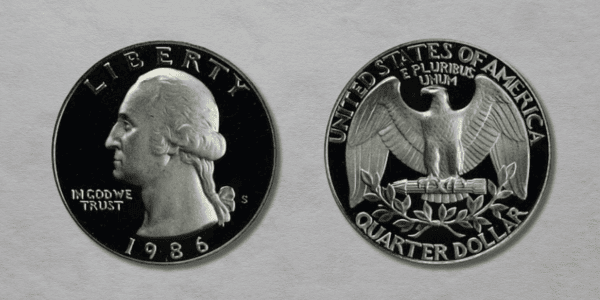
The obverse features John Flanagan‘s dignified portrait of George Washington, based on Jean-Antoine Houdon‘s 1785 bust. The design includes:
- Washington‘s profile facing left
- "LIBERTY" above the portrait
- "IN GOD WE TRUST" to the left
- Date and mint mark below
The reverse shows:
- A heraldic eagle with spread wings
- Bundle of arrows in talons
- Olive branches below
- "UNITED STATES OF AMERICA" above
- "QUARTER DOLLAR" below
- "E PLURIBUS UNUM" in the field
Current Market Values
The value of 1986 quarters varies significantly based on condition:
Circulated Specimens:
- Average circulated: 25 cents
- Well-preserved circulated: [$.50-1.00]
Uncirculated Specimens:
- MS-60 to MS-63: [$1-3]
- MS-64: [$5-8]
- MS-65: [$10-15]
- MS-66: [$30-50]
- MS-67: [$100-500]
- MS-67+ and above: [$500-2,880]
Proof Coins:
- Regular Proof: [$2-5]
- Cameo Proof: [$18-25]
- Deep Cameo Proof: [$100-552]
Notable Error Varieties
Some of the most valuable 1986 quarters are error coins. Here are the most significant varieties I‘ve encountered:
Broad Strike Errors: When the collar fails to contain the planchet during striking, resulting in a wider, thinner coin. These typically sell for [$20-100].
Double Strikes: Coins struck twice by the dies, showing overlapping images. Values range from [$125-500] depending on the severity.
Off-Center Strikes: When the planchet isn‘t properly centered during striking. Values increase with the percentage off-center:
- 10% off-center: [$20-30]
- 20% off-center: [$40-60]
- 50% off-center: [$150-300]
Wrong Planchet Errors: 1986 quarters struck on nickel planchets are particularly valuable, commanding [$300-1,000].
Authentication Guidelines
Through my years of experience, I‘ve developed a reliable process for authenticating 1986 quarters:
Visual Inspection:
First, examine the overall appearance under good lighting. Authentic coins show crisp design details and proper copper-nickel coloration. The reeding on the edge should be sharp and evenly spaced.
Weight and Measurements:
Use a precise digital scale and calipers to verify:
- Weight: 5.67 grams (±0.1 grams)
- Diameter: 24.3mm
- Thickness: 1.75mm
Surface Analysis:
Under 10x magnification, look for:
- Proper metal flow lines
- Natural luster patterns
- Expected surface texture
- Authentic strike characteristics
Conservation and Storage
Proper preservation is crucial for maintaining value. Based on my experience, I recommend:
Environmental Control:
- Maintain constant temperature (65-72°F)
- Keep relative humidity below 50%
- Avoid direct sunlight
- Prevent exposure to chemicals
Storage Solutions:
- Use inert, non-PVC holders
- Consider PCGS or NGC slabs for valuable specimens
- Store in album systems for collections
- Use cotton gloves when handling
Regional Market Variations
Through my dealings across the country, I‘ve noticed distinct regional patterns in 1986 quarter values:
Northeast:
- Higher premiums for proof coins
- Strong demand for top-grade specimens
- Active auction market
Midwest:
- Premium prices for error varieties
- Strong collector base for original mint state coins
- Regular coin show activity
West Coast:
- Higher overall prices
- Strong demand for certified coins
- Active dealer network
Southeast:
- Growing collector interest
- Moderate price points
- Emerging market for high-grade examples
Investment Strategies
For those considering 1986 quarters as investments, I suggest:
Focus on Quality:
The greatest potential lies in high-grade specimens. MS-67 coins have shown consistent appreciation, particularly those with exceptional eye appeal.
Target Special Varieties:
Major error coins, especially dramatic off-centers and wrong planchets, have demonstrated strong growth potential.
Consider Proof Coins:
Deep Cameo proofs in PR69 and PR70 grades offer solid investment potential, particularly when acquired at reasonable prices.
Building a Collection
For collectors starting with 1986 quarters, I recommend:
Basic Set:
- Philadelphia Mint example
- Denver Mint example
- San Francisco proof specimen
Advanced Set:
- High-grade business strikes (MS-65 or better)
- Deep Cameo proof
- Notable error variety
- Multiple grade points for comparison
Conclusion
The 1986 Washington quarter presents fascinating opportunities for both collectors and investors. While most examples are worth face value, exceptional specimens can command significant premiums. Understanding the nuances of grading, authentication, and market dynamics will help you make informed decisions whether buying or selling these interesting pieces of American numismatic history.
Remember, condition is paramount, and patience in searching for the right specimens will reward you with better long-term results. Whether you‘re a seasoned collector or just starting out, the 1986 quarter offers an accessible entry point with potential for significant returns on carefully chosen examples.