How Much Is a $10,000 Bill Worth? (Most Valuable Sold For $504,000)
As I held my first $10,000 bill during an authentication session at a major auction house, the weight of history in my hands was palpable. This wasn‘t just currency – it was a rare artifact from an era when financial transactions worked very differently from today. That particular note would later sell for $504,000, highlighting the extraordinary value these bills now command in the collector‘s market.
The Evolution of High-Denomination Currency
The story of the $10,000 bill begins in an America without digital banking or electronic transfers. In the early 20th century, banks needed efficient ways to move large sums of money between institutions. The Federal Reserve‘s solution was to print high-denomination notes, with the $10,000 bill serving as the largest denomination ever released to the public.
The practical necessity of these bills becomes clear when you consider the economic landscape of their time. A bank in Chicago needing to transfer $1 million to New York would require only 100 of these notes, rather than 10,000 $100 bills. This efficiency made these notes invaluable for inter-bank transactions, though they rarely circulated among the general public.
The Three Series: A Detailed Examination
The 1918 Series: The Holy Grail
The 1918 series represents the most elusive of all $10,000 bills. Only five specimens are known to exist, all held in government institutions. These notes feature distinct characteristics:
The paper contains distinctive silk fibers, a security measure that helped prevent counterfeiting. The printing technique utilized a wet-paper process that created uniquely sharp detail in the engravings. Each known specimen carries one of these serial numbers: B1A, B420A, D1A, L204, and L1957A.
The 1928 Series: The Premium Collectible
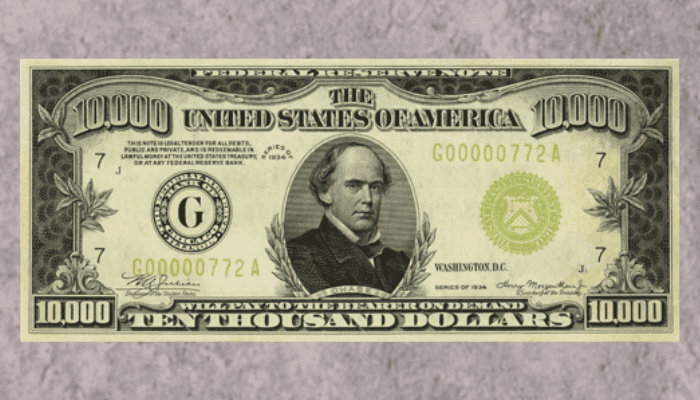
With only ten known specimens, the 1928 series commands extraordinary prices. The printing quality improved from the 1918 series, featuring stronger detail in Chase‘s portrait and crisper geometric patterns on the reverse.
The recent sale of an MS-58 grade specimen for $504,000 demonstrates the tremendous value collectors place on these notes. The eight specimens in private hands typically trade between serious collectors through private treaty sales, making public auctions rare events.
The 1934 Series: The "Accessible" Rarity
Though 328 specimens make this the most numerous series, finding one remains incredibly challenging. These notes incorporate subtle security improvements, including modified fiber patterns in the paper and enhanced ink formulations.
Recent sales show prices ranging from $90,000 for circulated specimens to over $300,000 for pristine examples. The market has seen steady appreciation, with prices doubling over the past decade.
Authentication: The Science Behind Verification
Authenticating a $10,000 bill requires extensive expertise and specialized equipment. The process begins with high-resolution microscopic analysis of the paper structure. Genuine specimens contain precisely positioned silk fibers that were embedded during manufacturing.
The printing examination focuses on several key areas:
- Intaglio printing depth and consistency
- Ink chemical composition analysis
- Serial number font characteristics
- Treasury seal precise measurements
- Ultraviolet light response patterns
Modern forgeries often fail in subtle ways, such as incorrect paper thickness or inaccurate ink formulations. Professional authentication services maintain databases of known genuine specimens, allowing for detailed comparisons of specific characteristics.
Conservation Science and Preservation
Proper preservation of these valuable notes requires understanding of paper chemistry and environmental control. The ideal storage environment maintains:
- Temperature between 65-70°F (18-21°C)
- Relative humidity at 45-50%
- Zero UV light exposure
- Minimal air pollutant exposure
Professional conservation involves:
- Non-invasive cleaning techniques
- pH-neutral materials for storage
- Regular condition monitoring
- Documentation of any changes
- Specialized handling protocols
Market Analysis and Investment Considerations
The market for $10,000 bills operates differently across regions. East Coast collectors typically pay premium prices, influenced by the concentration of wealth and historical significance in traditional financial centers. West Coast buyers often focus more on condition and preservation quality.
Investment returns have proven substantial:
- Average annual appreciation: 8-12%
- Premium specimen appreciation: 15-20%
- Market stability during economic downturns
- Strong international demand growth
Risk factors include:
- Authentication challenges
- Storage and insurance costs
- Market liquidity constraints
- Regulatory considerations
Building a Collection Strategy
For serious collectors considering these notes, developing a comprehensive strategy is essential. This includes:
Research and Education
Understanding printing techniques, paper composition, and historical context provides crucial knowledge for making informed purchases. Building relationships with reputable dealers and auction houses creates access to market opportunities.
Documentation and Provenance
Maintaining detailed records of ownership history, condition reports, and authentication certificates preserves value and facilitates future sales. Photographs and detailed descriptions should document any conservation work or condition changes.
Market Monitoring
Tracking both public and private sales helps identify market trends and fair values. Auction results provide benchmarks, while private treaty sales often indicate premium market levels.
Future Market Outlook
Several factors suggest continued strong appreciation potential:
Supply Dynamics
The fixed and diminishing supply of genuine specimens creates natural price pressure. Government holdings are unlikely to enter the market, further restricting availability.
Demand Factors
Growing international collector interest, particularly from Asia and the Middle East, expands the potential buyer pool. Wealth concentration among collectors continues to support premium prices for top specimens.
Market Evolution
Digital documentation and improved authentication techniques provide greater market confidence. Online auction platforms increase market efficiency and accessibility.
Collecting Guidelines
Success in collecting these notes requires:
Authentication Expertise
Working with recognized currency dealers and third-party grading services ensures authenticity. Understanding authentication techniques helps in evaluating potential purchases.
Condition Assessment
Developing skills in grading and condition analysis supports informed buying decisions. Regular condition monitoring helps preserve value.
Market Knowledge
Understanding price variations across different markets and conditions guides purchasing strategy. Building relationships with other collectors and dealers provides market insights.
Legal and Regulatory Considerations
While $10,000 bills remain legal tender, special regulations apply to their ownership and transfer. These include:
Reporting Requirements
Transactions must be reported under various financial regulations. International transport requires specific documentation and declarations.
Insurance Considerations
Specialized insurance coverage protects against loss and damage. Secure storage facilities may be required by insurers.
Transportation Security
Professional security services are often necessary for moving these valuable notes. Specialized shipping protocols protect against loss or damage.
The $10,000 bill represents a fascinating intersection of American financial history and modern collecting. From their practical origins facilitating bank transfers to their current status as premium collectibles, these notes continue to captivate collectors and investors alike. With proper knowledge, care, and strategy, they offer both historical significance and investment potential in the numismatic market.