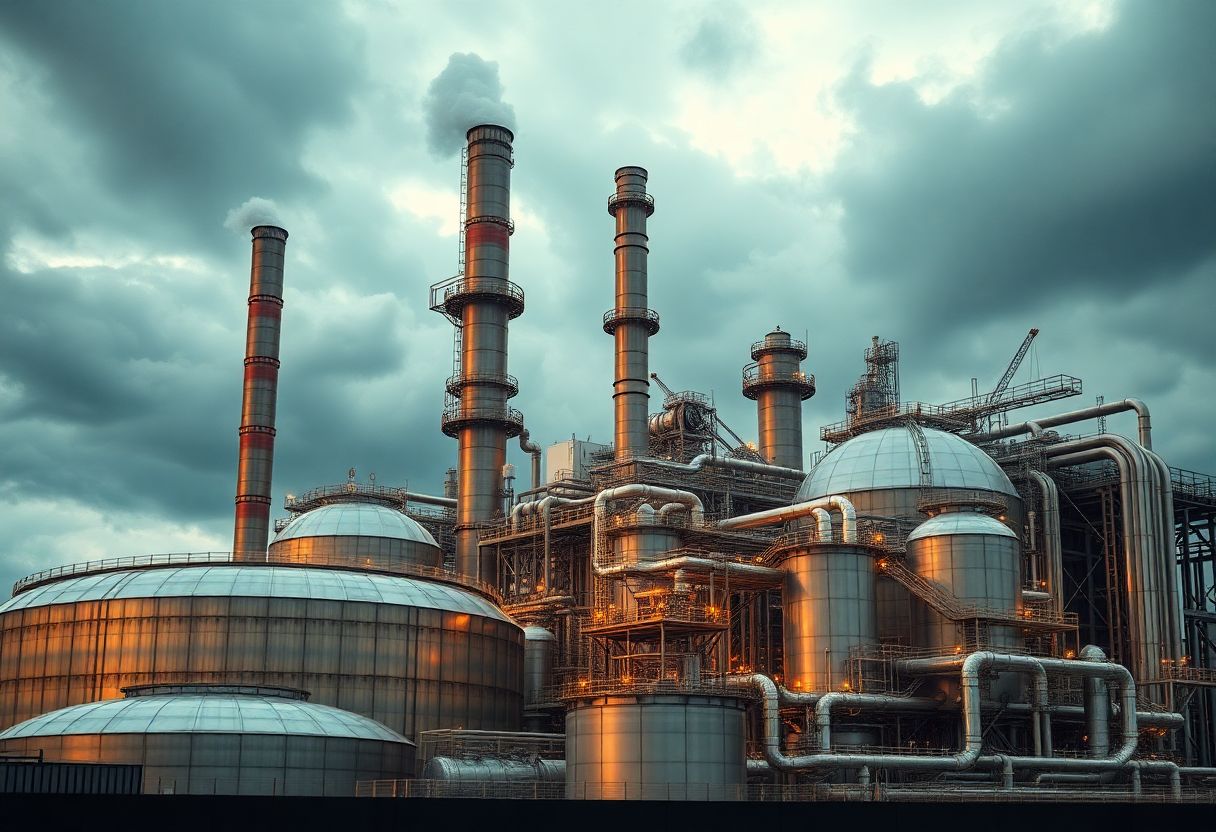
Carbon Capture and Storage: A Crucial Technology in the Fight Against Climate Change
Climate change poses one of the greatest challenges humanity has ever faced. As global temperatures continue to rise due to increasing greenhouse gas emissions, particularly carbon dioxide (CO2), scientists and engineers are racing to develop solutions to mitigate the worst impacts. One of the most promising technologies in this effort is carbon capture and storage (CCS). This article will explore how CCS works, its current applications, challenges, and potential to help address the climate crisis.
The Carbon Dioxide Problem
To understand the importance of CCS, we must first grasp the scale of the CO2 problem. Since the Industrial Revolution, human activities have dramatically increased the concentration of CO2 in Earth's atmosphere. In 1750, atmospheric CO2 levels were around 280 parts per million (ppm). As of 2021, they have surpassed 410 ppm, a 46% increase. This rise is primarily due to the burning of fossil fuels like coal, oil, and natural gas for energy production and industrial processes.
CO2 is a greenhouse gas that traps heat in the Earth's atmosphere. As CO2 levels rise, more heat is trapped, leading to global warming and its associated impacts: rising sea levels, more frequent and intense extreme weather events, disruption of ecosystems, and threats to food and water security. The Intergovernmental Panel on Climate Change (IPCC) has warned that to avoid the most catastrophic effects of climate change, global warming must be limited to 1.5°C above pre-industrial levels. This requires rapid and drastic reductions in CO2 emissions.
What is Carbon Capture and Storage?
Carbon capture and storage is a set of technologies designed to prevent large amounts of CO2 from entering the atmosphere by capturing it at the source, transporting it, and storing it permanently underground. CCS can be applied to large point sources of CO2 emissions, such as power plants, steel mills, cement factories, and other industrial facilities.
The concept of CCS is not new – the first large-scale CCS project began operation in 1996 at the Sleipner gas field in Norway. However, recent years have seen increased interest and investment in CCS as the urgency of addressing climate change has become more apparent.
How Does CCS Work?
Carbon capture and storage involves three main steps: capture, transport, and storage. Let's examine each of these in detail.
Carbon Capture
There are three primary methods for capturing carbon dioxide:
- Post-combustion capture
- Pre-combustion capture
- Oxyfuel combustion
Post-combustion Capture
Post-combustion capture is the most widely applicable method, as it can be retrofitted to existing power plants and industrial facilities. In this process, CO2 is separated from the flue gases produced when fossil fuels are burned.
The most common technique for post-combustion capture is amine scrubbing. Flue gases are passed through a liquid solvent, typically monoethanolamine (MEA), which selectively absorbs CO2. The CO2-rich solvent is then heated to release pure CO2, which is compressed for transport and storage. The regenerated solvent is recycled back into the process.
While effective, amine scrubbing is energy-intensive, requiring significant heat for solvent regeneration. This energy penalty can reduce a power plant's efficiency by 20-30%. Researchers are working on developing more efficient solvents and processes to reduce this energy cost.
Pre-combustion Capture
Pre-combustion capture is primarily used in integrated gasification combined cycle (IGCC) power plants. In this process, fuel is first converted into syngas, a mixture of carbon monoxide (CO) and hydrogen. The CO is then reacted with steam to produce CO2 and more hydrogen. The CO2 is separated, and the hydrogen can be used as a clean fuel.
This method has the advantage of producing a high-pressure, high-concentration CO2 stream, which is easier and less energy-intensive to separate. However, it requires significant modifications to existing power plants and is mainly applicable to new facilities.
Oxyfuel Combustion
In oxyfuel combustion, fuel is burned in pure oxygen rather than air. This results in a flue gas composed primarily of CO2 and water vapor, from which CO2 can be easily separated by condensing out the water.
While oxyfuel combustion can produce a very pure CO2 stream, it requires an air separation unit to produce pure oxygen, which is energy-intensive. Research is ongoing to develop more efficient oxygen production methods, such as chemical looping combustion.
CO2 Transport
Once captured, CO2 must be transported to a suitable storage site. For most large-scale CCS projects, pipelines are the most economical transportation method. CO2 is typically compressed to a supercritical fluid state, where it behaves like a gas but has a density closer to that of a liquid. This allows for more efficient transport.
In the United States, there are already over 5,000 miles of CO2 pipelines, primarily used for enhanced oil recovery (EOR). These existing networks could be expanded to support broader CCS deployment.
For offshore storage sites or where pipeline construction is not feasible, CO2 can be transported by ship, similar to liquefied natural gas (LNG). While more flexible than pipelines, ship transport is generally more expensive for large volumes of CO2.
CO2 Storage
The final step in CCS is the permanent storage of captured CO2. The most promising and well-developed storage method is geological sequestration, where CO2 is injected deep underground into suitable rock formations.
Ideal geological storage sites have several characteristics:
- Porous rock formations to allow CO2 injection
- Impermeable cap rock to prevent CO2 from escaping
- Sufficient depth (typically more than 800 meters) to keep CO2 in a supercritical state
- No valuable resources (e.g., freshwater aquifers) that could be contaminated
The three main types of geological storage sites are:
- Depleted oil and gas reservoirs
- Deep saline aquifers
- Unmineable coal seams
Depleted oil and gas reservoirs are attractive storage options because they have proven ability to trap gases over geological timescales and often have existing infrastructure that can be repurposed for CO2 injection.
Deep saline aquifers offer the largest potential storage capacity globally. The Sleipner CCS project in Norway, which has been operating since 1996, injects CO2 into a deep saline aquifer under the North Sea.
Unmineable coal seams can adsorb CO2 onto the coal surface, potentially allowing for enhanced coalbed methane recovery while storing CO2.
Current Applications and Projects
CCS is already being applied in various industries around the world. As of 2021, there were 26 commercial-scale CCS facilities in operation globally, with a combined capture capacity of about 40 million tonnes of CO2 per year. Some notable projects include:
-
Boundary Dam CCS Project (Canada): The world's first commercial-scale CCS project on a coal-fired power plant, operational since 2014.
-
Petra Nova Carbon Capture Project (USA): The largest post-combustion CO2 capture project installed on an existing coal-fired power plant, though operations were suspended in 2020 due to low oil prices affecting the economics of associated EOR.
-
Gorgon Carbon Dioxide Injection Project (Australia): One of the world's largest CCS projects, associated with natural gas production.
-
Quest CCS Facility (Canada): Captures and stores CO2 from oil sands upgrading.
-
Northern Lights Project (Norway): A full-scale CCS project that will capture CO2 from industrial sources and store it under the North Sea.
Challenges and Controversies
Despite its potential, CCS faces several significant challenges:
Cost
The high cost of CCS implementation remains a major barrier to widespread adoption. Capturing, transporting, and storing CO2 requires significant capital investment and increases operating costs. For power plants, CCS can increase the cost of electricity production by 50-100%. However, costs are expected to decrease as the technology matures and economies of scale are achieved.
Energy Penalty
The CCS process itself requires energy, particularly for CO2 capture and compression. This "energy penalty" can reduce a power plant's overall efficiency by 20-30%, meaning more fuel must be burned to produce the same amount of electricity. Ongoing research aims to develop more efficient capture technologies to reduce this penalty.
Storage Safety and Monitoring
Ensuring the long-term safety and stability of underground CO2 storage is crucial. While natural CO2 reservoirs demonstrate that geological storage can be stable over millions of years, there are concerns about potential leakage. Comprehensive monitoring systems are necessary to detect any CO2 migration or leakage, and further research is needed to understand the long-term behavior of stored CO2.
Scale
The sheer scale of CO2 emissions presents a challenge for CCS deployment. To make a significant impact on global emissions, CCS would need to be implemented on a massive scale. The International Energy Agency (IEA) estimates that CCS could contribute up to 14% of cumulative emissions reductions needed by 2060 to limit global warming to 2°C. This would require capturing and storing billions of tonnes of CO2 annually.
Public Perception and Social License
CCS faces challenges in gaining public acceptance. Some view it as prolonging dependence on fossil fuels rather than transitioning to renewable energy sources. There are also concerns about the safety of CO2 transport and storage, particularly among communities near proposed storage sites. Building public trust through transparent communication and community engagement is essential for successful CCS deployment.
Future Developments and Potential
Despite these challenges, CCS technology continues to evolve, and new approaches are being developed:
Direct Air Capture (DAC)
DAC technologies aim to capture CO2 directly from the atmosphere, rather than from point sources. While currently more expensive than point-source capture, DAC has the potential to address historical emissions and emissions from distributed sources like transportation. Companies like Carbon Engineering and Climeworks are developing and scaling up DAC technologies.
Bioenergy with CCS (BECCS)
BECCS combines biomass energy production with CCS, potentially achieving negative emissions. Plants absorb CO2 as they grow, and when used for energy production with CCS, the net result can be removal of CO2 from the atmosphere. However, concerns about land use and competition with food production need to be addressed.
Enhanced Weathering
This approach accelerates natural weathering processes that absorb CO2. By spreading finely ground silicate rocks over large areas, CO2 can be captured and converted into stable carbonate minerals. While promising, this method requires significant energy for rock grinding and large-scale land use.
Novel Capture Technologies
Researchers are developing new materials and processes for more efficient CO2 capture. These include advanced solvents, solid sorbents, and membranes that could significantly reduce the energy required for capture.
Utilization of Captured CO2
Carbon capture and utilization (CCU) technologies aim to convert captured CO2 into useful products, such as building materials, fuels, or chemicals. While the scale of CO2 utilization is likely to be smaller than what's needed for climate mitigation, it could improve the economics of some CCS projects.
Conclusion: The Role of CCS in Climate Mitigation
Carbon capture and storage is not a silver bullet for solving the climate crisis, but it is a crucial tool in our arsenal. As we transition to a low-carbon economy, CCS can play a vital role in reducing emissions from existing infrastructure and hard-to-decarbonize industries like cement and steel production.
The IPCC and other climate models consistently show that achieving global climate goals will be significantly more challenging and expensive without CCS. However, it's important to view CCS as part of a comprehensive climate strategy that includes rapid deployment of renewable energy, improvements in energy efficiency, and changes in consumption patterns.
The coming decades will be critical for CCS development and deployment. Supportive policies, continued research and development, and increased investment will be necessary to overcome current challenges and scale up the technology. As we race to address the urgent threat of climate change, CCS offers a promising pathway to significantly reduce CO2 emissions while we transition to a fully sustainable energy system.
By understanding the potential and limitations of CCS, policymakers, industry leaders, and the public can make informed decisions about its role in our clean energy future. As with any powerful technology, careful implementation, ongoing monitoring, and adaptive management will be key to maximizing the benefits of CCS while minimizing potential risks. The future of our planet may well depend on our ability to capture and safely store the carbon dioxide that has driven our industrial progress but now threatens our climate stability.