Forces and Motion: Unraveling the Mysteries of Our Dynamic Universe
Have you ever marveled at the graceful arc of a basketball swishing through a hoop, or pondered how massive ships stay afloat on the ocean's surface? These everyday phenomena, along with countless others, are governed by the fascinating principles of forces and motion. In this comprehensive exploration, we'll delve deep into the fundamental laws that shape our universe, from the tiniest subatomic particles to the grandest cosmic structures.
The Nature of Forces: Invisible Hands Shaping Our World
At its core, a force is simply a push or pull acting on an object. This deceptively simple concept underpins the behavior of everything we observe in the physical world. Forces are the invisible hands that shape our reality, responsible for every change we witness, from the gentle rustling of leaves in a breeze to the awe-inspiring power of a rocket launch.
The Fascinating World of Force Types
Our universe is a tapestry woven from various types of forces, each playing a unique role in the cosmic dance of matter and energy. Let's explore some of the most significant forces we encounter in our daily lives:
Gravitational force, perhaps the most familiar to us, is the attractive force between objects due to their mass. It's what keeps our feet firmly planted on the ground and orchestrates the celestial ballet of planets orbiting stars. The brilliant physicist Albert Einstein revolutionized our understanding of gravity with his theory of general relativity, revealing that massive objects actually warp the fabric of spacetime itself.
Friction, often overlooked but critically important, is the force that resists relative motion between surfaces in contact. It's the reason we can walk without slipping and why your car slows down when you take your foot off the accelerator. Without friction, our world would be a chaotic place of perpetual motion and instability.
The electromagnetic force is a fundamental interaction that governs the behavior of charged particles. It's responsible for holding atoms together and enables the existence of chemical bonds, making life as we know it possible. This force manifests in our daily lives through the electricity powering our devices and the magnetism that guides our compasses.
Normal force, while less glamorous, plays a crucial role in supporting objects against the pull of gravity. It's the force exerted by a surface on an object resting upon it, allowing us to stand on solid ground without sinking into it.
Tension force is transmitted through a string, rope, or cable when it's pulled tight by forces acting from opposite ends. This force is essential in engineering, from the construction of suspension bridges to the design of pulley systems.
Newton's Laws: The Pillars of Classical Mechanics
Sir Isaac Newton, a towering figure in the history of science, formulated three laws that serve as the foundation of classical mechanics. These laws, published in his seminal work "Philosophiæ Naturalis Principia Mathematica" in 1687, continue to be essential in explaining most of the motion we observe in our daily lives.
The Law of Inertia: Objects at Rest Stay at Rest
Newton's first law, often called the law of inertia, states that an object at rest stays at rest, and an object in motion stays in motion with the same speed and in the same direction, unless acted upon by an unbalanced force. This principle explains why you feel a sudden jerk when a stationary car starts moving, or why objects on a table don't spontaneously start sliding around.
The concept of inertia, the tendency of objects to resist changes in their state of motion, has far-reaching implications. In space, where friction is negligible, objects can continue moving indefinitely without any additional force applied. This principle is utilized in the design of spacecraft, which can coast vast distances through the vacuum of space with minimal fuel expenditure once they've achieved their desired velocity.
Force, Mass, and Acceleration: The Mathematical Relationship
Newton's second law provides a precise mathematical relationship between force, mass, and acceleration. Expressed as F = ma, where F is the net force acting on an object, m is the object's mass, and a is its acceleration, this equation is a powerful tool for predicting and analyzing motion.
This law tells us that the more force we apply to an object, the greater its acceleration will be. Conversely, the more massive an object is, the more force is required to achieve the same acceleration. This principle is evident in everyday situations, such as the difference in effort required to push an empty shopping cart versus a full one.
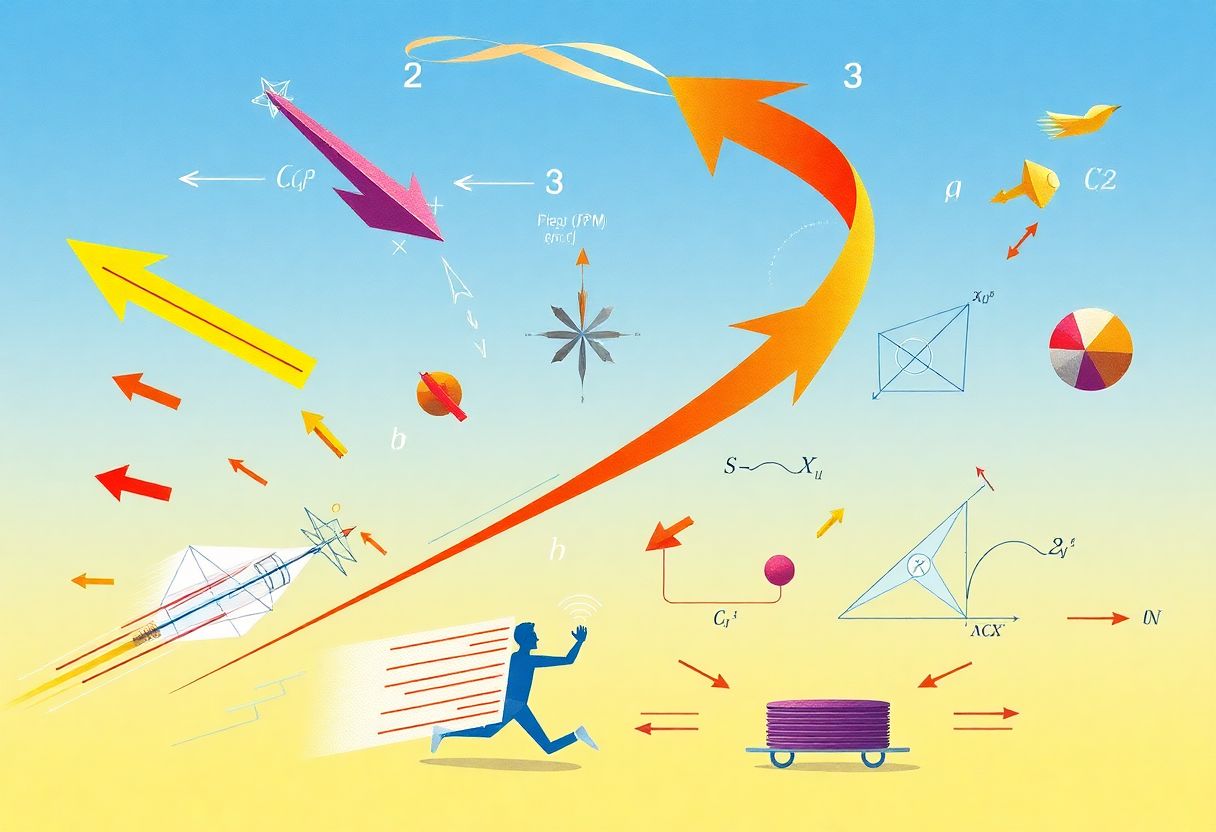
The second law also introduces the concept of net force, which is the vector sum of all forces acting on an object. When forces are balanced, meaning they cancel each other out, an object remains at rest or continues moving at a constant speed in a straight line. When forces are unbalanced, objects accelerate, decelerate, or change direction.
Action and Reaction: The Universal Dance of Forces
Newton's third law states that for every action, there is an equal and opposite reaction. This principle reveals the inherently symmetrical nature of forces in our universe. When you push against a wall, the wall pushes back against you with an equal force. This law is crucial in understanding everything from the propulsion of rockets to the mechanics of walking.
The third law has profound implications in fields like rocketry and space exploration. When a rocket expels hot gases downward, the equal and opposite reaction propels the rocket upward. This principle allows us to overcome Earth's gravity and explore the cosmos, demonstrating how understanding fundamental physics can lead to extraordinary technological achievements.
Measuring Motion: Quantifying the Dance of the Cosmos
To understand motion more precisely, scientists use several key concepts to measure and describe how objects move through space and time. These metrics allow us to analyze and predict motion with remarkable accuracy, forming the basis for countless applications in science and engineering.
Speed and Velocity: The Rate of Change in Position
Speed is a scalar quantity that measures how fast an object is moving, regardless of direction. It's calculated by dividing the distance traveled by the time taken. Velocity, on the other hand, is a vector quantity that includes both speed and direction. This distinction is crucial in fields like navigation and physics, where the direction of motion is as important as its magnitude.
For example, if you drive 60 miles north in one hour, your average speed is 60 miles per hour, and your velocity is 60 miles per hour north. This seemingly simple concept becomes more complex when dealing with non-uniform motion or curved paths, leading to the development of instantaneous velocity and average velocity in more advanced physics.
Acceleration: The Rate of Change in Velocity
Acceleration is the rate of change of velocity over time. It occurs when an object speeds up, slows down, or changes direction. Mathematically, acceleration is calculated as the change in velocity divided by the time taken for that change.
Understanding acceleration is crucial in many real-world applications. In automotive engineering, for instance, a car's acceleration from 0 to 60 mph is a key performance metric. In physics, the concept of acceleration due to gravity (approximately 9.8 m/s² on Earth's surface) is fundamental to understanding the motion of falling objects and projectiles.
Momentum: The Product of Mass and Velocity
Momentum is a measure of the motion of an object, taking into account both its mass and velocity. Mathematically expressed as p = mv, where p is momentum, m is mass, and v is velocity, this concept is crucial in understanding collisions and impacts.
The principle of conservation of momentum, which states that the total momentum of a closed system remains constant, has wide-ranging applications. It's used in analyzing everything from subatomic particle collisions in particle accelerators to the design of safety features in vehicles.
Kinetic Energy: The Energy of Motion
Kinetic energy is the energy an object possesses due to its motion. Calculated as KE = ½mv², where m is mass and v is velocity, this equation reveals that doubling an object's speed quadruples its kinetic energy.
This principle has significant implications in various fields. In transportation, it explains why the damage caused by a vehicle collision increases dramatically with speed. In renewable energy, it's the basis for harnessing wind power, as the kinetic energy of moving air is converted into electrical energy by wind turbines.
Forces in Action: From Sports to Space Exploration
Understanding forces and motion isn't just theoretical – it has countless practical applications in our daily lives and in various fields of science and engineering. Let's explore how these principles manifest in different areas:
Sports: The Physics of Human Performance
In the world of sports, understanding forces and motion can give athletes a competitive edge. A long jumper uses Newton's third law when pushing against the ground to propel themselves forward. The impulse-momentum theorem, derived from Newton's second law, explains how a tennis player can control the speed and direction of the ball by applying force over a specific time interval.
Swimming provides a fascinating example of Newton's third law in action. As swimmers push water backward with their arms and legs, the water pushes them forward with an equal force, propelling them through the pool. Understanding this principle allows swimmers and coaches to optimize techniques for maximum efficiency and speed.
Transportation: Overcoming Friction and Gravity
The principles of forces and motion are crucial in the design and operation of vehicles. Car designers use aerodynamics to reduce air resistance (drag force) and improve fuel efficiency. The shape of a car's body, from its front grille to its rear spoiler, is carefully engineered to minimize air resistance while maintaining stability at high speeds.
In aviation, the shape of airplane wings creates a pressure difference between the upper and lower surfaces, generating lift force that allows heavy aircraft to overcome gravity and fly. This principle, known as Bernoulli's principle, demonstrates how our understanding of fluid dynamics (a branch of physics dealing with forces in fluids) has enabled the development of modern air travel.
Rocket science, often used as a metaphor for extreme complexity, is fundamentally an application of Newton's third law. As a rocket expels hot gases downward, the equal and opposite reaction provides an upward force on the rocket. This principle, combined with our understanding of gravitational forces and orbital mechanics, has allowed humanity to explore space and place satellites in orbit around Earth.
Engineering: Applying Physics to Solve Real-World Problems
Engineers apply the principles of forces and motion in countless ways to create the infrastructure and technology that underpins modern civilization. Structural engineers ensure buildings can withstand forces from wind, earthquakes, and their own weight. They use concepts like stress and strain, derived from our understanding of forces, to design structures that are both safe and efficient.
Mechanical engineers design machines that convert forces into useful work. Hydraulic systems in construction equipment, for example, use the principle of Pascal's law to amplify force, allowing relatively small input forces to move heavy loads. This application of fluid mechanics principles enables the construction of massive structures and the operation of heavy machinery.
Biomechanical engineers study the forces involved in human movement to design better prosthetics and improve athletic performance. By analyzing the forces acting on joints and muscles during various activities, they can create artificial limbs that more closely mimic natural movement and develop training regimens that maximize performance while minimizing the risk of injury.
The Frontier of Force and Motion Research
While Newton's laws continue to be incredibly useful for most everyday situations, modern physics has revealed a more complex picture of forces and motion at extreme scales. Einstein's theories of special and general relativity have shown that Newton's laws break down at very high speeds or in very strong gravitational fields.
At the subatomic level, quantum mechanics describes a world where particles can exist in multiple states simultaneously and where the very act of observation can influence the behavior of particles. The search for a unified theory that can reconcile quantum mechanics with general relativity remains one of the greatest challenges in modern physics.
Recent advancements in our understanding of dark matter and dark energy, which together make up about 95% of the universe's content, have further complicated our picture of forces and motion on cosmic scales. These mysterious components seem to influence the motion of galaxies and the expansion of the universe in ways that challenge our current understanding of gravity.
Conclusion: The Endless Fascination of Forces and Motion
From the simple act of walking to the complex engineering of space exploration, forces and motion are at play everywhere in our universe. By understanding these fundamental principles, we gain insight into the world around us and the ability to manipulate it in remarkable ways.
As we continue to push the boundaries of science and technology, our understanding of forces and motion will only become more crucial. Whether we're developing new clean energy technologies, exploring distant planets, or unraveling the mysteries of the quantum world, the principles we've discussed here will continue to guide our quest for knowledge.
So the next time you throw a ball, drive a car, or watch a rocket launch, take a moment to appreciate the intricate dance of forces and motion that makes it all possible. In doing so, you'll be tapping into the same sense of wonder and curiosity that has driven scientific discovery for centuries, connecting you to the great thinkers of the past and the exciting frontiers of future research.