The 10 Greatest Physics Experiments: Shaping Our Understanding of the Universe
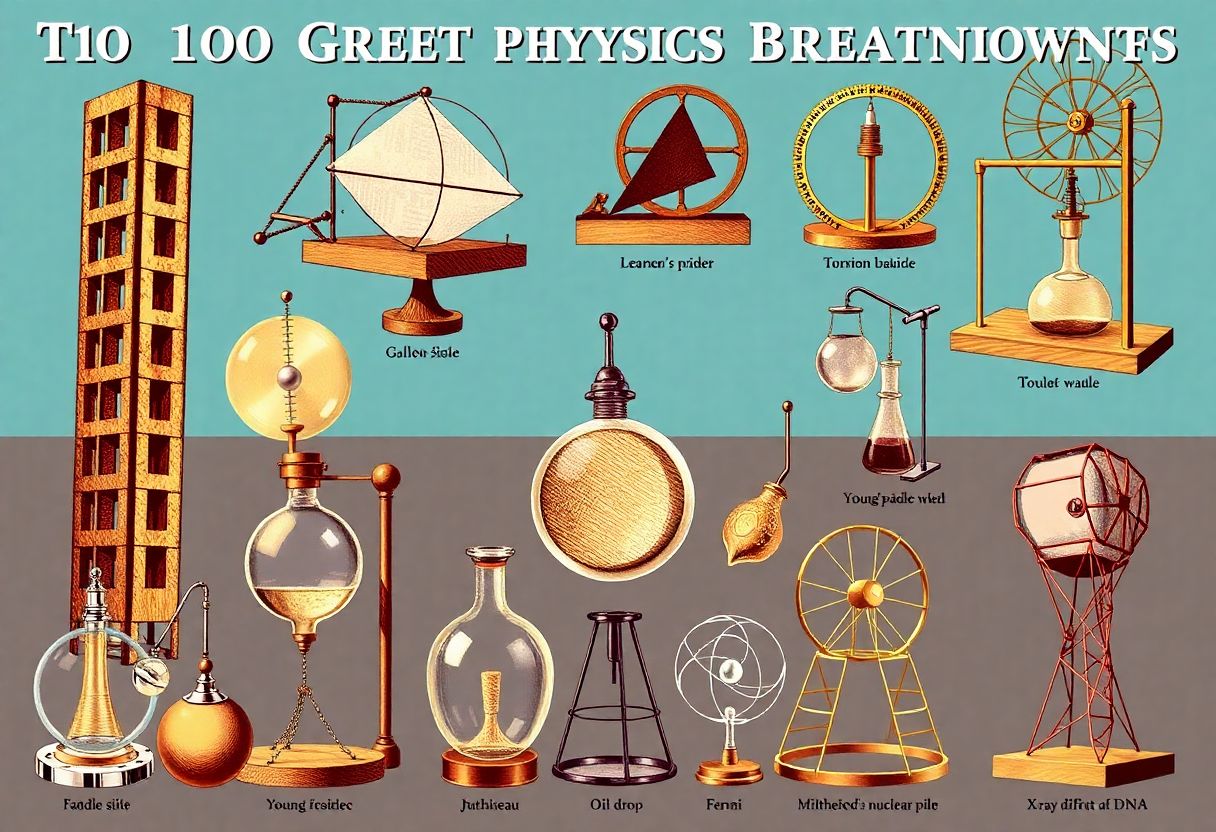
In the grand tapestry of scientific discovery, physics experiments stand out as brilliant threads, weaving together our understanding of the universe. These experiments have not only expanded our knowledge but have also challenged our perceptions, pushing the boundaries of what we thought possible. Let's embark on a journey through time to explore ten groundbreaking physics experiments that have fundamentally altered our view of the world around us.
1. Galileo's Leaning Tower of Pisa Experiment (1589)
Challenging Ancient Wisdom
Imagine yourself in 16th-century Italy, where the ideas of ancient Greek philosophers still held sway over scientific thought. One such idea, proposed by Aristotle, was that heavier objects fall faster than lighter ones. Enter Galileo Galilei, a man whose curiosity would shake the foundations of this long-held belief.
The Experiment
Picture this: Galileo climbs to the top of the Leaning Tower of Pisa, carrying two balls of different weights. As a crowd gathers below, he releases the balls simultaneously. According to Aristotle's theory, the heavier ball should hit the ground first. But what happens next astonishes everyone.
The Result
Both balls hit the ground at the same time! This simple yet profound experiment demonstrates that the acceleration due to gravity is independent of an object's mass.
Real-World Impact
This experiment laid the groundwork for our modern understanding of gravity and motion. It's a principle that affects everything from the design of aircraft to the trajectories of spacecraft.
An Interesting Twist
Centuries later, during the Apollo 15 mission to the Moon, astronaut David Scott recreated this experiment. In the vacuum of the lunar surface, without air resistance, he dropped a feather and a hammer simultaneously. Just as Galileo had shown on Earth, both objects hit the lunar surface at the same time.
2. Newton's Prism Experiment (1672)
Unraveling the Mystery of Light
Have you ever wondered why rainbows appear after a rainstorm? Isaac Newton's groundbreaking experiment with light provided the answer, revolutionizing our understanding of color and optics.
The Setup
Picture a dark room with a single beam of sunlight entering through a small hole. Newton placed a glass prism in the path of this light beam.
The Magical Moment
As the light passed through the prism, something extraordinary happened. The beam split into a beautiful spectrum of colors – red, orange, yellow, green, blue, indigo, and violet. This rainbow-like display was a revelation.
The Implications
Newton's experiment proved that white light is actually composed of all the colors of the rainbow. Each color is bent (refracted) by a different amount as it passes through the prism, causing them to separate.
Everyday Applications
This discovery forms the basis of many technologies we use today:
- Fiber optic communications
- Spectroscopy in astronomy
- Color television and computer displays
A Simple Demonstration
You can recreate a version of Newton's experiment at home. On a sunny day, fill a glass with water and place it near a window. The water acts like a prism, potentially creating a small rainbow on a nearby surface.
3. Cavendish's Gravitational Experiment (1798)
Weighing the Earth
How do you weigh something as massive as the Earth? This was the challenge tackled by Henry Cavendish in what is often called "the experiment that weighed the world."
The Ingenious Apparatus
Cavendish constructed a torsion balance – imagine a horizontal bar suspended by a thin fiber, with small lead balls at each end. Near these, he placed two larger lead balls.
The Delicate Dance of Gravity
The gravitational attraction between the small and large balls caused the horizontal bar to rotate slightly. By measuring this tiny rotation, Cavendish could calculate the gravitational force between the balls.
From Small Balls to Big Planet
Using this data and some clever calculations, Cavendish was able to determine the average density of the Earth. From this, he could calculate the Earth's mass.
The Far-Reaching Impact
Cavendish's experiment didn't just give us the weight of our planet. It provided the first accurate measurement of the gravitational constant (G), a fundamental constant of nature that appears in Einstein's theory of general relativity.
Modern Applications
The principles behind Cavendish's experiment are still used today in precise measurements of gravitational forces, helping us understand everything from the structure of our planet to the behavior of distant galaxies.
4. Young's Double-Slit Experiment (1803)
The Wave-Particle Duality Puzzle
Thomas Young's experiment is perhaps one of the most mind-bending in physics, revealing the strange dual nature of light and matter.
The Setup
Imagine a board with two narrow slits cut into it. Young shone a beam of light through these slits onto a screen behind.
The Surprising Result
Instead of seeing two bright lines on the screen (as you might expect if light behaved only as particles), Young observed an interference pattern – alternating bright and dark bands.
What It Means
This pattern could only be explained if light behaved as a wave, interfering with itself after passing through the slits. But wait, didn't Newton show that light was made of particles?
The Plot Thickens
Later experiments showed that even when individual particles (like electrons) are fired one at a time through the slits, they still create an interference pattern over time. It's as if each particle interferes with itself!
Quantum Weirdness
This experiment is a gateway to the bizarre world of quantum mechanics, where particles can behave like waves and vice versa. It challenges our classical intuitions about the nature of reality.
Real-World Applications
The wave-particle duality revealed by this experiment is fundamental to technologies like:
- Electron microscopes
- Solar cells
- Quantum computers
5. Joule's Paddle Wheel Experiment (1840)
The Conservation of Energy
James Prescott Joule's experiment demonstrated one of the most fundamental principles in physics: the conservation of energy.
The Apparatus
Picture a container of water with a paddle wheel inside. The wheel is connected by a pulley system to a weight that can fall.
The Experiment in Action
As the weight falls, it turns the paddle wheel, which agitates the water. Joule measured the temperature rise in the water and compared it to the gravitational potential energy lost by the falling weight.
The Groundbreaking Discovery
Joule found that the energy lost by the falling weight was equal to the heat energy gained by the water. This showed that energy can be converted from one form to another, but is never created or destroyed.
Everyday Examples
This principle is at work all around us:
- A car converting chemical energy (fuel) into kinetic energy (motion) and heat
- A hydroelectric dam converting the gravitational potential energy of water into electrical energy
The Legacy
The SI unit of energy, the joule, is named after James Prescott Joule in recognition of this pivotal work.
6. Fizeau's Speed of Light Measurement (1851)
Racing with Light
How do you measure something as fast as light? Hippolyte Fizeau devised an ingenious method to do just that, providing the first accurate terrestrial measurement of light's speed.
The Clever Setup
Fizeau used a rapidly rotating toothed wheel and a mirror placed several kilometers away. He shone a light beam through a gap in the wheel towards the distant mirror.
The Race Begins
The light would travel to the mirror and back. If the wheel rotated at just the right speed, the returning light would pass through the next gap in the wheel.
Calculating the Speed
By knowing the distance to the mirror and the rotation speed of the wheel, Fizeau could calculate how long it took the light to make its round trip.
The Result
Fizeau's measurement was remarkably close to the modern value, off by only about 5%.
Modern Applications
While we now have more precise methods, the principles behind Fizeau's experiment are still used in various technologies:
- Laser range-finding
- Fiber optic data transmission
- LIDAR systems in self-driving cars
7. Millikan's Oil Drop Experiment (1909)
Catching the Electron
Robert Millikan's ingenious experiment allowed him to measure the charge of a single electron, one of the fundamental particles of the universe.
The Setup
Millikan sprayed tiny oil droplets between two electrically charged plates. He could control the electric field between the plates and observe the droplets through a microscope.
The Clever Trick
By adjusting the electric field, Millikan could make the droplets hover in mid-air, balancing the electrical force against gravity.
The Key Insight
Millikan noticed that the charge on the droplets always came in discrete multiples of a fundamental unit – the charge of a single electron.
The Impact
This experiment not only measured the electron's charge but also provided strong evidence for the quantization of electric charge – it comes in discrete packets, not a continuous range.
Modern Connections
The precise measurement of the electron's charge is crucial for:
- Understanding atomic structure
- Developing electronic devices
- Calibrating particle physics experiments
8. Rutherford's Gold Foil Experiment (1909)
Peering Inside the Atom
Ernest Rutherford's experiment, conducted with his students Hans Geiger and Ernest Marsden, revealed the structure of the atom, overturning existing models.
The Experimental Setup
They fired alpha particles (helium nuclei) at a thin gold foil and observed how the particles scattered.
The Shocking Observation
Most particles passed straight through, but occasionally, a particle would bounce back almost 180 degrees. Rutherford likened it to firing a 15-inch shell at tissue paper and having it bounce back at you!
The Revolutionary Conclusion
This led Rutherford to propose the nuclear model of the atom – a tiny, dense, positively charged nucleus surrounded by electrons in mostly empty space.
Visualizing the Atom
Imagine an atom scaled up to the size of a football field. The nucleus would be about the size of a pea at the center, with electrons buzzing around the edges of the field.
The Far-Reaching Impact
This model of the atom is fundamental to our understanding of:
- Chemical bonding
- Nuclear physics
- The structure of matter itself
9. Fermi's Nuclear Chain Reaction (1942)
Unleashing the Power of the Atom
Enrico Fermi's experiment demonstrated the first controlled, self-sustaining nuclear chain reaction, ushering in the atomic age.
The "Atomic Pile"
Fermi and his team built a structure of uranium and graphite bricks under the stands of a squash court at the University of Chicago.
The Moment of Truth
As they removed control rods, the reaction began to sustain itself. Fermi calmly announced, "The reaction is self-sustaining."
The Science Behind It
When a uranium-235 atom splits, it releases neutrons. These neutrons can then cause other uranium atoms to split, creating a chain reaction.
The Enormous Implications
This experiment paved the way for both nuclear power and nuclear weapons, fundamentally changing geopolitics and energy production.
Peaceful Applications
Nuclear technology, stemming from this experiment, has applications in:
- Medical imaging and cancer treatment
- Carbon dating in archaeology
- Powering deep space probes
10. Franklin's X-ray Diffraction of DNA (1952)
Capturing the Blueprint of Life
Rosalind Franklin's X-ray diffraction images of DNA were crucial in uncovering its double helix structure, one of the most important discoveries in biology.
The Technique
Franklin used X-ray crystallography, where X-rays are diffracted by the atoms in a crystal, creating a pattern that reveals the crystal's structure.
The Famous "Photo 51"
This X-ray diffraction image of DNA showed a distinctive X-shaped pattern, a hallmark of a helical structure.
The Unsung Hero
While James Watson and Francis Crick are often credited with discovering DNA's structure, Franklin's work was crucial to their insight.
The Far-Reaching Impact
Understanding DNA's structure has revolutionized fields such as:
- Genetics and genomics
- Forensic science
- Personalized medicine
A Lasting Legacy
Franklin's work exemplifies the power of imaging techniques in uncovering the invisible structures that govern life itself.
Conclusion: The Ongoing Journey of Discovery
These ten experiments represent pivotal moments in our quest to understand the universe. From the fundamental nature of light and matter to the structure of atoms and the blueprint of life, each experiment has peeled back a layer of mystery surrounding our world.
Yet, the journey of scientific discovery is far from over. Even now, experiments are underway that may once again revolutionize our understanding:
- The Large Hadron Collider probes the fundamental particles of matter
- Gravitational wave detectors listen for ripples in spacetime
- Quantum computers explore the strange realm of superposition and entanglement
As we stand on the shoulders of giants like Galileo, Newton, and Franklin, we continue to push the boundaries of knowledge. Who knows what groundbreaking experiments the future holds, and how they might once again transform our view of the universe?
The beauty of science lies not just in the answers it provides, but in the questions it continues to ask. Each experiment, each discovery, opens up new avenues of inquiry, reminding us that the greatest experiment of all is the never-ending pursuit of knowledge itself.